
What Speech Language Disorder Accommodation Covers
Knowing what speech language disorder accommodation covers can make the difference between a student who thrives and one who quietly disengages. 1 in 5 children experience challenges with talking or understanding words, yet many families still encounter confusion about what schools and testing organizations are actually required to provide. Accommodations go far beyond a little extra time. They include therapy services, communication devices, modified test formats, and more. This guide gives parents and educators a clear picture of what’s available and how to secure it.
Table of Contents
- Key takeaways
- Common accommodations in educational settings
- Testing accommodations for speech language disorders ️
- How to request and secure accommodations
- Practical supports beyond formal accommodations
- My perspective on advocating for speech accommodations
- How Testaccommodations can help your family
- FAQ
Key takeaways
| Point | Details |
|---|---|
| Accommodations are broad, not narrow | Speech language disorder support covers therapy, assistive technology, classroom modifications, and test adjustments. |
| Legal backing is strong | ADA, IDEA, and Section 504 require effective communication aids in both school and testing environments. |
| Documentation drives decisions | A formal evaluation from a speech-language pathologist is the foundation of any successful accommodation request. |
| Specific requests win | Naming precise aids like a speech-to-speech transliterator produces better outcomes than generic asks for extra time. |
| Testing accommodations are separate | High-stakes test accommodations must be requested directly from testing agencies and require their own supporting documentation. |
Common accommodations in educational settings
Most parents assume that speech language disorder support means a child gets pulled out of class for therapy once or twice a week. That is one piece of the picture, but it is far from complete. Schools are required under the Individuals with Disabilities Education Act (IDEA) and Section 504 to provide services and modifications tailored to each student’s functional needs.
Speech-language therapy itself takes several forms. Pull-out sessions give students individualized attention in a quieter setting. In-class support places a speech-language pathologist (SLP) directly in the classroom to reinforce communication during instruction. Consultation models involve the SLP advising the teacher on how to support the student without removing them from the learning environment. Effective SLP services include diagnostics, therapy, consultation, and coordinated family support, making the SLP a central figure in the student’s entire support team.
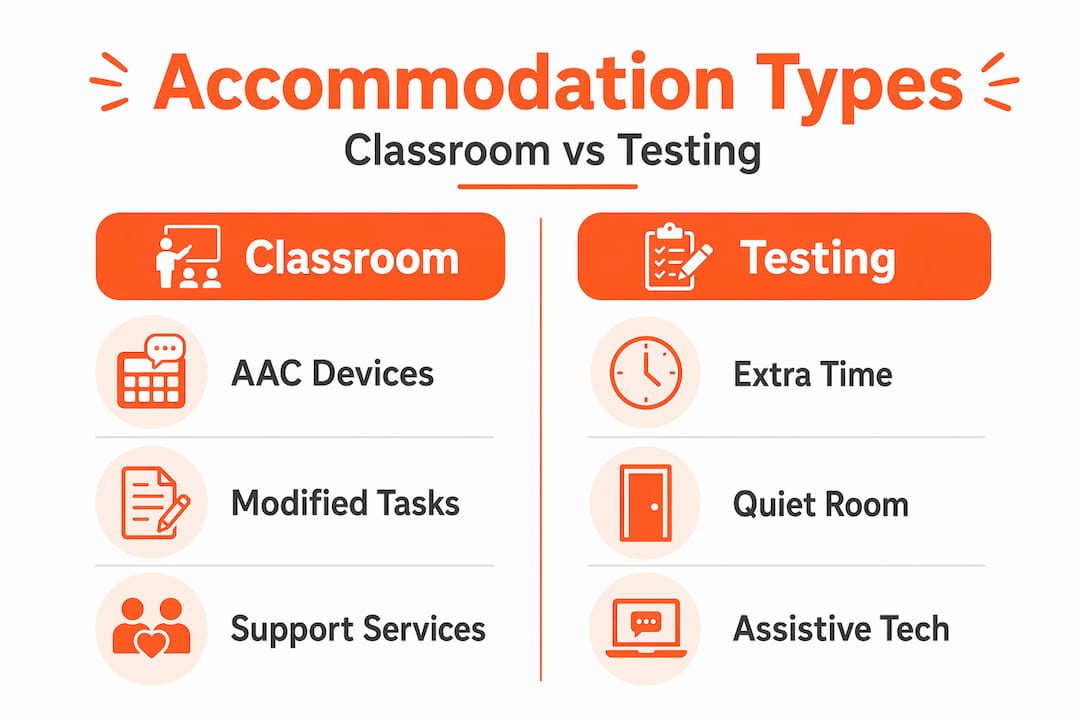
Beyond therapy sessions, students with speech and language disorders commonly access the following classroom accommodations:
- Preferential seating near the teacher to reduce auditory distractions and make verbal exchanges easier
- Written or visual instructions alongside spoken directions so students don’t rely solely on auditory processing
- Read-aloud support for assignments and assessments to separate reading ability from comprehension
- Extended response time for verbal tasks, reducing anxiety around oral participation
- Augmentative and alternative communication (AAC) devices, ranging from low-tech picture boards to high-tech speech-generating devices
- Assistive technology apps such as text-to-speech software, voice amplifiers, and communication symbol programs
AAC devices and specialized apps significantly improve communication and participation for students with speech-language impairments, and their use should be explicitly written into the student’s IEP or 504 plan. A vague mention of “technology support” is not enough. The specific device or software needs to be named.
Pro Tip: If your child uses an AAC device at school, request that it be permitted during all assessments, not just routine classroom activities. Write this explicitly into the IEP rather than assuming it carries over automatically.
Testing accommodations for speech language disorders ️
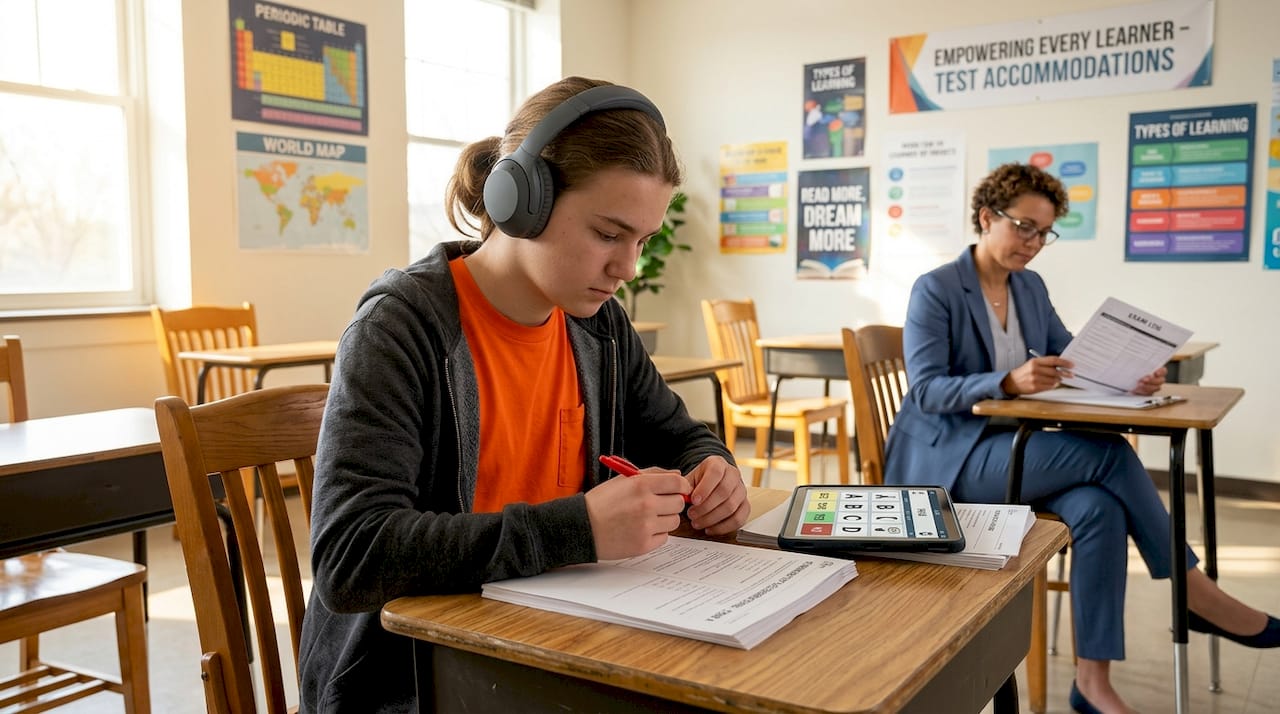
Standardized and high-stakes testing environments present a distinct set of challenges for students with speech and language disorders. A student who communicates effectively with an AAC device at school may suddenly find themselves without that tool during an ACT or SAT exam if the accommodation was never formally requested and approved.
Testing accommodations under the ADA include extended time, use of assistive technology, distraction-free testing rooms, and alternative communication methods. These are not optional gestures. For covered testing entities, they are legal obligations. The table below outlines the most common testing accommodations and who typically provides them:
| Accommodation | What it covers | Who provides it |
|---|---|---|
| Extended time | Additional time (often 1.5x or 2x) to complete test sections | Testing agency (e.g., College Board, ACT) |
| Speech-to-speech transliterator | A trained person who repeats spoken questions in clear speech for students with speech disabilities | Testing agency or third-party provider |
| Communication board or AAC device | Student uses a symbol board or device to indicate answers | Testing agency (requires prior approval) |
| Distraction-free room | Separate testing environment to reduce anxiety and distractions | Testing site |
| Breaking tests into smaller parts | Test is divided into shorter segments with scheduled breaks | Testing agency |
| Scribe or oral response | Student dictates answers verbally or through a communication device | Testing site proctor |
The legal basis for these accommodations is clear. ADA Titles II and III mandate that covered entities provide effective communication aids, including speech-to-speech transliterators, for people with speech disabilities. This applies directly to organizations that administer standardized tests. For students in K-12 settings, IDEA and Section 504 further reinforce the right to accessible assessment.
For more detail on how these requirements apply to specific exams, the testing accommodations FAQs at Testaccommodations are worth reviewing before you submit any request.
How to request and secure accommodations
Securing the right accommodations for speech language disorders is a process that rewards preparation and precision. Many families lose months because they submit incomplete documentation or phrase their requests too broadly. Here is a step-by-step approach that works:
Obtain a formal evaluation. A licensed speech-language pathologist must document the student’s diagnosis, functional impact, and recommended supports. Schools are required to conduct evaluations at no cost to families under IDEA. For standardized testing, testing agencies generally require current documentation (within 3 to 5 years).
Establish eligibility through IEP, 504, or ADA. Students in K-12 settings typically receive accommodations through an IEP (for those eligible under IDEA) or a 504 plan (for those whose disability substantially limits a major life activity). Students without either formal plan can still access accommodations under the ADA. Getting accommodations without an IEP or 504 is possible but requires direct engagement with the testing agency.
Write specific accommodation language. Vague language is the enemy of effective accommodation. Specific aid requests like naming a speech-to-speech transliterator consistently produce better outcomes than generic requests. Name the exact device, software, or support service your student requires.
Submit requests to testing agencies early. Most major testing organizations require accommodation requests weeks or months in advance. The College Board’s Services for Students with Disabilities (SSD), for example, typically needs requests submitted well before the test registration deadline.
Follow up in writing. After submitting a request, confirm receipt and expected processing timeline in writing. If a request is denied, ask for the specific reason. Denials can often be appealed successfully with additional documentation.
Pro Tip: Ask the student’s SLP to write a statement specifically connecting the diagnosed disorder to the requested accommodation. A letter that says “this student stutters” is far less persuasive than one explaining how stuttering under timed pressure affects oral response accuracy and why extended time or a specific communication aid directly addresses that functional limitation.
Children may hesitate academically and socially due to communication fears, which means accommodation eligibility should not hinge solely on whether a student is failing academically. Functional impairment in the classroom context is sufficient grounds for an IEP or 504 evaluation.
Practical supports beyond formal accommodations
Formal accommodations form the legal foundation of speech language disorder support. But they work best when paired with consistent, practical strategies at home and in the classroom. These everyday supports can meaningfully reinforce what therapy and formal accommodations provide.
Embedding therapy techniques into daily routines rather than relying solely on clinical sessions improves communication outcomes for children. This means parents can actively participate in progress, not just observe it from the sidelines. Simple practices like narrating daily activities, modeling slow and clear speech, and creating low-pressure communication opportunities at home all contribute to real gains.
In the classroom, teachers play a significant role even without specialized training. Consider the following practical approaches:
- Allow multiple modalities for responses. Let students write, draw, point, or use a device to communicate rather than requiring verbal responses exclusively.
- Avoid cold-calling students with speech disorders. Give them advance notice of when they will be asked to contribute verbally, reducing surprise-triggered anxiety.
- Reduce time pressure on oral tasks. Timed oral presentations create disproportionate stress for students with fluency disorders like stuttering, which affects 1% of the global population.
- Collaborate proactively with the SLP. Teachers who coordinate regularly with the school’s SLP are better positioned to reinforce communication goals throughout the school day.
- Address social and emotional challenges directly. Families often underestimate the emotional weight of speech disorders. Pairing academic support with counseling or peer support programs helps students build confidence alongside communication skills.
Universal Design for Learning practices benefit all students and reduce the stigma that can come with singling out one child for special supports. When a teacher builds in multiple ways to demonstrate learning across the whole class, students with speech disorders participate naturally without feeling marked as different.
My perspective on advocating for speech accommodations
I have worked with families navigating this process for years, and the pattern I see most often is not lack of love for their child. It is lack of preparation. Parents come to me after a denial and say, “We asked for extra time and they said no.” When I look at their documentation, the evaluation is three years old, the SLP letter is two paragraphs with no functional impact analysis, and the accommodation request form lists “extended time” with no explanation of why the student’s specific disorder requires it.
The families who succeed are not the ones with the most dramatic cases. They are the ones who document precisely, request specifically, and follow up persistently. I have seen students with moderate stuttering secure speech-to-speech transliterators for high-stakes exams because their SLP wrote a clear, thorough letter linking the disorder to the testing environment. And I have seen students with severe speech disorders denied accommodations because their paperwork was generic.
What I want parents and educators to understand is this: the shift from thinking about “fixing” a child’s speech to “enabling” their full participation changes everything. Proactive communication with schools protects both academic progress and social confidence. Start early, document well, and do not accept a denial without understanding exactly why it happened. That is almost always the starting point for a successful appeal.
— Roger
How Testaccommodations can help your family
When accommodation requests get denied, families often feel like they have run out of options. They have not. Testaccommodations specializes in helping students and families who have been denied testing accommodations for high-stakes exams including the ACT, SAT, MCAT, and LSAT. The team reviews your documentation, identifies the gaps that led to the denial, and helps you build a stronger case for appeal. For families facing the intersection of speech language disorders and standardized testing, having an expert review your request before submitting it can prevent a denial entirely. Visit Testaccommodations to learn more about how the service works, or explore practical accommodation examples that apply directly to communication disorders.
FAQ
What does speech language disorder accommodation cover?
Speech language disorder accommodation covers therapy services, assistive communication devices, classroom modifications like read-aloud and preferential seating, and testing accommodations such as extended time, speech-to-speech transliterators, and alternative response formats. The exact supports depend on the student’s diagnosis, functional impact, and the setting (school vs. standardized testing).
Can a student get testing accommodations without an IEP or 504 plan?
Yes. Students can request accommodations directly from testing agencies under the ADA even without an IEP or 504 plan, though they will need current documentation from a qualified clinician like a speech-language pathologist to support the request.
What is a speech-to-speech transliterator?
A speech-to-speech transliterator is a trained professional who listens to a person with a speech disability and repeats their words clearly for others to understand. Under ADA requirements, testing organizations may be required to provide this service for students with speech disorders.
How early should I request testing accommodations for speech disorders?
Submit requests as early as possible. Most testing agencies require accommodation requests weeks to months before the exam date. College Board and ACT typically have deadlines tied to test registration windows, and documentation review can take additional time on top of that.
What documentation do testing agencies require for speech language disorder accommodations?
Testing agencies generally require a current evaluation (typically within 3 to 5 years) from a licensed speech-language pathologist, a diagnosis with a clear description of functional impairment, and a specific recommendation connecting the disorder to the requested accommodation.