
Processing Disorder Accommodations: A 2026 Parent's Guide
Processing disorders that qualify for accommodations are defined as neurodevelopmental conditions that substantially limit major life activities such as learning, concentrating, or thinking. Under the Americans with Disabilities Act (ADA) and the Individuals with Disabilities Education Act (IDEA), auditory processing disorder, visual processing disorder, language processing disorder, specific learning disabilities like dyslexia, and ADHD all meet this threshold when supported by current clinical evidence. Knowing what processing disorder qualifies for accommodations is the first step toward securing the support your child deserves on standardized tests like the ACT, SAT, MCAT, or LSAT.
What processing disorders qualify for accommodations?
The legal standard under the ADA and IDEA is clear: a disorder qualifies when it substantially limits major life activities like learning, concentrating, or thinking. The diagnosis itself is not enough. The evidence must show how the disorder affects your child’s ability to perform specific tasks in a testing environment.
The following processing disorders and related neurodevelopmental conditions are recognized for accommodations in educational and standardized testing settings:
- Auditory Processing Disorder (APD): The brain struggles to interpret sounds correctly despite normal hearing. Students with APD often have difficulty following spoken directions, distinguishing similar words, and processing verbal information under time pressure.
- Visual Processing Disorder (VPD): The brain misinterprets visual information. Students may struggle with reading fluency, tracking text across a page, or distinguishing between similar symbols and letters.
- Language Processing Disorder (LPD): A subset of auditory processing issues, LPD specifically affects the ability to attach meaning to spoken language. It directly impacts reading comprehension and written expression.
- Specific Learning Disabilities (SLD): This IDEA category covers dyslexia (reading), dysgraphia (writing), and dyscalculia (math). Each affects a distinct academic skill set and creates measurable functional limitations during timed tests.
- Attention Deficit Hyperactivity Disorder (ADHD): ADHD affects sustained attention, working memory, and impulse control. An ADHD diagnosis alone does not guarantee accommodations. Evidence must show a direct impact on test timing and task completion.
These disorders frequently overlap. A student with dyslexia may also show auditory processing deficits. A student with ADHD may have co-occurring language processing challenges. Testing boards evaluate each case based on the functional evidence presented, not the number of diagnoses listed.
What documentation and evaluation standards are required?

Testing boards do not accept a doctor’s note or a school diagnosis report as sufficient proof. Comprehensive psychoeducational evaluations using standardized cognitive batteries are required. The two most widely accepted instruments are the WISC-V (Wechsler Intelligence Scale for Children, Fifth Edition) and the Woodcock-Johnson Tests of Cognitive Abilities.
These evaluations must measure processing speed, working memory, phonological processing, and related cognitive functions. Scores must show significant deficits relative to the student’s overall intellectual profile. A student who scores in the average range on most cognitive tasks but shows a sharp drop in processing speed has a much stronger case for extended time than a student with uniformly low scores.
Documentation must be recent. Most testing boards require evaluations completed within 3–5 years. An evaluation from elementary school will not support an accommodation request for the SAT or ACT in high school.
| Assessment | What it measures | Why it matters for accommodations |
|---|---|---|
| WISC-V | Processing speed, working memory, verbal comprehension | Identifies specific cognitive deficits tied to test performance |
| Woodcock-Johnson IV | Academic achievement, cognitive processing | Links cognitive deficits to reading, writing, and math tasks |
| CTOPP-2 | Phonological awareness and memory | Supports dyslexia and language processing disorder claims |
| BASC-3 | Behavioral and emotional functioning | Documents ADHD impact on attention and task completion |
| GFTA-3 | Speech sound production | Supports language processing disorder documentation |
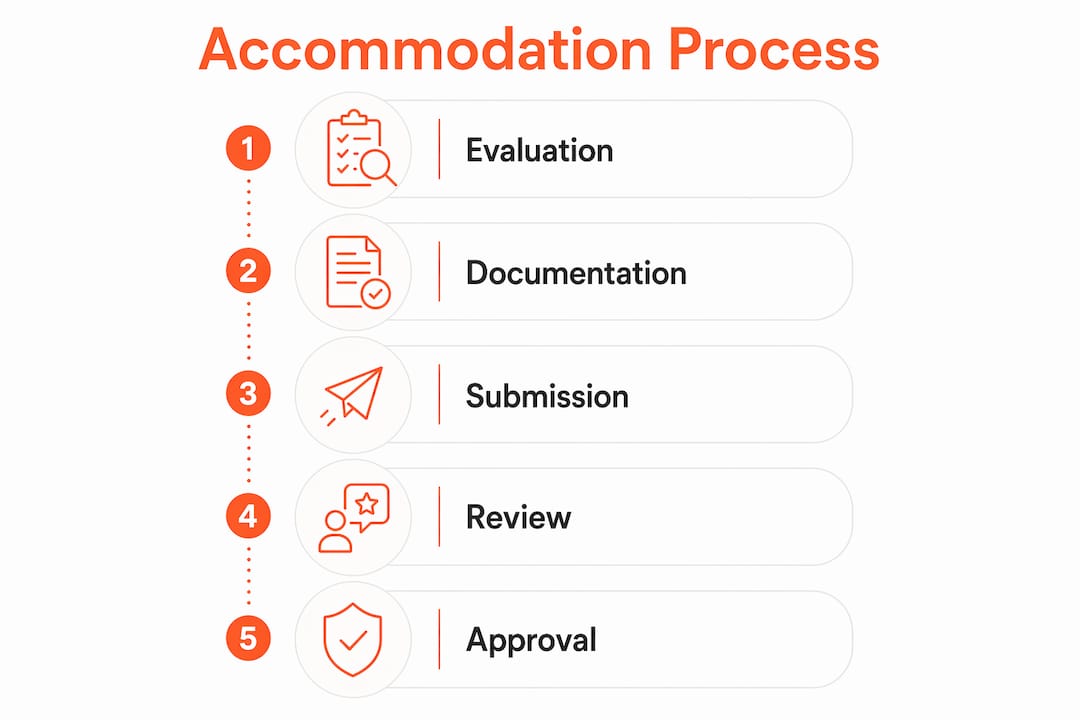
The evaluation report must do more than list scores. It must explicitly connect each deficit to the specific challenges your child faces during timed, high-stakes testing. A report that states “processing speed is below average” without explaining what that means for a four-hour standardized test will likely be rejected.
Pro Tip: Ask the evaluating psychologist to include a section in the report titled “Functional Limitations in Testing Environments.” This section should describe, in plain language, how each deficit affects your child’s ability to complete timed tasks, read passages, or write essays under pressure.
How do standardized test requirements differ from school accommodations?
Many parents assume that an IEP or 504 plan automatically transfers to standardized testing. It does not. Standardized testing boards maintain stricter requirements than K-12 schools and conduct independent reviews of every accommodation request.
A school may grant extended time based on a teacher’s observation and a brief evaluation. The College Board, ACT, Inc., or the LSAC will require a full psychoeducational evaluation with standardized scores, a clear diagnosis, and a detailed explanation of functional limitations. The school accommodation establishes a history of need, but it does not satisfy the testing board’s evidentiary standard on its own.
The independent review process means your child must present fresh, concrete evidence of functional challenges specific to the test-taking context. Even students with years of school accommodations should prepare to submit updated documentation tailored to the standardized testing environment.
Commonly approved accommodations for processing disorders on standardized tests include:
- Extended time (time and a half or double time): The most frequently approved accommodation for processing speed deficits and specific learning disabilities.
- Separate testing room: Reduces auditory and visual distractions for students with APD or ADHD.
- Text-to-speech technology: Supports students with visual processing disorders or dyslexia by converting written text to audio.
- Use of visual aids: Approved for students whose visual processing deficits affect reading comprehension.
- Preferential seating: Positions the student away from distractions, supporting attention and auditory processing.
- Breaks during testing: Approved for students with ADHD or processing disorders that cause fatigue during extended tasks.
These accommodations help mitigate processing deficits during lengthy and complex testing sessions. The specific accommodations approved depend entirely on the functional evidence in the evaluation report.
Pro Tip: When submitting to a standardized testing board, include a cover letter that maps each requested accommodation directly to a specific score or finding in the psychoeducational evaluation. Testing reviewers handle hundreds of applications. Making their job easier increases your approval odds.
What practical steps can parents take to prepare?
Preparation starts well before the test registration deadline. Testing boards typically require accommodation requests weeks or months in advance. Waiting until the last minute is the single most common reason families face denials.
- Obtain a current psychoeducational evaluation. If your child’s most recent evaluation is more than three years old, schedule a new one. Work with a licensed psychologist who has experience evaluating students for standardized testing accommodations specifically.
- Request a detailed functional limitations section. The evaluator must connect every deficit score to real-world testing challenges. Generic language will not satisfy a testing board’s review standards.
- Gather supporting documentation. Collect your child’s IEP or 504 plan, teacher observations, grade reports, and any prior accommodation approvals. These establish a consistent history of need.
- Review the specific testing board’s requirements. The College Board, ACT, Inc., LSAC, and AAMC each have distinct documentation standards. Review the current guidelines for the specific test your child will take.
- Submit early and completely. Incomplete applications are rejected outright. Confirm that every required form, score report, and supporting document is included before submitting.
| Preparation step | Key action |
|---|---|
| Evaluation currency | Confirm the evaluation is within the testing board’s recency window (typically 3–5 years) |
| Functional documentation | Verify the report explicitly ties deficits to test-taking tasks |
| Supporting history | Include IEP, 504 plan, and prior accommodation records |
| Board-specific requirements | Download and review the current guidelines for the specific test |
| Submission timeline | Submit at least 6–8 weeks before the test registration deadline |
Coordinating with your child’s school counselor and the evaluating psychologist is not optional. Successful accommodation applications involve organized, current reports and proactive advocacy. A parent’s guide to psychoeducational evaluations can help you understand exactly what to request from the evaluating professional.
Key takeaways
Processing disorders qualify for standardized test accommodations when current psychoeducational evaluation data demonstrates substantial functional limitations in the testing environment, not when a diagnosis alone is presented.
| Point | Details |
|---|---|
| Qualifying disorders | Auditory, visual, and language processing disorders, dyslexia, dysgraphia, dyscalculia, and ADHD all qualify when functional impact is documented. |
| Documentation standard | Evaluations using WISC-V or Woodcock-Johnson must be within 3–5 years and explicitly link deficits to test-taking challenges. |
| School vs. testing boards | An IEP or 504 plan establishes history but does not satisfy the independent review standards of testing boards like the College Board or LSAC. |
| Most common denial reason | Submitting a diagnosis without detailed functional limitation evidence is the leading cause of accommodation denials. |
| Preparation timeline | Submit accommodation requests at least 6–8 weeks before the test deadline with complete, board-specific documentation. |
What parents consistently get wrong about this process
The families I work with most often arrive with the same misconception: they believe the diagnosis is the finish line. A child receives an ADHD or dyslexia diagnosis, the school sets up a 504 plan, and the parents assume the standardized testing accommodation will follow automatically. It rarely does.
Testing boards are not being unreasonable when they ask for more. They are applying a legal standard that requires evidence of substantial functional limitation, not just a clinical label. The distinction matters enormously. A student can have a legitimate diagnosis and still be denied accommodations if the evaluation report does not show, in concrete terms, how that diagnosis affects their ability to complete a timed, high-stakes test.
The second mistake I see frequently is outdated documentation. A psychoeducational evaluation from three years ago may no longer reflect your child’s current cognitive profile. Students change. Their processing deficits may shift in severity as they age and as academic demands increase. Fresh documentation is not bureaucratic red tape. It is the only way to give a testing board an accurate picture of your child’s current needs.
What actually works is a combination of a thorough, recent evaluation and a report written by a psychologist who understands what testing boards look for. Not every evaluator has this experience. Asking specifically whether the psychologist has written reports for standardized testing accommodation requests is a reasonable and important question before you hire them.
If your child’s application has already been denied, that is not the end of the road. The accommodation eligibility criteria for standardized tests can be met on appeal with stronger documentation. Denials are often reversible when the right evidence is presented.
— Roger
How Testaccommodations can support your family
Securing accommodations for a standardized test is a process with real legal and procedural complexity. Testaccommodations advises families whose children are entitled to accommodations on the ACT, SAT, MCAT, LSAT, and other major tests and who have received denials or face obstacles in the application process.
The Testaccommodations team helps parents understand what testing boards require, identify gaps in existing documentation, and build the strongest possible case for approval or appeal. Whether your child is applying for the first time or challenging a denial, expert guidance at this stage makes a measurable difference. Visit Testaccommodations to learn how the team can support your child’s accommodation request.
FAQ
What processing disorders qualify for test accommodations?
Auditory processing disorder, visual processing disorder, language processing disorder, specific learning disabilities (dyslexia, dysgraphia, dyscalculia), and ADHD all qualify when they substantially limit learning or concentration and are supported by current psychoeducational evaluation data.
Does an IEP or 504 plan guarantee standardized test accommodations?
No. School accommodations establish a history of need but do not satisfy the independent review standards of testing boards. Students must submit current documentation tailored to the standardized testing environment.
How recent does a psychoeducational evaluation need to be?
Most testing boards require evaluations completed within 3–5 years. Older evaluations are typically rejected regardless of the diagnosis they document.
What is the most common reason accommodation requests are denied?
The most common reason is submitting a diagnosis without functional limitation evidence. Reports must explicitly connect each deficit to specific challenges in the test-taking environment.
What accommodations are most commonly approved for processing disorders?
Extended time, a separate testing room, text-to-speech technology, and scheduled breaks are among the most frequently approved accommodations for students with processing speed and working memory deficits on standardized tests.