
Accommodation Eligibility Criteria for Standardized Tests
Accommodation eligibility criteria define the documented disability standards a student must meet to qualify for testing supports on standardized exams such as the SAT, ACT, MCAT, and LSAT. These criteria exist to ensure that students with disabilities can demonstrate their true academic abilities without being disadvantaged by the testing format itself. College Board and ACT, the two most prominent testing organizations in the United States, each maintain specific accommodation requirements tied to formal school-based plans like an Individualized Education Program (IEP) or a 504 Plan. Understanding what is accommodation eligibility criteria means knowing which documentation qualifies, how it must be submitted, and what happens if procedural steps are missed.
What formal plans and documentation qualify for accommodation eligibility?
The foundation of accommodation eligibility criteria rests on two school-based legal documents: the IEP and the 504 Plan. An IEP is developed under the Individuals with Disabilities Education Act (IDEA) and outlines specialized instruction and services for students with qualifying disabilities. A 504 Plan is created under Section 504 of the Rehabilitation Act and provides accommodations for students whose disabilities affect a major life activity, including learning, without necessarily requiring specialized instruction.
College Board automatically approves accommodations for students whose IEP or 504 Plan meets its specific evaluation and team criteria. This means the plan must have been developed by a knowledgeable team using appropriate professional evaluations. Not every IEP or 504 Plan triggers automatic approval. The plan itself must reflect the rigor College Board expects, including assessments conducted by qualified professionals such as licensed psychologists or educational diagnosticians.

Under the Americans with Disabilities Act (ADA), documentation requests must be reasonable and limited to what is necessary to establish the need for the specific accommodation requested. Testing organizations cannot demand broad medical histories or excessive records. This protects students from being buried in paperwork while still requiring meaningful evidence of functional need.
For students who do not have a qualifying IEP or 504 Plan, independent psychoeducational evaluations conducted by licensed professionals can support an accommodation request. These evaluations must document functional limitations, not just a diagnosis. A diagnosis of ADHD, for example, does not automatically establish eligibility. The evaluation must show how that diagnosis substantially limits a major life activity such as reading, concentration, or time management in a testing context.
- IEP or 504 Plan: The most direct path to automatic approval with College Board when the plan meets evaluation and team criteria.
- Independent psychoeducational evaluation: Required when no qualifying school plan exists; must document functional limitations, not diagnosis alone.
- Professional qualifications: Evaluations must come from licensed psychologists, neuropsychologists, or educational diagnosticians.
- Completeness: Incomplete submissions are one of the leading causes of denials at both College Board and ACT.
Pro Tip: Before submitting any documentation, have your school’s SSD (Services for Students with Disabilities) coordinator review the IEP or 504 Plan against College Board’s published criteria for automatic approval. A 15-minute review can prevent a months-long appeals process.
How do eligibility criteria differ between College Board and ACT?
Understanding how to qualify for accommodation varies meaningfully between the two major testing boards. Both require documented disability and functional need, but their administrative processes differ in ways that trip up even experienced school coordinators.
| Criteria | College Board (SAT/AP) | ACT |
|---|---|---|
| Automatic approval | Yes, for qualifying IEP/504 Plans | No automatic approval; full plan submission required |
| Submission platform | SSD Online portal | State/district coordinator submission |
| Required identifiers | Student SSD ID | Student name, date of birth, plan dates |
| Prior approval required | Yes, before test day | Yes, before test day |
| Score invalidation risk | Yes, if accommodations used without approval | Yes, if accommodations used without approval |
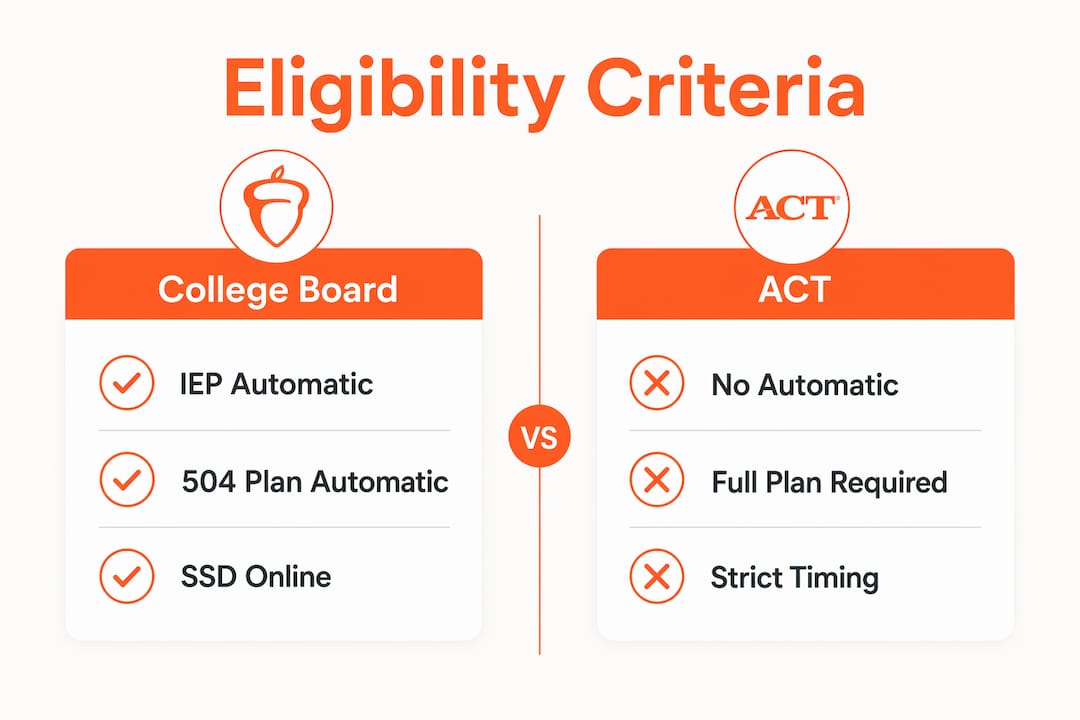
College Board’s SSD Online system allows school coordinators to submit accommodation requests and track approvals digitally. Students with qualifying plans often move through this process without needing to submit additional documentation beyond what the school already holds. The key variable is whether the existing plan meets College Board’s internal evaluation criteria.
ACT takes a different approach. ACT requires submission of the complete IEP or 504 Plan, including student identifiers such as name and date of birth, along with the plan’s effective dates. A common and avoidable error occurs when coordinators submit only the accommodations page of a plan rather than the full document. This partial submission leads directly to a denial, even when the student clearly qualifies.
Timing is non-negotiable for both organizations. Accommodation requests must be approved before the student sits for the exam. Neither College Board nor ACT allows retroactive approval. If a student uses extended time on test day without prior written approval, the scores from that sitting are invalidated. This is not a technicality. It is a firm policy that affects college admissions timelines.
Pro Tip: For ACT submissions, always attach the full plan document, not just the accommodations summary page. Confirm that the student’s legal name, date of birth, and plan dates appear on every page submitted. ACT coordinators have flagged incomplete submissions as the single most common reason for avoidable denials.
Why prior approval and accurate documentation matter
Securing eligibility recognition before test day is not a formality. It is the operational step that determines whether a student’s accommodations are legally valid on the day they matter most.
Submit documentation well in advance. College Board recommends submitting accommodation requests at least seven weeks before the test date. ACT timelines vary by testing program, but earlier is always safer. Late submissions risk missing the processing window entirely.
Verify the SSOR roster. Schools must confirm that approved accommodations appear on the student’s record in College Board’s Student Score Reporting system before test day. Using the student’s SSD ID to cross-check the roster is the most reliable way to catch errors before they become crises.
Confirm accommodations in writing. Parents should request written confirmation from the school’s SSD coordinator that the accommodation request has been submitted and approved. Verbal assurances are not sufficient when a student’s test scores are at stake.
Address errors immediately. If an accommodation does not appear on the test-day roster, College Board allows retesting requests to correct the error before the exam. This window is narrow. Acting within days of discovering an error, not weeks, is the standard that protects the student.
Keep copies of everything. Retain copies of the IEP or 504 Plan, the accommodation request submission confirmation, and the approval letter. Administrative errors or omissions can cause denials or invalid scores even when a student fully qualifies. Documentation protects against those errors.
College Board’s policy is unambiguous: scores are invalidated if a student uses accommodations on test day without prior approval from Services for Students with Disabilities. No exceptions are made after the fact. This policy exists to maintain test integrity, but it places the full burden of procedural compliance on families and school coordinators.
How is eligibility assessed under the ADA?
The ADA provides the legal framework that governs accommodation eligibility criteria across all major standardized testing organizations. Under the ADA, a disability is defined as a physical or mental impairment that substantially limits one or more major life activities. This definition is broader than most families expect.
Academic success does not disqualify a student from accommodation eligibility. A student who has earned strong grades through significant compensatory effort, tutoring, or untimed conditions may still have a substantial limitation in a timed, standardized testing environment. The ADA explicitly recognizes that functional limitation, not academic outcome, determines eligibility. This distinction matters enormously for high-achieving students with ADHD, dyslexia, or anxiety disorders who are sometimes denied accommodations on the grounds that their grades suggest no impairment.
The ADA’s framework focuses on functional criteria rather than diagnostic labels alone. Evaluators and testing organizations must consider how the disability affects the student’s ability to perform specific tasks under specific conditions. For a standardized test, the relevant conditions include time pressure, reading speed, processing demands, and sustained attention. A student with a processing speed deficit may perform adequately in a classroom with extended deadlines but face a genuine and documented barrier in a timed exam setting.
“The ADA requires that testing entities provide reasonable accommodations to persons with disabilities. Documentation requests must be reasonable and limited to the need for the requested accommodation.” — ADA.gov
Accommodation eligibility under the ADA also covers students with mental health disabilities, including anxiety disorders, depression, and PTSD. These conditions qualify when they substantially limit a major life activity and are documented through appropriate clinical evaluation. The documentation must connect the diagnosis to the functional limitation and then connect that limitation to the specific accommodation being requested.
The ADA’s guidance frames documentation as narrowly tailored to functional need. Testing organizations should not require broad medical records or demand that students prove their disability through excessive clinical documentation. A well-written psychoeducational evaluation that addresses functional limitations in the testing context satisfies the ADA standard.
Key takeaways
Accommodation eligibility criteria for standardized tests require documented functional limitations, a qualifying formal plan or independent evaluation, and accurate administrative submission before test day to be recognized by College Board or ACT.
| Point | Details |
|---|---|
| IEP and 504 Plans are primary pathways | College Board grants automatic approval when these plans meet its evaluation and team criteria. |
| ACT requires complete plan submission | Submitting only the accommodations page, without identifiers and dates, leads to avoidable denials. |
| Prior approval is mandatory | College Board invalidates scores if accommodations are used on test day without prior SSD approval. |
| ADA focuses on functional limitation | Academic success does not disqualify a student; documented functional impairment in testing conditions is the standard. |
| Administrative accuracy determines outcomes | Verifying accommodations on the SSOR roster before test day prevents last-minute eligibility failures. |
What I’ve learned helping families navigate eligibility
Working with families through accommodation denials has taught me one consistent lesson: most denials are preventable. The eligibility criteria themselves are not the obstacle. The obstacle is the gap between what families assume has been handled and what has actually been submitted, verified, and confirmed.
Parents often believe that having an IEP or 504 Plan guarantees accommodation approval on the SAT or ACT. That assumption is understandable, but it is incomplete. The plan must meet specific criteria, the submission must be complete and timely, and the approval must be confirmed on the student’s test-day record. Each of those steps is a potential failure point.
The families who navigate this process successfully share one habit: they treat accommodation eligibility as a project with deadlines, not a form to fill out once. They start early, they follow up in writing, and they verify every step. Families who struggle are typically those who relied on verbal assurances from school staff or assumed that a previous approval would carry forward automatically to a new exam. It often does not.
If you are facing a denial or are unsure whether your student’s documentation meets the accommodation eligibility guidelines for College Board or ACT, do not wait to seek expert guidance. The SAT and ACT differ in their requirements in ways that matter, and understanding those differences before submission is far less costly than appealing a denial after the fact.
— Roger
How Testaccommodations can help your family
Testaccommodations specializes in guiding students and families through the accommodation eligibility process for standardized tests including the SAT, ACT, MCAT, and LSAT. If your student has received a denial or you are unsure whether your current documentation meets the accommodation requirements for your target exam, expert help is available.
The team at Testaccommodations reviews documentation, identifies gaps, and advises families on the strongest path to approval. For complex cases involving prior denials or unusual disability profiles, the Exam Expert service provides individualized support from professionals who understand both the legal standards and the administrative realities of each testing organization. Do not let a procedural error or incomplete submission stand between your student and the accommodations they are entitled to receive.
FAQ
What is accommodation eligibility criteria for standardized tests?
Accommodation eligibility criteria are the documented disability and functional limitation standards a student must meet to qualify for testing supports on exams like the SAT or ACT. Eligibility is established through formal school plans such as an IEP or 504 Plan, or through independent psychoeducational evaluations conducted by qualified professionals.
Does having an IEP or 504 Plan guarantee accommodation approval?
Not automatically. College Board grants automatic approval when an IEP or 504 Plan meets its specific evaluation and team criteria, but the plan must reflect appropriate professional assessments. ACT requires submission of the complete plan with student identifiers and does not offer automatic approval.
Can a student with strong grades still qualify for accommodations?
Yes. Under the ADA, a history of academic success does not disqualify a student if documented functional limitations exist in a standardized testing context. A student who compensates effectively in class may still face a genuine barrier under timed, high-stakes exam conditions.
What happens if accommodations are used on test day without prior approval?
College Board invalidates test scores if a student uses accommodations without prior approval from Services for Students with Disabilities. This policy applies without exception, making advance approval confirmation a critical step for every student seeking accommodations.
What is the most common reason ACT accommodation requests are denied?
The most common reason is incomplete documentation submission. ACT coordinators frequently receive only the accommodations page of a plan rather than the full IEP or 504 Plan with required student identifiers, effective dates, and supporting evaluation records.