
Psychoeducational Evaluation Accommodations: a Parent's Guide
When your child struggles with standardized tests, the role of psychoeducational evaluation accommodations often becomes the deciding factor between a score that reflects their ability and one that reflects their disability. Many parents first hear about these evaluations during an IEP meeting or after a test accommodation denial, and the process can feel opaque and overwhelming. This guide explains what psychoeducational evaluations actually involve, how they translate into legally recognized accommodations, and what you can do right now to advocate effectively for your child.
Table of Contents
- Key takeaways
- The role of psychoeducational evaluation accommodations
- What a psychoeducational evaluation involves
- How evaluation results support test accommodations
- Myths and misconceptions about evaluations and accommodations
- School-based vs. private evaluations
- Practical steps to obtain an evaluation and secure accommodations
- My perspective: why these evaluations change everything
- How Testaccommodations can support your family
- FAQ
Key takeaways
| Point | Details |
|---|---|
| Evaluations drive accommodations | A psychoeducational evaluation is the legal foundation for securing IEP, 504, and standardized test accommodations. |
| Diagnosis alone is not enough | Accommodation eligibility depends on demonstrated functional impairment, not just a diagnostic label. |
| School and private evals are complementary | School-based evaluations establish legal eligibility; private evaluations provide deeper functional insight. |
| Timing matters significantly | Formal evaluations can take up to six months, so starting early is critical for test deadlines. |
| Myths undermine access | Misconceptions about “unfair advantage” often delay accommodations that students are legally entitled to receive. |
The role of psychoeducational evaluation accommodations
The connection between a psychoeducational evaluation and standardized test accommodations is direct and legal. Evaluation reports are the gold-standard documentation required by schools and testing organizations under the ADA to validate requests for accommodations such as extended time, separate testing rooms, or the use of assistive technology.
Without a current, thorough evaluation report, most accommodation requests for high-stakes tests like the SAT, ACT, MCAT, or LSAT will be denied. Testing agencies do not accept a teacher’s note, a parent statement, or even a prior diagnosis on its own. They need documented evidence of functional impairment, and that evidence comes from a psychoeducational evaluation. Understanding this distinction is the first step toward navigating the system with confidence.
What a psychoeducational evaluation involves
Parents often picture a single appointment with a school counselor. The reality is more involved, and knowing what to expect makes the process far less intimidating.
A comprehensive evaluation typically includes three core components: a detailed parent and teacher interview, a review of medical and educational records, and a battery of standardized tests assessing cognitive ability, academic achievement, memory, processing speed, and neurological function. The testing itself requires about 5 to 6 hours of active participation, typically spread across multiple sessions to prevent fatigue from skewing results.
Here is how the process unfolds in practice:
- Referral and scheduling. You or your child’s school initiates the evaluation. Private psychologists may have waitlists of several weeks to months.
- Intake interview. The evaluator collects detailed background on your child’s developmental, medical, and academic history.
- Records review. Past report cards, prior assessments, teacher reports, and medical records are all considered.
- Standardized testing. Your child completes measures such as the WISC (cognitive), Woodcock-Johnson (academic), and NEPSY or BRIEF (neuropsychological function).
- Report writing. The evaluator synthesizes findings into a written report with scores, interpretations, a diagnosis if applicable, and specific accommodation recommendations.
- Feedback session. You meet with the evaluator to review results and discuss next steps.
Evaluations are conducted by licensed psychologists or neuropsychologists, either through the school district at no cost to the family or privately at a fee that typically ranges from $2,000 to $5,000 depending on the provider and the depth of testing required.
Pro Tip: If you are pursuing accommodations for a specific test such as the ACT or SAT, ask your private evaluator explicitly to address functional impairment in timed testing conditions. A generic report that omits this connection is frequently insufficient for testing agency review boards.
How evaluation results support test accommodations
Once the evaluation is complete, the written report becomes your most powerful advocacy tool. Evaluation reports include background history, standardized test scores, clinical interpretation, diagnostic conclusions, and specific accommodation recommendations tailored to your child’s profile.

The legal importance of this document cannot be overstated. Schools use evaluation findings to build IEP and 504 plans. The College Board, ACT, and other testing bodies rely on them to approve accommodation requests. Employers use them for ADA workplace adjustments. A single well-documented report can serve multiple purposes across years of your child’s academic and professional life.
Here is how specific findings translate into common accommodations:
- Slow processing speed scores often support extended time (time and a half or double time) on all sections.
- Working memory deficits can justify rest breaks or the use of scratch paper and calculators.
- Reading fluency difficulties linked to dyslexia frequently result in approval for text-to-speech technology or human readers. You can explore dyslexia accommodation strategies in detail through Testaccommodations.
- Attention and executive function impairments tied to ADHD often support separate testing environments and extended time. Testaccommodations covers ADHD-specific accommodation approaches that follow from thorough assessments.
- Anxiety disorders with documented functional impact may support extended time or additional breaks.
A critical distinction parents must understand: Accommodation eligibility is based on functional impairment, not diagnosis alone. A child with a documented ADHD diagnosis who performs within normal limits on timed testing measures may not qualify for extended time on a standardized test. Accommodations hinge on how a child functions under academic pressure, not on what label they carry.
This distinction is also why the quality and depth of the evaluation report matters. A report that states a diagnosis without connecting it to measurable functional limitations will not satisfy most testing agencies’ review criteria.
Myths and misconceptions about evaluations and accommodations
One of the biggest obstacles families face is not the evaluation process itself. It is the social stigma and misinformation surrounding accommodations. Several persistent myths delay children from getting supports they are legally entitled to and clinically need.
Consider the most common ones:
- “Accommodations are unfair advantages.” This framing misunderstands what accommodations do. Accommodations function as essential scaffolding, removing barriers so students can demonstrate what they actually know. A student with dyslexia who receives extended time is not gaining an advantage over peers. They are getting the same access to assessment that typical readers already have. Testaccommodations addresses this directly in its guide on testing modifications vs. accommodations.
- “My child’s struggles are visible enough that a diagnosis is obvious.” Many disabilities, including ADHD, processing disorders, anxiety, and learning differences, are invisible. Schools and testing agencies do not act on observation alone. Data-driven, individualized accommodations require documented evidence, and that evidence only comes from a formal evaluation.
- “Getting evaluated will label my child and limit their opportunities.” The opposite is more often true. Without a documented evaluation, students with real functional limitations compete on an uneven playing field. The evaluation does not create limitations. It names existing ones so they can be addressed.
Experts are consistent on this point. Accommodations are equalizers, not unfair benefits, enabling students with invisible disabilities to access assessments fairly. Shifting your perspective from “seeking an exception” to “asserting an equity right” changes how you approach the entire process.
School-based vs. private evaluations
Parents navigating this process quickly encounter a choice: pursue an evaluation through the school district or hire a private evaluator. Both options have real value, and understanding the distinction helps you make a smarter decision for your child.
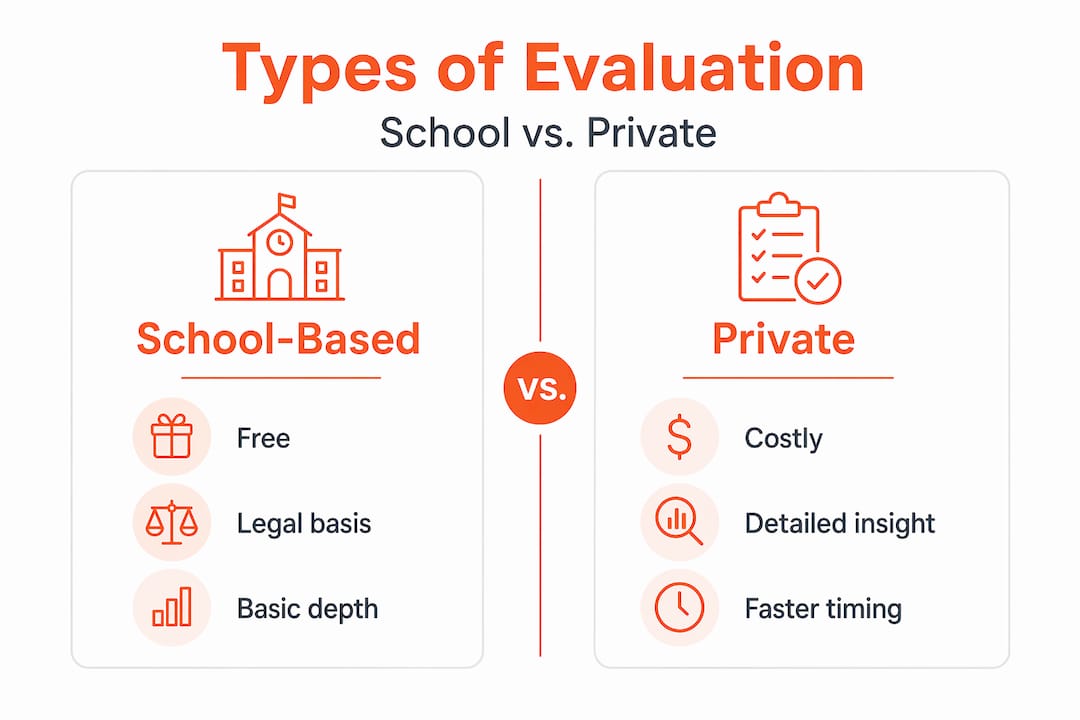
| Factor | School-based evaluation | Private evaluation |
|---|---|---|
| Cost | Free under IDEA | $2,000 to $5,000 typically |
| Purpose | Establish eligibility for special education services | Provide detailed functional insight |
| Depth | Focused on eligibility criteria | More thorough; covers broader functional domains |
| Timeline | Legally required within 60 days of consent | Varies by provider; often faster |
| Testing agency acceptance | Sometimes insufficient alone | Generally stronger for standardized test requests |
| Legal weight | Foundational for IEP and 504 | Supplementary; highly valuable for appeals |
School-based evaluations create the legal structure for services, while private evaluations provide deeper functional insight. Used together, they build a stronger case for accommodations than either could alone. Dr. Alan Jacobson has emphasized viewing psychoeducational evaluations as a front-line equity tool, focusing on individualized functional assessment rather than standardized labels. This philosophy reflects the best practice approach that private evaluators typically take.
Pro Tip: If your child’s school-based evaluation results in a denial or minimal accommodations, and you believe their needs are greater than documented, you have the right to request an Independent Educational Evaluation (IEE) at public expense. This gives you access to a private evaluator’s depth of analysis without the full out-of-pocket cost.
Practical steps to obtain an evaluation and secure accommodations
Knowing the process exists is one thing. Taking concrete action is another. Here is a practical sequence to get started.
- Submit a written request to the school. Put your request for a psychoeducational evaluation in writing, addressed to the special education director. The school is legally required to respond within a specific timeframe under IDEA.
- Research private evaluators simultaneously. If you anticipate a long wait or want a more in-depth assessment, contact neuropsychologists in your area while the school process is underway. Private waitlists can extend for months, so starting early is critical.
- Gather background documents. Collect report cards, prior assessments, teacher observations, and any medical records. A well-documented intake packet speeds up the evaluation process and improves the report’s accuracy.
- Understand what the report should contain. After the evaluation, confirm the report includes test scores, interpretation of those scores, a diagnostic statement where applicable, and specific accommodation recommendations linked to functional findings. A neuropsychological evaluation guide from Testaccommodations offers a detailed breakdown of what strong documentation looks like.
- Use the report to request accommodations formally. Submit the report to your child’s school for IEP or 504 consideration, and directly to the testing agency’s accommodations office for standardized test requests.
- Pursue interim supports while you wait. Parents can work with educators and use informal screeners to begin understanding your child’s processing profile before a formal evaluation is complete. This also strengthens your advocacy position during IEP meetings.
Pro Tip: Testing agencies often require that evaluations be conducted within the past three to five years. If your child’s most recent report is older than that, start the re-evaluation process well before test registration deadlines.
My perspective: why these evaluations change everything
I’ve worked with enough families at Testaccommodations to say this plainly: the evaluation is not a bureaucratic hurdle. It is the document that determines whether your child competes on an equal footing or not.
What I’ve seen repeatedly is that parents who act early, who push for thorough private evaluations and don’t settle for minimal school reports, get results. Their children secure accommodations that hold up under scrutiny from the College Board, ACT, and graduate school testing bodies. Parents who wait, or who accept a vague report because the process felt uncomfortable, often end up in appeals that take months and cause real academic harm.
The most common mistake I observe is conflating diagnosis with eligibility. A diagnosis opens the door. The functional impact documented in the evaluation is what walks through it. If a report doesn’t describe exactly how your child’s disability affects their performance in timed, high-pressure testing, it will not satisfy a testing agency’s review process.
My take on the equity argument is straightforward. Accommodations are not charity. They are corrections to a system that was designed without neurodiverse students in mind. Pursuing them is not asking for special treatment. It is asking for accurate measurement. Every parent in this situation deserves to feel confident making that case. Don’t let anyone, including a school administrator or a testing agency’s form letter, convince you otherwise.
— Roger
How Testaccommodations can support your family
Securing accommodations through a testing agency is rarely as simple as submitting a report and waiting for approval. Testing bodies like the College Board and ACT have specific documentation standards, and even well-written evaluation reports get denied when they don’t align with those requirements.
Testaccommodations specializes in exactly this situation. Whether you are facing a first-time accommodation request or appealing a denial, the accommodation support resources at Testaccommodations walk you through what documentation testing agencies actually require, what common errors get requests rejected, and how to build the strongest possible case for your child. You don’t have to figure out the process alone. Expert guidance is available, and it can make the difference between a denial and an approval.
FAQ
What is a psychoeducational evaluation used for?
A psychoeducational evaluation assesses a child’s cognitive, academic, and neuropsychological functioning to identify learning disabilities and support accommodation requests for school, IEP or 504 plans, and standardized tests.
Does a diagnosis alone qualify my child for test accommodations?
No. Testing agencies require documented evidence of functional impairment, not just a diagnosis. The evaluation report must connect the disability to specific performance limitations in timed or high-pressure testing conditions.
How recent does a psychoeducational evaluation need to be?
Most testing agencies, including the College Board and ACT, require evaluations completed within the past three to five years. Older reports are typically not accepted for standardized test accommodation requests.
What is the difference between a school-based and private evaluation?
School-based evaluations establish eligibility for special education services under IDEA and are conducted at no cost to families. Private evaluations offer more in-depth functional analysis and are often stronger documentation for standardized test accommodation requests, though they come with significant out-of-pocket costs.
What should I do if my child’s accommodation request is denied?
Review the denial letter carefully for the stated reason, gather any additional documentation the agency requests, and consider consulting a specialist. Testaccommodations provides guidance specifically for families dealing with accommodation denial situations across major standardized tests.