
The Role of Accommodation in Career Exam Testing
Accommodation in career exam testing is defined as a legally mandated adjustment that removes disability-related barriers so test-takers can demonstrate their true aptitude on standardized exams. Under 28 C.F.R. § 36.309, the Americans with Disabilities Act requires testing entities to provide these adjustments without compromising what the exam actually measures. The distinction matters enormously for students preparing for exams like the ACT, SAT, MCAT, or LSAT, and for the parents supporting them. Getting accommodations right is not just a procedural step. It is a civil rights protection with direct consequences for career readiness and long-term opportunity.
What is the role of accommodation in career exam testing?
Accommodations in testing are changes to how an exam is administered, not changes to what the exam measures. Federal guidelines describe them as modifications that enable equal access while preserving the integrity of the test. A student with dyslexia who receives extended time is still answering the same questions under the same scoring criteria as every other test-taker. The accommodation removes the barrier created by the disability, not the challenge of the exam itself.
The ADA’s mandate under 28 C.F.R. § 36.309 applies to any entity that offers exams related to educational or professional licensing. That scope covers the ACT, SAT, GRE, MCAT, LSAT, and many state licensing boards. Testing organizations must provide accommodations unless doing so would fundamentally alter what the exam measures or impose an undue burden. Those two defenses are narrow and legally defined. They are not a general license to deny requests.

The importance of exam accommodations extends well beyond test day. A 2026 BMC Psychology study found that academic accommodations mediate 57% of the effect of self-advocacy on career readiness for students with learning disabilities. That figure means accommodations are not just a testing convenience. They are a structural bridge between a student’s disability, their academic performance, and their professional future.
What are common types of testing accommodations and how do they support fairness?
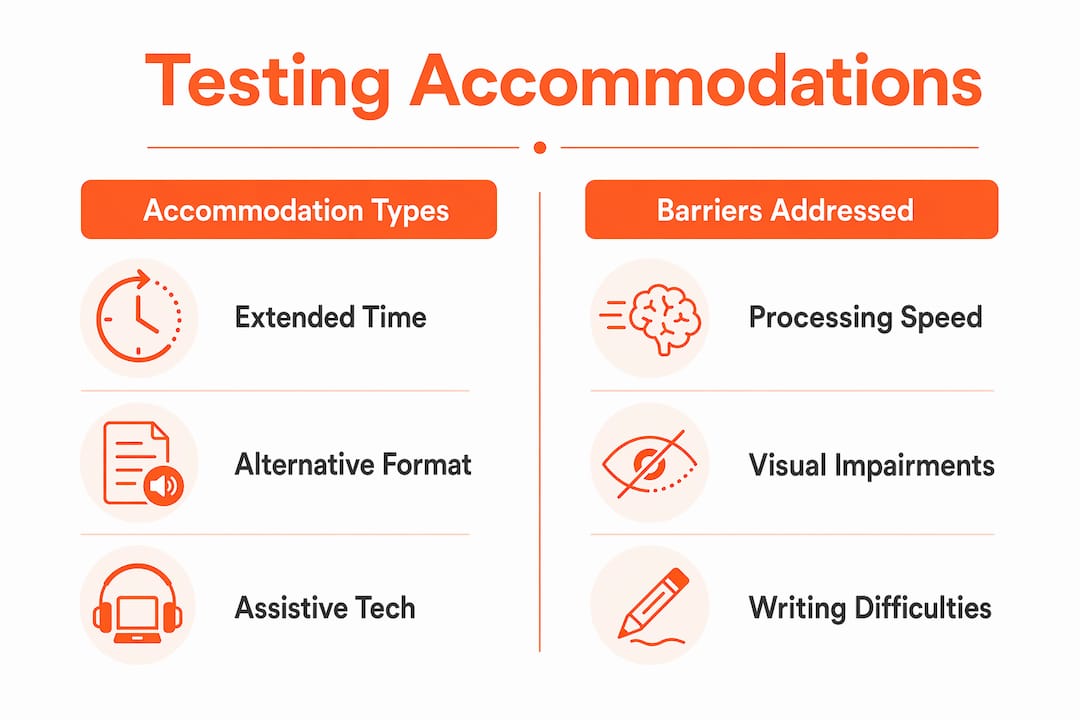
Testing accommodations fall into several clear categories. Each type targets a specific barrier without altering the construct the exam is designed to measure.
- Extended time: Available in tiers of 25%, 50%, or 100% additional time, this accommodation addresses processing speed differences caused by conditions like ADHD, dyslexia, or anxiety disorders.
- Separate testing room: Reduces auditory and visual distractions for students with sensory sensitivities or attention-related disabilities.
- Assistive technology: Includes screen readers, text-to-speech software, and magnification tools for students with visual impairments or reading-based disabilities.
- Readers and scribes: A reader reads exam content aloud; a scribe records the student’s dictated answers. Both serve students with motor or visual impairments.
- Breaks and scheduling changes: Extended or additional breaks address fatigue or medical conditions that affect sustained attention.
Research confirms that accommodations remove what researchers call “construct-irrelevant barriers.” That phrase means the barrier being removed is not part of what the test is trying to measure. Removing it does not give the student an unfair advantage. It gives them a fair shot.
Pro Tip: Do not confuse accommodations with modifications. Accommodations change how a test is taken. Modifications change what is being tested. Only accommodations are legally required under the ADA for standardized career exams.
| Accommodation type | Primary barrier addressed | How it preserves fairness |
|---|---|---|
| Extended time | Processing speed deficits | Does not alter question content or scoring |
| Separate room | Sensory or attention distraction | Same exam, different environment |
| Assistive technology | Visual or reading impairment | Accesses content without changing it |
| Reader or scribe | Motor or visual impairment | Delivers or records answers, not ideas |
| Additional breaks | Fatigue or medical conditions | Maintains stamina without altering rigor |
How does the accommodation process work for career exams?
The application process for testing accommodations follows a defined sequence. Understanding each step reduces the risk of denial and delays.
- Identify the testing organization’s requirements. Each exam board, whether ACT, College Board, NBME, or LSAC, has its own accommodation request portal and documentation standards. Start there before gathering any paperwork.
- Gather qualifying documentation. Under 28 C.F.R. § 36.309, documentation requests must be reasonable and limited to what is necessary to evaluate the specific accommodation requested. A diagnosis alone is rarely sufficient. Documentation must link the disability to a functional impairment that affects test access.
- Submit prior accommodation records. IEP and 504 plan records carry considerable weight in the review process. Federal law requires testing entities to give these documents serious consideration, though they do not guarantee approval.
- File the request well in advance. Most testing organizations require accommodation requests weeks or months before the exam date. Late submissions are routinely denied on procedural grounds alone.
- Respond to requests for additional information promptly. Testing organizations may ask for supplemental documentation. Delays in responding can push the request past the testing window.
One critical point that families often miss: school accommodations under an IEP or 504 plan do not automatically transfer to standardized or professional exams. Separate applications are required for each testing body. A student who has received extended time throughout high school still needs to apply independently to the ACT or SAT.
Requests are sometimes denied on “fundamental alteration” grounds, meaning the testing organization argues the accommodation would change what the exam measures. Documentation must specifically connect the disability’s functional impact to the test access issue being addressed. Vague or general diagnoses give reviewers grounds to deny.
Pro Tip: A psychoeducational evaluation completed within the past three to five years, written by a licensed professional and explicitly linking your disability to functional limitations in timed or reading-based tasks, is the strongest documentation you can submit.
What is the impact of accommodations on exam performance and career readiness?
Accommodations do not inflate scores. They allow scores to reflect what students actually know. That distinction is the foundation of the fairness argument for testing accommodations.
ACT research shows that students who use accommodations tend to improve their scores when retesting, at rates consistent with non-accommodated students. That pattern indicates accommodations are working as intended: removing barriers, not manufacturing ability. If accommodations provided an unfair advantage, accommodated students would show disproportionate score gains. The data does not support that claim.
Academic accommodations mediate 57% of the effect of self-advocacy on career readiness for students with learning disabilities. That means the path from self-advocacy to professional opportunity runs directly through access to accommodations. Denying accommodations does not make exams more rigorous. It makes them less valid.
The role of accessibility in exams is fundamentally about score validity. A score earned without needed accommodations does not accurately reflect a student’s knowledge or ability. It reflects their disability. That is not a measure of career readiness. It is a measure of impairment.
A common misconception is that accommodations give students an unfair edge over peers who do not receive them. Research on equity in testing consistently shows the opposite. Equity in testing means giving students what they need to demonstrate what they know. Equality means giving everyone the same conditions regardless of need. For students with disabilities, identical conditions produce unequal results.
How should students prepare for exams when using accommodations?
Securing accommodations is only half the work. Using them effectively on test day requires deliberate preparation.
- Practice under your actual accommodation conditions. If you have 50% extended time, run every practice test with that exact time allocation. Students who practice under standard conditions and then test with extended time often struggle with pacing because the rhythm feels unfamiliar.
- Integrate assistive technology into your study routine. If your accommodation includes a screen reader or text-to-speech tool, use it during every practice session. Comfort with the technology reduces cognitive load on exam day.
- Simulate the separate room environment. If you will test in a separate room, practice in a quiet, isolated space. The absence of ambient noise can feel disorienting if you have only studied in busier environments.
- Build your timing strategy around your accommodation. Extended time does not mean unlimited time. Students need a pacing plan that accounts for the additional minutes across each section.
- Work with your school’s SSD coordinator. Student Support Services or Special Education coordinators can help you align your school-based accommodations with the documentation needed for standardized exams.
Effective accommodation preparation is as important as securing the accommodations themselves. Students who practice with their approved adjustments report greater confidence and lower anxiety on test day. That confidence translates directly into performance.
Pro Tip: Start practicing with your accommodations at least eight weeks before your exam date. Early practice reveals pacing gaps and technology issues while there is still time to adjust your strategy.
Self-advocacy is also a preparation skill. Students who understand their rights and can clearly articulate their needs to test coordinators are better positioned to resolve day-of issues quickly. Self-advocacy strategies include knowing your accommodation letter by heart, arriving early to confirm your setup, and having a contact number for the testing organization’s accessibility office.
Key takeaways
Accommodations mediate 57% of the effect of self-advocacy on career readiness, making them a structural necessity for students with disabilities, not a procedural formality.
| Point | Details |
|---|---|
| Legal foundation | The ADA under 28 C.F.R. § 36.309 mandates accommodations for all career and educational exams. |
| Fairness, not advantage | Accommodations remove disability barriers without altering test standards or scoring criteria. |
| Documentation is decisive | Linking your disability’s functional impact to test access issues is the strongest factor in approval. |
| School records don’t transfer | IEP and 504 plans carry weight but require separate applications for each standardized exam. |
| Practice with accommodations | Preparing under actual accommodation conditions reduces pacing problems and cognitive load on test day. |
What I’ve learned from watching families navigate this process
Most families come to this process believing the hardest part is getting the diagnosis. It is not. The hardest part is translating a clinical diagnosis into documentation that a testing organization’s review committee will accept. I have seen students with well-documented ADHD, dyslexia, and anxiety disorders receive denials because their evaluations described symptoms in general terms rather than linking those symptoms to specific, measurable impacts on timed reading or writing tasks.
The misconception I encounter most often is that accommodations are a shortcut. Parents worry that requesting accommodations will signal weakness or invite skepticism from admissions offices. That concern is understandable, but it is not supported by evidence. Admissions committees do not see accommodation flags on score reports. What they see is a score that reflects the student’s actual ability.
The policy gap that frustrates me most is the disconnect between school-based accommodations and standardized testing accommodations. A student can spend four years in high school with a 504 plan providing extended time, then face a completely separate application process for the ACT or SAT with no guarantee of approval. That gap falls hardest on families who do not know it exists. Proactive involvement, starting the standardized exam application process at least a semester before the test date, is the single most effective thing a family can do.
Accommodations are not about lowering the bar. They are about making sure the bar is measuring the right thing.
— Roger
How Testaccommodations supports students seeking exam adjustments
Students and families who have received accommodation denials from testing organizations like ACT, College Board, NBME, or LSAC often do not know where to turn. Testaccommodations specializes in exactly that situation.
Testaccommodations advises students and families on accommodation eligibility criteria and helps build the documentation needed to support a strong request or appeal. The team understands the specific evidentiary standards each testing organization applies and can identify the gaps that lead to denials. Whether you are preparing a first-time request or challenging a denial, Testaccommodations provides the guidance that turns a frustrating process into a clear path forward. Visit Testaccommodations to learn how the team can help you secure the access your student is entitled to.
FAQ
What does accommodation in testing mean under the ADA?
Accommodation in testing means a change to how an exam is administered that removes a disability-related barrier without altering what the test measures. The ADA requires these adjustments under 28 C.F.R. § 36.309 for any exam related to education or professional licensing.
Do testing accommodations give students an unfair advantage?
No. ACT research confirms that accommodations remove construct-irrelevant barriers without inflating scores or providing advantages over non-disabled peers.
Does an IEP or 504 plan guarantee accommodations on the SAT or ACT?
No. IEP and 504 records carry considerable weight but do not guarantee approval. Each testing organization requires a separate application, and documentation must specifically link the disability to a functional impact on test access.
How far in advance should students apply for exam accommodations?
Students should apply several months before the exam date. Most testing organizations have strict deadlines, and late submissions are routinely denied on procedural grounds regardless of eligibility.
What is the most common reason accommodation requests are denied?
Requests are most often denied because documentation fails to connect the disability’s functional impact to a specific test access barrier. A diagnosis alone is not sufficient. The evaluation must explain how the condition impairs performance under standard testing conditions.
Recommended
- How to Choose the Right Admissions Exam With Accommodations - Test Accomodations
- The Role of Accommodations in Testing Fairness - Test Accomodations
- Testing Modifications vs Accommodations: Key Differences - Test Accomodations
- Testing Accommodations Examples That Can Support Success - Test Accomodations