
Physical Disability Accommodation Request Process: 2026 Guide
The physical disability accommodation request process is the formal procedure by which students with physical disabilities obtain modifications and supports during standardized testing, including the ACT, SAT, MCAT, and LSAT. Governed by frameworks such as the Americans with Disabilities Act (ADA) and Section 504 of the Rehabilitation Act, this process requires parents and guardians to submit documentation, engage in dialogue with testing agencies, and follow specific timelines. Getting it right from the start determines whether your student receives the support they are legally entitled to. This guide walks you through every stage, from gathering documentation to responding to a denial.
What does the physical disability accommodation request process require?
The accommodation request process for standardized testing requires three things: proper documentation of your student’s physical disability, a formal written request submitted to the relevant testing agency, and active participation in a collaborative review. The process is not simply filling out a form. Testing agencies such as the College Board (for the SAT) and ACT, Inc. (for the ACT) each maintain their own submission portals, deadlines, and documentation standards.
The legal foundation matters here. Under the ADA, testing organizations must provide reasonable accommodations unless doing so fundamentally alters the test. That distinction, “reasonable” versus “preferred,” shapes every decision the agency makes. Parents who understand this distinction enter the process with clearer expectations and stronger requests.

The term used in educational and legal contexts is “reasonable accommodation.” The phrase “physical disability accommodation request process” describes the same procedure from a practical, step-by-step perspective. Both terms refer to the same formal pathway, and knowing either one helps you communicate effectively with school officials and testing agencies alike.
What documentation is needed for a disability accommodation application?
Strong documentation is the foundation of any successful request. Testing agencies do not approve accommodations based on a diagnosis alone. They need evidence of how the physical disability creates a functional barrier during testing conditions.
Core documents to gather
- Medical evaluation or physician’s report: A current letter from a licensed physician or specialist describing the diagnosis, its severity, and how it affects the student’s ability to perform under standard testing conditions.
- Functional impact statement: A written explanation of specific tasks the student cannot perform or performs with significant difficulty, such as writing by hand, sitting for extended periods, or operating a standard computer mouse.
- IEP or 504 plan (if applicable): School-based plans provide supporting evidence, though testing agencies conduct their own independent review and are not bound by school decisions.
- Psychoeducational or neuropsychological evaluation: Required for some conditions, particularly when the physical disability intersects with a learning or processing difference.
- History of prior accommodations: Records showing the student has previously received similar supports at school strengthen the case significantly.
Focusing on functional barriers over diagnosis is more effective than emphasizing medical labels alone. A report that says “the student has cerebral palsy” is far less persuasive than one that says “the student cannot write legibly for more than five minutes due to spasticity in the right hand.”
Medical documentation must typically be submitted within 20 business days of a request for additional information. Missing that window can delay or derail an otherwise strong application.
| Document type | Purpose |
|---|---|
| Physician’s report | Confirms diagnosis and functional limitations |
| Functional impact statement | Links disability to specific testing barriers |
| IEP or 504 plan | Provides school-based accommodation history |
| Prior accommodation records | Demonstrates established pattern of need |
| Specialist evaluation | Adds clinical depth for complex conditions |
Pro Tip: Ask the physician to write the report specifically for a standardized testing context. Generic medical letters rarely include the functional detail testing agencies require.
How do you formally request accommodations for standardized tests?
The steps below apply broadly across major testing programs. Always verify the specific portal and deadline for the test your student is taking, since each agency maintains its own process.
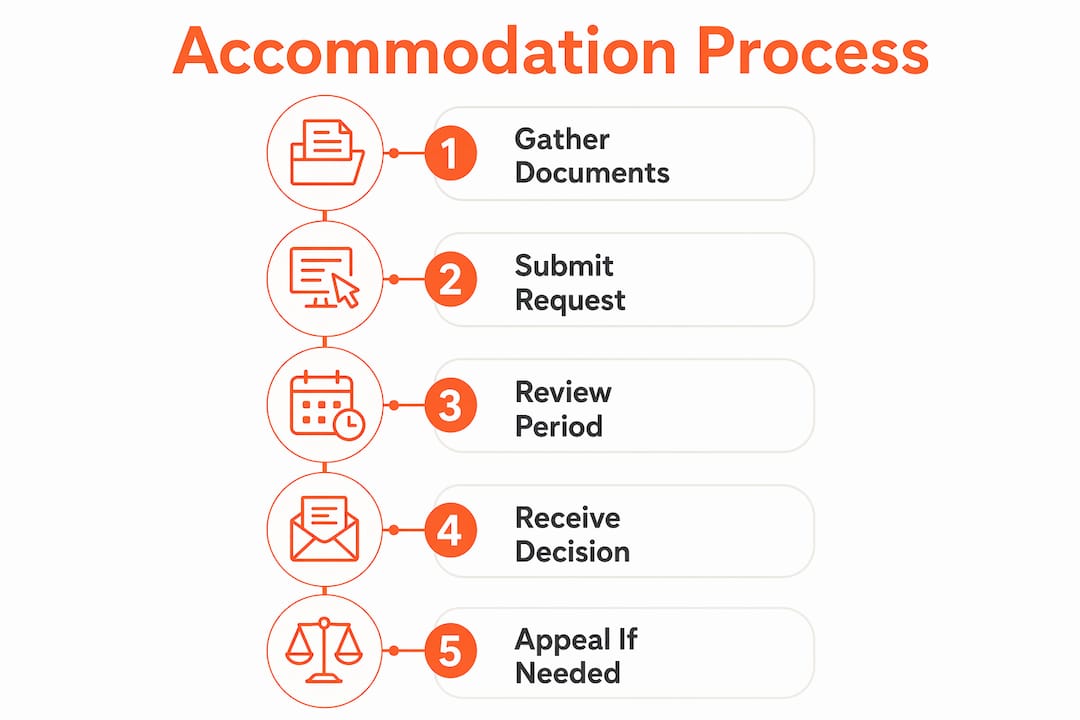
Identify the correct testing agency contact. For the SAT, submit through the College Board’s Services for Students with Disabilities (SSD) portal. For the ACT, use ACT’s Accommodations and Supports system. For graduate and professional tests such as the MCAT or LSAT, contact the AAMC or LSAC directly.
Notify your student’s school SSD coordinator. Many accommodation requests for high school students must be initiated or co-signed by the school’s SSD coordinator. Contact them early, since school-side processing adds time.
Submit a written request with supporting documentation. No specific legal language is required to initiate a request. A clear statement of your student’s needs and the accommodations being requested is sufficient. Attach all documentation at the time of submission.
Confirm receipt in writing. After submitting, send a follow-up email to the testing agency confirming the date of submission and the documents included. This creates a timestamped record.
Engage in the interactive process. The testing agency may contact you to request clarification, additional documentation, or to discuss alternative accommodations. This collaborative dialogue is legally required and must be conducted in good faith by both parties.
Track the timeline. Large organizations typically target a response within 2–3 business days for initial acknowledgment, though full decisions on accommodation requests often take longer. Follow up if you have not received a decision within the agency’s stated window.
Review the decision carefully. Approvals may be partial. The agency may grant some accommodations and deny others. Read the decision letter in full before deciding on next steps.
Pro Tip: Submit your request at least 8–10 weeks before the test date. Most agencies have firm deadlines, and appeals or resubmissions require additional time.
What challenges do parents face during the accommodation request process?
The most common obstacle is receiving a request for additional documentation after submission. Testing agencies frequently ask for more detail about functional limitations, updated evaluations, or clarification from the treating physician. This is not a denial. Respond promptly and specifically, addressing each item the agency flagged.
A second challenge involves understanding the difference between a preferred accommodation and a reasonable one. Testing agencies are not required to provide the exact accommodation requested if an equally effective alternative is available. For example, if a student requests a scribe but the agency offers voice-to-text software, that alternative may be legally acceptable even if it is not the student’s first choice.
Failing to engage genuinely in the interactive process is a legal violation. Testing agencies that ignore or unreasonably delay accommodation requests without cause are acting unlawfully. Parents who document every communication have a clear record to support an appeal or complaint if the process stalls.
Additional challenges parents commonly encounter include:
- Outdated documentation: Agencies often require evaluations completed within the past three to five years. Older reports may be rejected regardless of their quality.
- Incomplete functional impact statements: Physicians who are unfamiliar with standardized testing requirements may omit the specific functional detail agencies need.
- Partial approvals: A student may receive extended time but not a separate testing room, or vice versa. Each denied element can be appealed independently.
- Communication delays: Verbal conversations with agency representatives carry no legal weight. Always follow up in writing immediately after any phone call or meeting.
Maintaining a written record of every interaction, including dates, names, and the content of conversations, is the single most protective step you can take throughout this process.
How can parents advocate effectively throughout the process?
Effective advocacy starts before the first form is submitted. Parents who prepare thoroughly and communicate clearly get better outcomes than those who rely on the process to work itself out.
Before any meeting or submission, list the specific tasks your student struggles with and the accommodations that would address each one. Preparing concrete notes on challenges and potential solutions before meetings gives you a structured, credible position to present.
Key advocacy practices include:
- Frame every request around function, not diagnosis. Describe what the student cannot do under standard conditions, not just what condition they have.
- Treat the process as collaborative. Approaching the interactive process as a problem-solving conversation rather than a confrontation produces better results and preserves the relationship with the agency.
- Use expert recommendations as evidence. A physician or specialist who explicitly recommends a specific accommodation carries more weight than a parent’s request alone.
- Escalate when necessary. If a request is denied without adequate explanation, or if the agency fails to respond within its stated timeline, file a formal appeal. Testing agencies have internal appeals processes, and unresolved complaints can be directed to the U.S. Department of Education’s Office for Civil Rights.
- Consult a specialist. Organizations like Testaccommodations work specifically with families whose accommodation requests have been denied or delayed, providing targeted guidance on how to strengthen and resubmit.
Pro Tip: Keep a dedicated folder, physical or digital, for every document, email, and decision letter related to the accommodation request. If you ever need to appeal, that folder is your case.
Key Takeaways
The physical disability accommodation request process succeeds when parents combine thorough documentation, timely submission, and active participation in the interactive review with the testing agency.
| Point | Details |
|---|---|
| Documentation drives decisions | Focus on functional barriers, not diagnosis labels, to build the strongest possible request. |
| Timelines are strict | Submit documentation within required windows (often 20 business days) to avoid delays. |
| Written records protect you | Follow up every verbal communication in writing to create a timestamped, verifiable record. |
| Alternatives may be offered | Testing agencies can substitute a different accommodation if it removes the same barrier. |
| Escalation is a right | Denied or stalled requests can be appealed internally or reported to the Office for Civil Rights. |
What I’ve learned from watching families navigate this process
After working with families across dozens of standardized testing accommodation cases, one pattern stands out clearly. The requests that succeed are not always the ones with the most extensive medical records. They are the ones where the parent understood the agency’s actual decision criteria and built the submission around those criteria.
Testing agencies are not evaluating how serious a student’s condition is. They are evaluating whether the documentation demonstrates a specific functional barrier that a specific accommodation would address. That is a narrow question, and most physician letters do not answer it directly. The gap between what a doctor writes and what an agency needs to see is where most denials originate.
The other thing I have seen repeatedly is that parents who treat the process as adversarial from the start tend to get worse outcomes. Agencies have discretion. A parent who communicates respectfully, responds promptly to requests for additional information, and engages genuinely in the interactive process is far more likely to reach a workable resolution than one who leads with legal threats. Save the formal escalation for situations where the agency has clearly acted in bad faith or violated its own procedures.
Start earlier than you think you need to. Build your documentation around function, not diagnosis. And if you hit a wall, get help from someone who knows the specific agency’s standards.
— Roger
How Testaccommodations can help with your request
Navigating a standardized testing accommodation request is demanding, especially when documentation requirements are unclear or a request has already been denied. Testaccommodations works directly with families of students with physical disabilities to build stronger requests, identify documentation gaps, and respond to denials with targeted, evidence-based submissions.
Whether your student is preparing a first-time disability accommodation application or challenging a partial approval, Testaccommodations provides the specific guidance that generic advice cannot. The team understands the standards each major testing agency applies and knows how to frame functional limitations in the language those agencies respond to. Visit Testaccommodations to learn how the service supports families at every stage of the process, from initial submission through formal appeal.
FAQ
What is the physical disability accommodation request process?
The physical disability accommodation request process is the formal procedure for obtaining testing modifications from agencies like the College Board or ACT, Inc. It involves submitting medical documentation, completing agency-specific forms, and engaging in a review dialogue with the testing organization.
How long does it take to get a decision on an accommodation request?
Response timelines vary by agency, but initial acknowledgment often comes within a few business days. Full decisions on accommodation requests can take several weeks, which is why submitting at least 8–10 weeks before the test date is strongly recommended.
What happens if an accommodation request is denied?
A denial can be appealed through the testing agency’s internal appeals process. If the agency fails to respond or the denial appears unlawful, parents can file a complaint with the U.S. Department of Education’s Office for Civil Rights.
Does my student need an IEP or 504 plan to request test accommodations?
An IEP or 504 plan supports a request but is not always required. Testing agencies conduct independent reviews, and students without a formal plan can still qualify if their documentation demonstrates a functional barrier.
What documentation do testing agencies typically require?
Agencies generally require a current physician’s report, a functional impact statement, and records of prior accommodations. The documentation must describe how the physical disability creates a specific barrier under standard testing conditions, not just confirm the diagnosis.