
MCAT Accommodations: Types, Docs, and How to Apply
MCAT accommodations are formal modifications to standard testing conditions that the Association of American Medical Colleges (AAMC) grants to test-takers with documented disabilities or medical needs. The types of accommodations available for the MCAT span extended testing time, additional breaks, assistive technologies, and specialized testing environments. Each category addresses a specific functional barrier, not just a diagnosis. Understanding what options exist, what documentation the AAMC requires, and how the application process works gives you a real advantage before you ever register for the exam.
What are the main types of accommodations available for the MCAT?
The AAMC recognizes four broad categories of MCAT testing accommodations: timing modifications, break accommodations, physical and environmental changes, and assistive technology. Each category serves a distinct population of test-takers, and many students qualify for more than one type.
Timing Modifications
Extended testing time is the most requested accommodation. The AAMC offers time extensions of 25% or 50% above the standard allotment. Students with processing speed deficits, reading disabilities like dyslexia, or attention disorders such as ADHD most commonly receive this type of support. Time extensions apply across all four sections of the exam.

Break Accommodations
Stop-the-clock breaks and extended section breaks are available for students who need to manage symptoms during the exam. Stop-the-clock breaks allow medication access and physiological regulation without reducing the time available for test content. This distinction matters: a break accommodation does not shorten your testing window the way a timing modification might appear to on paper.
Physical and Environmental Accommodations
- Separate testing rooms for students who are distracted by ambient noise or require privacy
- Adjustable-height workstations for test-takers with mobility impairments or chronic pain conditions
- Wheelchair access, which the AAMC permits without prior approval
- Continuous food and drink access for students with diabetes, eating disorders, or other metabolic conditions
- Pregnancy and lactation support, including private space and additional break time
Assistive Technology
Screen readers, speech recognition software, and large-print paper formats are available for test-takers with visual or motor impairments. These tools require advance approval through the standard accommodations process. You cannot bring your own software; the AAMC provides approved tools at the testing site.
Pro Tip: Share the AAMC Evaluator Guide with your specialist before your evaluation appointment. This document tells evaluators exactly what the AAMC needs to see, and reports written without it often miss critical documentation standards.
What documentation do you need to qualify?
Documentation requirements are where most accommodation requests succeed or fail. The AAMC does not approve accommodations based on a diagnosis alone. The functional impairment must be directly connected to the specific demands of the MCAT, including its unusual length and the sustained mental fatigue it produces.
Here is what strong documentation looks like:
- A current, comprehensive evaluation. For learning disabilities and psychiatric conditions, the AAMC expects evaluations completed within the past 6–24 months. Childhood-only assessments are almost always insufficient. The evaluation must use adult norms and reflect your current functioning.
- Functional impact tied to the MCAT. Your evaluator must explain how your specific deficits affect performance on a seven-hour standardized exam. Generic language like “patient has ADHD and may benefit from extended time” does not meet the standard.
- Diagnosis, symptom history, and treatment record. For psychiatric conditions, documentation should include your current diagnosis, recent symptom updates, and your treatment plan. Evaluations older than six months for psychiatric disabilities may be considered, but updates are expected for evaluations up to 24 months old.
- Prior accommodations history. Records from your IEP, 504 plan, SAT, ACT, or college disability services office are supportive evidence. However, prior accommodations on other exams do not guarantee MCAT approval. The AAMC applies its own independent standards.
- Evaluator credentials. The professional who completes your evaluation must be licensed and qualified to assess the condition in question. A primary care physician’s note is not a substitute for a psychoeducational evaluation.
Pro Tip: If you previously took the MCAT without accommodations, your new evaluation must explain why that prior attempt did not reflect the full impact of your disability. The AAMC will ask.
How do you apply for MCAT accommodations step by step?
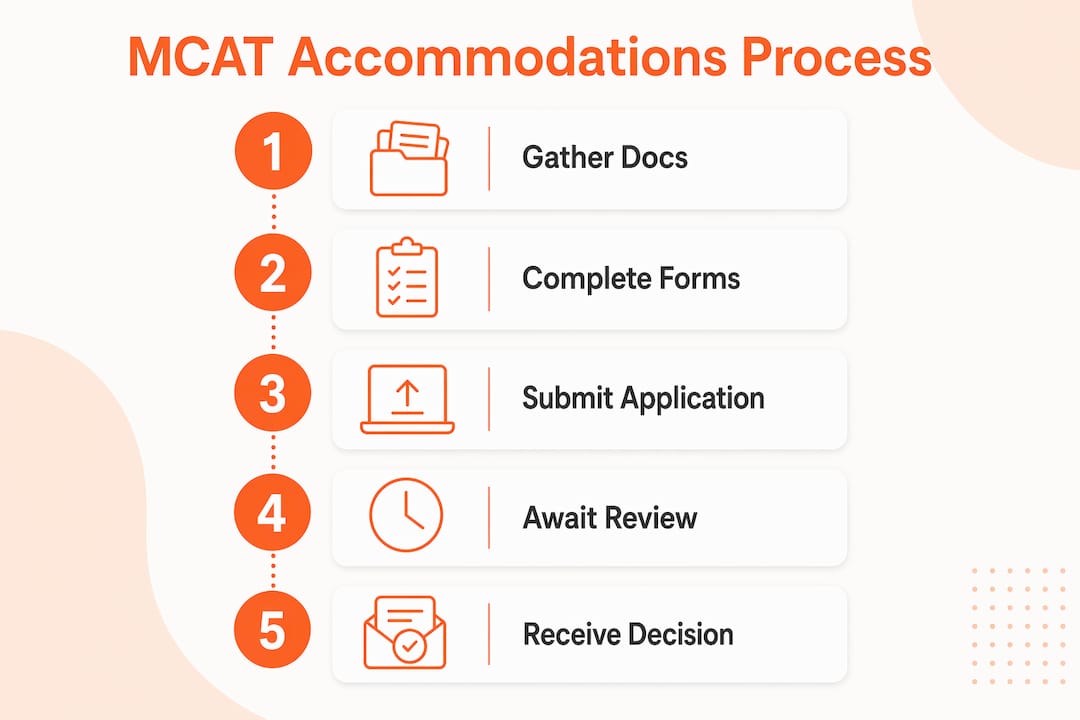
The application process requires planning well in advance. Starting 4–5 months before your target exam date is the minimum recommended lead time. The AAMC’s review periods are fixed, and there is no expedited option.
Step-by-Step Application Process
- Gather your documentation. Confirm your evaluation is current, uses adult norms, and addresses functional impact specific to the MCAT. Collect all supporting records, including prior accommodation approvals.
- Create your AAMC account and complete the accommodations application. The application is submitted through the AAMC’s online portal. You will describe your disability, list the accommodations you are requesting, and upload all supporting documentation.
- Submit and wait for the initial review. The AAMC’s initial review period takes up to 60 days. Do not register for a specific exam date until you receive approval, as scheduling without confirmed accommodations creates complications.
- Respond to any requests for additional information. The AAMC may ask for clarification or supplemental documentation. Respond promptly to avoid extending the timeline.
- Request reconsideration or file an appeal if denied. Reconsideration and appeals each add approximately 30 days to the process. If you receive a denial, review the specific reasons carefully before resubmitting.
- Schedule your exam with accommodations confirmed. Submit your scheduling request at least 15 days before your intended exam date. Accommodations must be confirmed before you book a seat.
The table below summarizes the key timeline milestones:
| Stage | Timeframe |
|---|---|
| Begin documentation process | 4–5 months before exam |
| Submit accommodations application | 3–4 months before exam |
| AAMC initial review period | Up to 60 days |
| Reconsideration period (if needed) | Additional 30 days |
| Appeal period (if needed) | Additional 30 days |
| Schedule exam with accommodations | At least 15 days before exam |
One common mistake is assuming that approval on a previous MCAT attempt carries forward automatically. It does not. Each application cycle requires a fresh submission, and documentation currency requirements still apply.
How are psychiatric and learning disabilities treated differently?
The MCAT accommodations process treats psychiatric disabilities and learning disabilities as distinct categories, even though both may result in a request for extended time. Understanding the difference helps you request the right accommodation and build a stronger application.
For learning disabilities such as dyslexia or a processing speed disorder, extended testing time is typically the most appropriate and defensible accommodation. The functional deficit directly affects how quickly a student can read, process, and respond to test content. Timing modifications address that deficit at its source.
For psychiatric disabilities such as anxiety, depression, or PTSD, the picture is more nuanced. Break accommodations are often more successful and logically sound than extra time for these conditions. Breaks address symptom management during testing without altering the core content timing requirements. A student with panic disorder, for example, may need a private space and a few minutes to regulate before continuing, not additional minutes on the clock.
Key distinctions to keep in mind:
- Anxiety and depression often benefit most from stop-the-clock breaks, private testing rooms, and access to medication or coping tools during the exam.
- ADHD can qualify for both timing modifications and break accommodations, depending on whether the primary impairment is processing speed, attention regulation, or both.
- Documentation currency is stricter for psychiatric conditions. The AAMC expects evaluations no older than six months for active psychiatric diagnoses, with updates required for older reports.
- Symptom management accommodations differ from timing accommodations in how they are reviewed. The AAMC evaluates whether the requested accommodation matches the documented functional barrier, not just the diagnosis.
For a deeper look at how psychiatric disability accommodations work in standardized testing, the specific documentation requirements are worth reviewing before you meet with your evaluator.
Key takeaways
Securing MCAT accommodations requires demonstrating current, specific functional impairment tied to the exam’s demands, not just holding a diagnosis.
| Point | Details |
|---|---|
| Four accommodation categories | Timing, breaks, physical environment, and assistive technology each serve distinct needs. |
| Documentation currency matters | Evaluations must be 6–24 months old and use adult norms tied to MCAT demands. |
| Prior approvals do not transfer | SAT, ACT, or college accommodations support your case but do not guarantee MCAT approval. |
| Start 4–5 months early | AAMC review alone takes up to 60 days, with additional time for reconsideration or appeals. |
| Match accommodation to disability type | Psychiatric conditions often benefit more from break accommodations than extended time. |
What i’ve learned after years of MCAT accommodation cases
The single most damaging misconception I see is that a prior accommodation approval is a guarantee. Students come to us after receiving a denial from the AAMC, genuinely confused because they had extended time on the SAT, a 504 plan in high school, and accommodations through their university disability office. None of that automatically transfers. The AAMC is evaluating whether your disability creates a specific functional barrier to this exam, at this stage of your life, with adult-level demands.
The second pattern I see constantly is documentation that describes a diagnosis without connecting it to the MCAT’s actual structure. The MCAT is approximately seven hours long. It demands sustained concentration across four sections with limited breaks. An evaluation that says “the patient has generalized anxiety disorder” without explaining how that condition degrades performance over a seven-hour cognitive marathon is not going to move the AAMC. Your evaluator needs to speak the AAMC’s language, and that means reading the Evaluator Guide before writing a single sentence of the report.
My honest advice: do not treat the accommodations application as an afterthought to your study schedule. Treat it as its own project with its own deadlines. If you are considering applying for MCAT accommodations and you are not sure whether your documentation meets the standard, get a second opinion before you submit. A denial adds 30–60 days to your timeline and creates a record the AAMC will reference on any future application.
— Roger
How Testaccommodations can help you secure your MCAT accommodations
Navigating the AAMC’s documentation standards and review timelines is genuinely difficult, especially when a denial is already on record. Testaccommodations works directly with students and families who are entitled to testing accommodations and are facing denials or complex documentation challenges.

Testaccommodations provides expert guidance on building documentation that meets AAMC standards, preparing reconsideration and appeal submissions, and coordinating with evaluators who understand what the AAMC actually reviews. If you are unsure whether your current documentation is strong enough, or if you have already received a denial, visit Testaccommodations to learn how the team can support your application from start to approval.
FAQ
What types of MCAT accommodations does the AAMC offer?
The AAMC offers extended testing time (25% or 50%), stop-the-clock breaks, separate testing rooms, adjustable workstations, assistive technology such as screen readers and speech recognition software, and special accommodations for pregnancy, lactation, and continuous food or drink access.
Does having a 504 plan or IEP guarantee MCAT accommodations?
No. Prior accommodations from a 504 plan, IEP, SAT, ACT, or college disability office are supportive evidence, but the AAMC applies its own independent standards and requires current documentation of functional impairment specific to the MCAT.
How far in advance should i apply for MCAT accommodations?
Start the process 4–5 months before your target exam date. The AAMC’s initial review takes up to 60 days, and reconsideration or appeals each add approximately 30 days. You must also schedule your exam at least 15 days after receiving approval.
Are break accommodations better than extra time for anxiety?
For many psychiatric conditions including anxiety and depression, break accommodations are more defensible and better suited to symptom management than extended time. Breaks allow regulation and medication access without altering the core content timing structure of the exam.
Can i qualify for MCAT accommodations without a formal diagnosis?
Qualifying without a formal diagnosis is rare but possible in limited circumstances. The AAMC requires documented evidence of functional impairment. For more detail on alternative qualification pathways, review the MCAT accommodations eligibility guidance from Testaccommodations.