
How to Use a Therapist Letter for Test Accommodations
A therapist letter for standardized testing accommodations is defined as written professional documentation that connects a student’s diagnosed condition to specific functional limitations affecting timed test performance. Under the Americans with Disabilities Act and Section 504 of the Rehabilitation Act, testing entities must provide reasonable accommodations to qualified individuals with disabilities. The challenge for most parents is that documentation must be narrowly tailored to show both the nature of the disability and the need for specific accommodations. Generic diagnosis letters rarely meet this standard. Knowing how to use a therapist letter in a testing accommodation request correctly is the difference between approval and denial.
How to use a therapist letter in a testing accommodation request
A therapist letter works as supporting evidence within a broader accommodation request, not as a standalone qualification document. Testing entities like College Board, ACT, and the LSAC evaluate letters against specific documentation criteria. The letter must demonstrate that your student’s condition creates measurable barriers in a timed testing environment. Without that functional connection, even a well-written letter from a licensed professional will fall short.

The ADA.gov testing accommodations framework makes clear that documentation must be individualized. That means a letter describing general anxiety or ADHD symptoms is not sufficient. The letter must explain how those symptoms specifically impair your student’s ability to read, process, or respond under time pressure. This specificity is what separates accepted documentation from rejected documentation.
Parents should also understand the difference between a therapist letter and a full psychoeducational evaluation. For high-stakes tests like the SAT, GRE, or MCAT, comprehensive psychoeducational reports are preferred over brief letters from general practitioners. A therapist letter can supplement a full evaluation, but it rarely replaces one for major standardized tests. Knowing where your therapist’s letter fits in the overall documentation package is the first step toward a successful request.
What should a therapist letter include for accommodations?
The content of the letter determines whether the accommodation request succeeds. A letter missing even one key component gives the testing board grounds for denial. Every effective testing accommodation letter contains the following elements:
- Professional credentials and licensure. The therapist must identify their license type (LCSW, LPC, PhD, PsyD), state of licensure, and their treatment relationship with the student.
- Diagnosis with DSM-5 or ICD-10 reference. A named diagnosis tied to a recognized classification system establishes clinical legitimacy.
- Description of functional impairments. This is the most critical section. The letter must describe how the condition affects the student’s ability to perform under timed conditions, not just in daily life.
- Specific accommodation recommendations. The therapist should name the exact accommodations requested, such as extended time (time and a half or double time), separate testing room, or frequent breaks.
- Rationale connecting condition to accommodation. The letter must explain why each requested accommodation addresses the identified functional barrier.
- Professional letterhead and signature. Accommodation letters should be on professional letterhead using plain language and include only the information necessary to support the request.
Pro Tip: Ask your therapist to avoid copying diagnostic language directly from the DSM-5. Testing reviewers want to see the therapist’s clinical observations about your specific student, not textbook symptom lists.
Privacy matters here. The letter should include only what the testing board needs to evaluate the request. Full treatment notes, session summaries, and medication histories are not required and should not be included. Employers and schools require proof of condition and accommodation need, not full medical records. The same principle applies to testing entities.
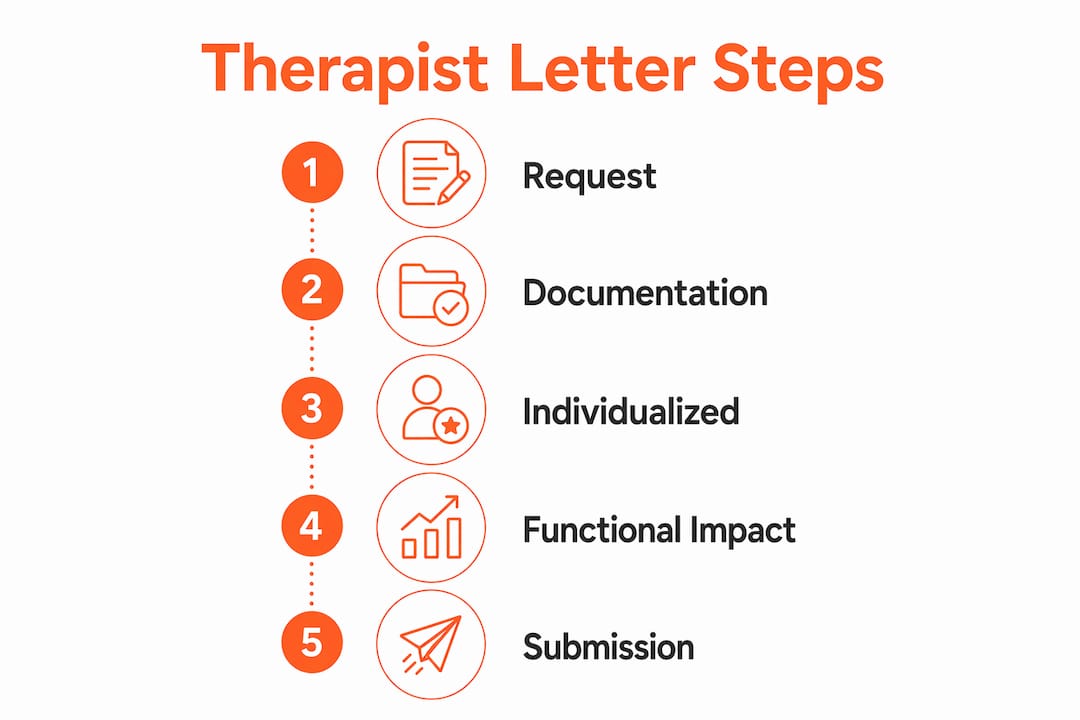
How to prepare your therapist to write an effective letter
The quality of the letter depends heavily on how well you prepare your therapist before the request. Therapists who receive vague requests produce vague letters. A structured, professional conversation produces documentation that meets testing board standards.
- Explain the specific purpose. Tell your therapist which test your student is taking (SAT, ACT, MCAT, LSAT, GRE) and which testing entity will review the letter. Each board has different documentation standards.
- Provide the testing board’s documentation guidelines. Download the specific requirements from the testing entity’s website and share them with your therapist before the appointment. This removes guesswork and reduces revision cycles.
- Share existing documentation. Bring copies of any current IEP, 504 plan, or prior psychoeducational evaluation. Supplying therapists with specific accommodation request forms and previous testing documentation greatly enhances letter effectiveness and reduces back-and-forth.
- Discuss fees and timeline upfront. Professional accommodation letters typically incur administrative fees ranging from $0 to $300, often not covered by insurance. Turnaround time is usually one to two weeks when the therapist has full background information.
- Clarify the therapist’s scope. Some therapists are not comfortable writing detailed functional capacity assessments. If your therapist expresses hesitation, consider a dual-provider approach: a brief diagnostic letter from the treating therapist combined with a separate functional assessment from a neuropsychologist or educational psychologist.
- Treat the request as a professional task. Parents should treat the letter request as a professional partnership with their therapist. Frame it as a formal administrative request, not a casual favor.
Pro Tip: Submit your letter request at least six to eight weeks before the testing deadline. This gives your therapist time to write a thorough letter and leaves room for revisions if the testing board requests additional information.
Step-by-step process for submitting your accommodation request
Once the therapist letter is ready, it becomes one component of a complete accommodation application. The following steps walk you through the full submission process.
- Confirm the testing board’s documentation requirements. Visit the official website for your test (College Board for SAT, ACT, Inc. for ACT, NBME for USMLE) and download the current documentation checklist. Requirements change, so always use the most current version.
- Gather all supporting documents. Compile the therapist letter, any psychoeducational evaluation, current IEP or 504 plan, and school records showing prior accommodations. Use the accommodation documentation checklist to confirm nothing is missing.
- Submit at least seven weeks before the test date. Testing bodies like College Board recommend submitting accommodation requests at least seven weeks before the test date. Late submissions risk denial on procedural grounds alone.
- Keep copies of everything. Retain copies of the therapist letter, all supporting documents, and your submission confirmation. You will need these if the board requests additional information or if you need to appeal.
- Follow up within two weeks. Contact the testing board’s disability services office to confirm receipt of your application. Ask for an estimated review timeline.
- Respond promptly to requests for additional documentation. Testing boards sometimes request clarification or supplemental records. A fast, complete response keeps your application moving forward.
| Step | Action | Timing |
|---|---|---|
| Confirm requirements | Download current documentation checklist from testing board | 10+ weeks before test |
| Gather documents | Compile letter, evaluation, IEP/504, school records | 9–10 weeks before test |
| Submit application | Upload or mail complete package to testing board | 7+ weeks before test |
| Follow up | Confirm receipt with disability services office | 5–6 weeks before test |
| Respond to requests | Provide any additional documentation requested | Within 5 business days |
Common mistakes that get therapist letters rejected
The most common reason for accommodation denials is a lack of documented connection between the disability and specific functional limitations in timed testing environments. A diagnosis alone is never sufficient. Parents who understand the most frequent pitfalls can help their therapists avoid them.
- Submitting a diagnosis-only letter. A letter that states “this student has ADHD” without explaining how ADHD impairs timed test performance will be denied.
- Using outdated documentation. Many testing entities require evidence updated within 3–5 years to reflect the student’s current needs. An IEP from elementary school does not meet this standard for a high school student applying for SAT accommodations.
- Requesting the letter too late. Therapists need time to write a thorough letter. Requesting documentation one week before the submission deadline produces rushed, incomplete letters.
- Misunderstanding therapist scope. Licensed counselors and therapists can document diagnosis and functional impact. They cannot always conduct the standardized cognitive assessments that some testing boards require. Know the difference before submitting.
- Failing to specify accommodations. A letter that says “this student needs support” without naming specific accommodations (extended time, breaks, separate room) gives the testing board nothing concrete to approve.
When an accommodation request is denied, the first step is to obtain a written explanation of the denial. Work with your therapist to address the specific gaps identified by the testing board. If the denial involves a procedural or legal issue, parents can file a complaint with the Office for Civil Rights under the Department of Education. The ADA.gov appeals process outlines the formal complaint pathway for education-related denials.
Key Takeaways
A therapist letter succeeds only when it explicitly connects a diagnosed condition to specific functional limitations that affect timed test performance.
| Point | Details |
|---|---|
| Functional specificity is required | The letter must describe how the condition impairs timed testing, not just daily life. |
| Prepare your therapist thoroughly | Share testing board guidelines, existing IEPs, and specific accommodation forms before the appointment. |
| Submit at least seven weeks early | Late submissions risk denial on procedural grounds regardless of documentation quality. |
| Keep documentation current | Most testing boards require evaluations updated within 3–5 years to reflect present needs. |
| Know when to escalate | A denial is not final. Obtain written reasons, address gaps, and use the Office for Civil Rights process if needed. |
What I’ve learned from watching families navigate this process
Working with families through accommodation denials has taught me one consistent lesson: the therapist letter is almost never the problem on its own. The problem is that parents and therapists rarely have a structured conversation before the letter is written. The therapist writes what they know. The parent submits what they receive. And the testing board denies what doesn’t meet their specific criteria.
The dual-provider approach is underused and underappreciated. A treating therapist who has worked with a student for two years has clinical insight that no outside evaluator can replicate. A neuropsychologist has the standardized assessment tools that testing boards trust. Combining both into a single application package is the strongest documentation strategy available.
I also want to be direct about timelines. Parents consistently underestimate how long this process takes. Requesting a letter, waiting for revisions, gathering a psychoeducational evaluation, and submitting a complete package to the testing board can take three months or more. Starting this process the week before a registration deadline is not a plan. It is a setup for denial.
The families who succeed treat this as a project with a timeline, a checklist, and a clear division of responsibilities. They read the eligibility criteria for standardized tests before they request anything. They communicate clearly with their therapist. And they submit complete, current, specific documentation well ahead of the deadline. That approach works. Rushing does not.
— Roger
How Testaccommodations can help when the process gets complicated
Families who have received an accommodation denial often feel stuck. The testing board’s letter is technical. The appeal process is unfamiliar. And the stakes are high when a student’s test date is approaching.

Testaccommodations specializes in exactly this situation. The team advises students and families who are entitled to accommodations for standardized tests including the ACT, SAT, MCAT, and LSAT, and who are facing denials of their requests. Whether you need help understanding why a therapist letter was rejected, building a stronger documentation package, or navigating the accommodation request process for the first time, Testaccommodations provides the guidance families need to move forward with confidence. The process is complex, but you do not have to work through it alone.
FAQ
What makes a therapist letter acceptable for SAT accommodations?
The letter must connect the student’s diagnosis to specific functional limitations in timed testing, be written on professional letterhead, and include the therapist’s credentials. College Board also prefers supporting documentation from a psychoeducational evaluation.
Can a therapist letter replace a psychoeducational evaluation?
For most high-stakes tests, a therapist letter alone is not sufficient. Testing boards like College Board and ACT, Inc. typically require a comprehensive psychoeducational evaluation alongside any supporting letters from treating clinicians.
How far in advance should I request the therapist letter?
Request the letter at least eight to ten weeks before the test date. This allows time for the therapist to write a thorough letter, make any revisions, and still meet the testing board’s seven-week submission deadline.
What happens if my accommodation request is denied?
Request a written explanation of the denial from the testing board. Work with your therapist to address the specific gaps, then resubmit. If the denial involves a legal issue, you can file a complaint with the Office for Civil Rights under the Department of Education.
Does the therapist letter need to be updated for each test?
Most testing boards require documentation updated within 3–5 years. If your student is applying for accommodations on multiple tests over several years, confirm the currency requirements for each testing entity separately.