
How Mental Health Conditions Qualify for Testing Accommodations
A mental health condition qualifies for standardized testing accommodations when it creates a substantial limitation in a major life activity directly relevant to test performance. This is the standard established under the Americans with Disabilities Act (ADA), and it applies to every major exam, including the SAT, ACT, MCAT, and LSAT. The key phrase parents need to understand is “functional limitation,” not diagnosis. Knowing how mental health conditions qualify accommodations shapes every decision you make, from choosing an evaluator to preparing documentation. This article explains the qualification criteria, documentation requirements, and the process your family will navigate under current federal guidance.
How mental health conditions qualify accommodations under ADA standards
The ADA does not provide a fixed list of qualifying mental health conditions. Qualification depends on an individualized assessment showing that the condition substantially limits one or more major life activities. This means a student with Major Depressive Disorder may qualify, and so may a student with PTSD, OCD, or a generalized anxiety disorder. What matters is not the label on the diagnosis but the documented evidence of how the condition disrupts the student’s ability to concentrate, process information, manage time, or sustain attention during a test.
This distinction is critical. A psychiatrist’s letter confirming a diagnosis carries far less weight than a detailed psychoeducational evaluation that maps specific functional deficits to specific testing barriers. The ADA framework focuses on equal opportunity. Accommodations exist to remove barriers created by the disability, not to give students an advantage. That framing matters when you are building your child’s case.
Federal guidance updated in 2026 reinforces that testing accommodations focus on functional limitations impacting test-taking ability rather than formal clinical diagnosis alone. Testing entities, including the College Board and ACT, Inc., must apply this standard when reviewing requests.

What conditions commonly qualify for mental health accommodations?
Several mental health diagnoses appear frequently in approved accommodation requests. The conditions below commonly qualify when documentation demonstrates the required functional impact:
- Major Depressive Disorder (MDD): Impairs concentration, processing speed, and sustained effort over long testing periods.
- Post-Traumatic Stress Disorder (PTSD): Causes intrusive thoughts, hypervigilance, and difficulty maintaining focus in high-pressure environments.
- Obsessive-Compulsive Disorder (OCD): Disrupts time management and pacing through compulsive checking behaviors during tests.
- Generalized Anxiety Disorder (GAD) and Panic Disorder: Produce physical and cognitive symptoms that interfere with reading comprehension and response accuracy.
- Bipolar Disorder: Affects cognitive consistency, energy, and concentration, particularly during depressive or mixed episodes.
Episodic conditions present a common misconception. Parents sometimes assume that because a student’s symptoms fluctuate, the condition will not qualify. Episodic and remitting conditions are eligible when the impairment is substantial during active episodes. Documentation should describe the frequency, duration, and functional impact of those episodes, not just the student’s best days.
Pro Tip: Ask the evaluating clinician to document both the student’s baseline functioning and their functioning during symptomatic periods. Reviewers need to see the full picture, not just a snapshot of a good week.
What documentation is required to establish eligibility?
Documentation is the foundation of every successful accommodation request. Qualified professionals conducting individualized assessments produce documentation far more likely to be accepted without challenges than generic letters from a treating physician. The evaluator must have expertise relevant to the condition being assessed. A licensed psychologist, neuropsychologist, or psychiatrist with experience in psychoeducational evaluation is the appropriate choice for most mental health accommodation requests.
The documentation must accomplish four specific things:
- Identify the diagnosis with clinical specificity, including the diagnostic criteria met and the assessment tools used.
- Describe functional limitations in concrete terms, explaining how the condition impairs concentration, reading, writing, or time management during testing conditions.
- Connect the limitation to the accommodation by explaining why extended time, a separate room, or frequent breaks directly addresses the identified barrier.
- Be current and relevant to the student’s present functioning. Outdated evaluations from years prior may not reflect the student’s current needs and are frequently challenged.
Simply having a diagnosis is insufficient. Documents must explain how the impairment disrupts specific testing abilities and how the requested accommodations resolve those barriers. A generic letter stating “this student has anxiety and needs extra time” will almost certainly trigger a request for additional documentation, which costs your family time and may push the request past the testing cycle.
Pro Tip: Use the documentation checklist developed for standardized test accommodation requests before submitting anything. Missing one required element is the most common reason families face delays.
Common documentation pitfalls include submitting evaluations that are more than three years old, using a provider unfamiliar with testing accommodation standards, and failing to specify which accommodation is needed and why. Delays from incomplete or generic documentation can be avoided entirely with thorough, targeted reports from qualified practitioners.
What is the process for requesting testing accommodations?
The accommodation request process follows a defined sequence, and timing matters significantly. Most testing entities require requests well in advance of the exam date. The College Board’s SSD (Services for Students with Disabilities) program and ACT’s Accommodations process both have submission deadlines tied to specific test administrations.
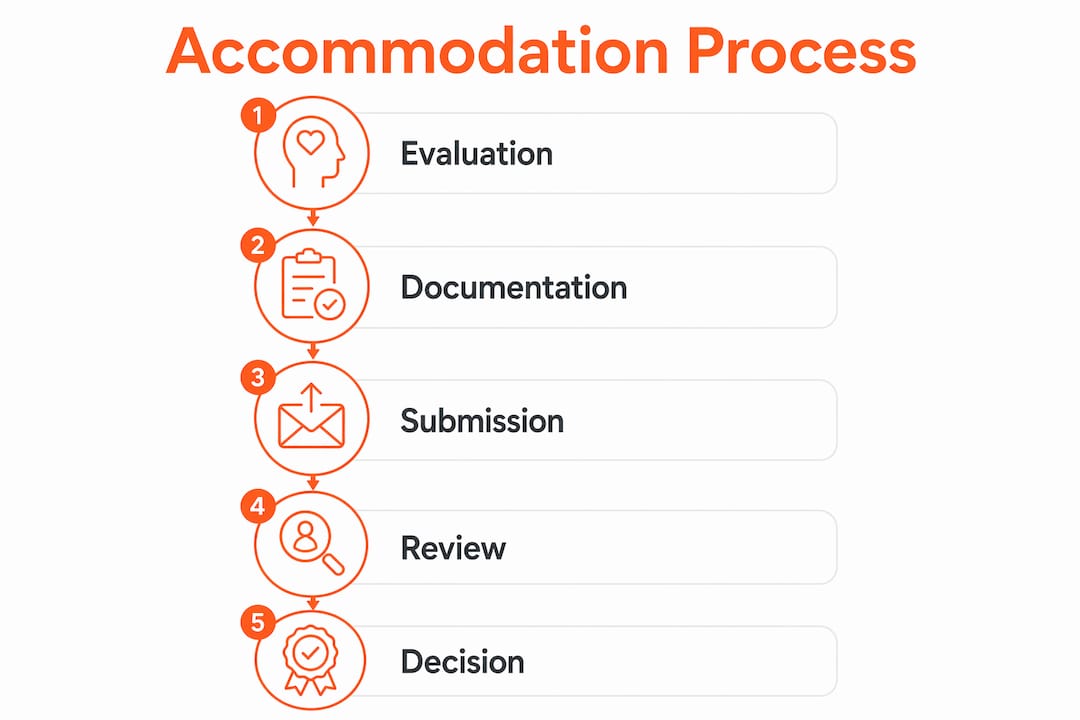
The process typically unfolds as follows:
- Step 1: Obtain a current psychoeducational evaluation from a qualified professional who understands testing accommodation documentation standards.
- Step 2: Complete the testing entity’s accommodation request form with full detail, including the specific accommodations requested and the functional basis for each.
- Step 3: Submit documentation through the testing entity’s designated portal or coordinator, meeting all format and deadline requirements.
- Step 4: Respond promptly to any requests for additional information. Requests for additional documentation are standard parts of the process, not outright rejections. Treat them as part of an interactive review, not a denial.
- Step 5: Confirm approval and verify accommodations are correctly reflected in the test registration before the exam date.
Testing entities must respond timely to accommodation requests so students can register and complete testing within the same cycle. Excessive documentation requests that delay the process beyond the intended testing cycle may constitute a denial of equal treatment under ADA standards. If your family encounters unreasonable delays or repeated requests that appear designed to obstruct rather than clarify, that is a situation where professional advocacy becomes necessary.
Testing entities are legally required to allow candidates a reasonable opportunity to submit follow-up documentation within the same testing cycle. You have rights in this process, and those rights have teeth.
What accommodations do students with mental health conditions typically receive?
Accommodations for mental health conditions address specific functional barriers, not general test difficulty. The table below shows common accommodations and the functional limitations they address.
| Accommodation | Functional limitation addressed |
|---|---|
| Extended time (50% or 100%) | Slowed processing speed, concentration disruption, anxiety-related pacing difficulties |
| Frequent breaks | Fatigue, hypervigilance, panic symptoms requiring brief recovery periods |
| Separate testing room | Distraction sensitivity, hyperarousal, difficulty filtering environmental stimuli |
| Reduced-distraction environment | Intrusive thoughts, OCD-related checking behaviors, anxiety triggered by ambient noise |
| Flexible scheduling | Medication timing needs, morning symptom severity, episodic symptom management |
Each accommodation must be directly tied to a documented limitation. Extended time, for example, is not granted simply because a student has anxiety. The documentation must show that anxiety measurably slows the student’s processing speed or causes them to reread questions repeatedly due to concentration loss. The goal is an evidence-based link between the impairment and the accommodation, not clinical proof of disability in isolation.
Families can review testing accommodations examples that have supported students with mental health conditions across major standardized exams to better understand what is realistic and what documentation supports each type.
Key Takeaways
Mental health conditions qualify for testing accommodations when professional documentation proves a substantial functional limitation in major life activities relevant to test performance, not through diagnosis alone.
| Point | Details |
|---|---|
| Functional limitation drives eligibility | Diagnosis alone does not qualify a student; documented impact on test-taking ability does. |
| Documentation quality determines outcomes | Individualized evaluations from qualified professionals outperform generic letters every time. |
| Episodic conditions still qualify | Conditions that fluctuate qualify when documentation captures impairment during active episodes. |
| Additional requests are not denials | Requests for more documentation are part of the interactive process; respond promptly and specifically. |
| Timing is critical | Submit requests early and confirm accommodations are registered before the exam date. |
What I’ve learned from years of mental health accommodation cases
The families I work with most often arrive after a denial, and the pattern is almost always the same. The documentation was either too vague, too old, or written by a provider who had no familiarity with what testing entities actually require. A treating therapist who has known a student for three years is not automatically the right person to write the evaluation. Familiarity with the student is valuable, but expertise in psychoeducational assessment and testing accommodation standards is what gets requests approved.
The second thing I see consistently is families treating a request for additional documentation as a rejection. It is not. The ADA framework is explicitly interactive. Testing entities are expected to engage with families, ask clarifying questions, and work toward a resolution. When you receive a request for more information, that is an opportunity, not a door closing.
My strongest advice: start the documentation process earlier than you think you need to. Evaluations take time to schedule, complete, and write. Testing entities need time to review. If you are targeting a specific exam date, work backward from that date by at least three to four months. Families who treat accommodation requests as a last-minute task almost always face preventable delays.
The accommodation eligibility criteria for standardized tests are clear once you understand the functional limitation standard. The challenge is translating that standard into documentation that a reviewer can act on. That translation is where most families need help.
— Roger
How Testaccommodations supports families seeking mental health testing accommodations
Testaccommodations works specifically with students and families who are navigating the accommodation request process for major standardized exams, including the SAT, ACT, MCAT, and LSAT. If your child’s request has been denied or delayed, or if you are preparing a first-time request and want to get it right, the resources at Testaccommodations are built for exactly that situation.
The mental health accommodations guide at Testaccommodations covers eligibility criteria, documentation standards, and procedural rights in detail. For families who need direct support, Testaccommodations provides personalized guidance on building a strong case and responding to testing entity requests. Visit Testaccommodations to connect with advisors who understand both the legal framework and the practical realities of securing accommodations for students with mental health conditions.
FAQ
What mental health conditions qualify for testing accommodations?
Conditions including Major Depressive Disorder, PTSD, OCD, and anxiety disorders commonly qualify when documentation demonstrates a substantial limitation in major life activities relevant to testing. There is no fixed list; eligibility depends on individualized functional assessment.
Does a diagnosis alone guarantee testing accommodations?
No. A diagnosis is the starting point, not the finish line. Documentation must show how the condition specifically impairs the student’s ability to perform during testing and why the requested accommodation addresses that barrier.
How far in advance should families request accommodations?
Most testing entities require requests several weeks before the exam, but families should begin the evaluation process three to four months in advance to allow time for assessment, documentation preparation, and review.
What should families do if a testing entity requests more documentation?
Respond promptly and specifically within the same testing cycle. Additional documentation requests are a standard part of the interactive review process and are not equivalent to a denial.
Can a student qualify if their mental health condition is episodic?
Yes. Episodic conditions qualify when documentation describes the frequency, duration, and functional impact of symptomatic periods. The condition does not need to be constant to create a substantial limitation.