
Winning Lawsuits for Test Accommodations: Appeal Playbook
Act now. The single most important thing you can do after a standardized-test accommodation denial is preserve your appeal window and submit targeted supplemental evidence that directly addresses the board’s stated reason for denial. Families who succeed at overturning denials do not simply resubmit the same paperwork. They read the denial letter carefully, identify the precise documentation gap the board flagged, and respond with individualized, test-specific functional evidence backed by a qualified professional.

Under ADA/DOJ guidance, testing entities are expected to give serious weight to documentation from qualified professionals and to honor prior accommodations on comparable high-stakes exams. That legal framework is your foundation. The practical challenge is meeting each board’s narrow deadlines before that window closes.
Your first 48 hours matter most. Here is what to do immediately:
- Save the denial letter. Screenshot or print the full decision, including any case ID or reference number.
- Note the exact denial date. Every board’s appeal clock starts from this date, and missing it by even one day can force a full restart.
- Identify the denial category. Does the letter say “more information needed” or “documentation does not support the request”? These require different responses.
- Flag your test registration. Contact the board to ask whether your slot can be preserved while an appeal is pending.
- Set calendar reminders for the board’s intent-to-appeal deadline and full-document submission deadline.
Pro Tip: Dr. Erica Hurley notes that the denial letter tells you exactly what to fix. Read it twice before doing anything else.
Table of Contents
- What should you do in the first 24–72 hours after a denial?
- Board-specific deadlines: what LSAC, ACT, and College Board each require
- What documentation actually convinces reviewers?
- How do you structure and submit a successful appeal packet?
- When does hiring a paid consultant make sense?
- Common mistakes that cause denials or failed appeals
- What outcomes and timelines should you expect after filing?
- Reproducible appeal packet checklist and templates
- Key Takeaways
- What we see working with families
- How Testaccommodations can help you win your appeal
- Authoritative sources and next reads
What should you do in the first 24–72 hours after a denial?
The first three days are your highest-leverage window. Start by recording the denial date and your case ID in writing, then triage the letter’s language.
If the letter says “more information needed,” the board is open to additional documentation. Focus immediately on the specific objective measures it lists as absent. If the letter says “documentation does not support the request,” you may need to pursue a formal appeal that cites policy misapplication rather than simply adding new records.
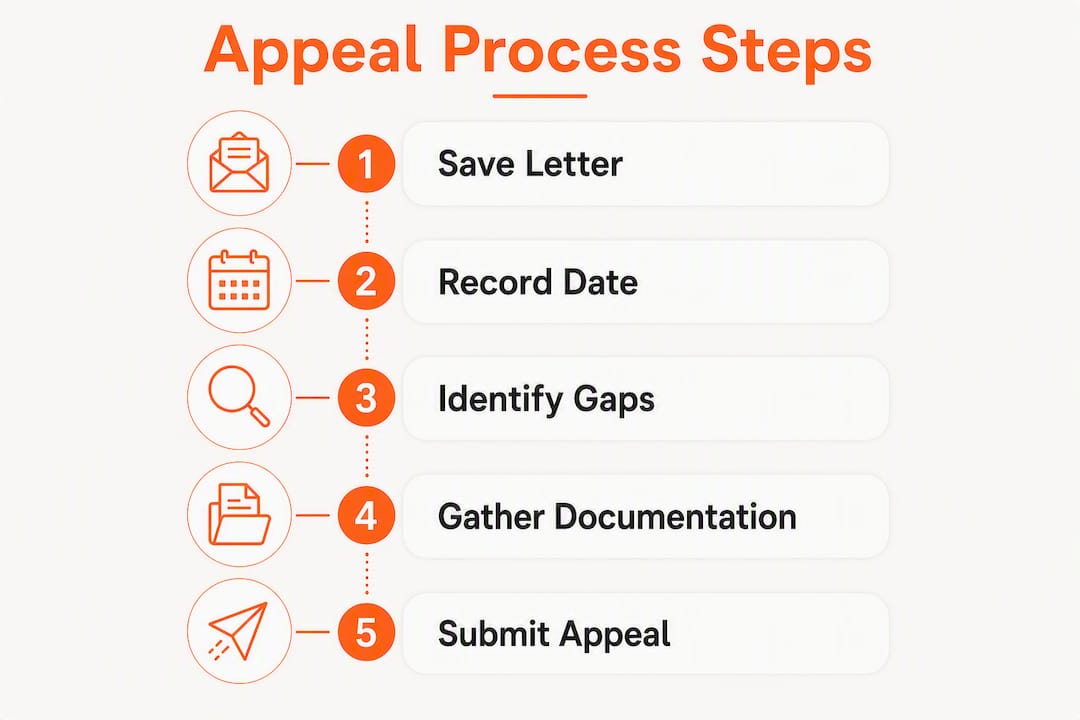
Preserve your test slot. Call or email the board’s accommodations office to ask about holding your registration during the review period. Then set two hard deadlines on your calendar: the intent-to-appeal notice and the full-document submission date. These are not the same date, and confusing them is a costly error.
Board-specific deadlines: what LSAC, ACT, and College Board each require
Each board runs on its own clock. Assuming the same rules across tests is one of the most common mistakes families make.
| Board | Intent/Notice Deadline | Full Documentation Deadline | Typical Decision Time |
|---|---|---|---|
| LSAC (LSAT) | 2 business days after denial | 5 calendar days after denial | ~1 week after submission |
| ACT | By published accommodation deadline for your test date | Same deadline | Tied to test-date cycle |
| College Board (SAT/AP) | Varies by decision type | Varies | Up to seven weeks for reopened requests |
A few critical details by board:
- LSAC: The 2-business-day intent window and 5-calendar-day full-doc rule are strict. Missing either forces a complete restart of the accommodations process for a future test date. See the LSAT eligibility checklist for what to prepare.
- ACT: ACT generally limits applicants to a single review, which means your reconsideration submission must be complete and accurate the first time. There is no second chance if you miss the accommodation deadline for your chosen test date.
- College Board: — Reopened requests can take up to seven weeks, so plan your test date accordingly. Decisions fall into two categories: “more information needed” (correctable with targeted evidence) and “documentation does not support” (requires a stronger evidentiary argument or formal appeal).
What documentation actually convinces reviewers?
Boards are not looking for a diagnosis. They are looking for proof that your disability creates a functional impairment specifically in timed, high-stakes testing conditions. An IEP or a general practitioner’s note rarely satisfies that standard on its own.
College Board and ACT both require reports that connect objective test data to the specific limitation the accommodation addresses. The ADA reinforces this: individualized assessments from qualified professionals that explicitly link testing data to functional impairment carry the most weight.
| Report Element | What Reviewers Need to See |
|---|---|
| Current diagnosis | Confirmed by a licensed, credentialed evaluator |
| Standardized test scores | Normed cognitive, academic, or processing measures with percentile ranks |
| Functional impact statement | Explicit link between the measured deficit and timed test performance |
| Accommodation rationale | Why the specific accommodation requested addresses the documented limitation |
| Evaluator credentials | License type, state, and relevant specialty |
| Prior accommodation history | Documentation of identical accommodations on comparable exams |
Pro Tip: Under ADA guidance, proof of prior identical accommodations on similar high-stakes exams is one of the strongest evidentiary strategies available. Include prior approval letters, IEP/504 entries, and any school-based accommodation records that document the same support.
How do you structure and submit a successful appeal packet?
A disorganized submission slows review and signals to the board that the case is not well-prepared. Follow this sequence:
- File your intent to appeal — (or reconsideration notice) within the board’s stated window. For LSAC, that is 2 business days.
- Submit through the correct portal — College Board uses SSD Online. LSAC has its own accommodations portal. ACT uses the TAA system. Confirm the upload path before submitting.
College Board warns that submitting a different accommodation request without new evidence is unlikely to succeed. Every item you add must map directly to a gap the board identified.
When does hiring a paid consultant make sense?
Not every denial requires professional help. But several situations make paid consulting the faster, lower-risk path.
Consider hiring a specialist if: the appeal deadline is within days and you have not yet gathered updated documentation; the denial cites a specific documentation gap you are unsure how to fill; you have no prior accommodation approvals to cite; the evaluation is outdated or does not include timed measures; or the denial appears to reflect a misreading of your documentation rather than a genuine evidentiary gap.
What a specialist typically does: triage the denial letter, identify the precise documentation gap, recommend targeted testing (neuropsychological or psychoeducational), draft the cover letter, assemble the evidence map, liaise with your school’s SSD coordinator, and manage portal submission. The Testing Accommodations Appeal guide outlines the step-by-step process Testaccommodations advisors use to build winning cases.
Pro Tip: Before your first consult, gather the denial letter, all prior evaluations, your IEP or 504 plan if you have one, and any prior accommodation approval letters. Having these ready cuts the triage time significantly.
Common mistakes that cause denials or failed appeals
Avoiding these errors is as important as knowing what to do right.
- Missing the deadline — LSAC’s 2-business-day intent window and 5-calendar-day full-doc rule are absolute. One missed day can mean starting over for the next test cycle.
What outcomes and timelines should you expect after filing?
| Board | Typical Decision Window | Possible Outcomes |
|---|---|---|
| LSAC | ~1 week after full submission | Approved, denied, more information needed |
| ACT | Tied to test-date accommodation deadline | Approved, denied (single review) |
| College Board | Up to 7 weeks for reopened requests | Approved, partial, more info needed, does not support |
Decision categories matter. “More information needed” means the board is open to approval with additional evidence. “Documentation does not support” is a harder denial that may require a formal appeal citing policy sections rather than just adding records.
After submitting, check the portal every 3–5 business days. If the decision window passes without a response, contact the accommodations office directly by phone, not just email. If an appeal will exceed your test-date cycle, ask the board about moving your registration to the next available date before that window closes.
Reproducible appeal packet checklist and templates
Full Packet Checklist
- Intent-to-appeal notice (filed within board’s stated window)
- Cover letter (under 300 words, maps each new item to the denial reason)
- Updated individualized evaluation from a qualified professional
- Standardized test data with timed measures and percentile scores
- Functional impact statement linking deficit to timed test performance
- Prior accommodation approval letters or IEP/504 entries
- Evaluator credentials page
- Collateral letters (teacher, clinician) if relevant
Short Cover Letter Template
Dear [Board] Accommodations Office,
I am writing to reopen my denied request (Case ID: [XXXXX], denial date: [DATE]) for [accommodation type] on the [test name].
The denial stated: [quote the board’s exact reason].
I am submitting the following additional documentation to address that gap directly:
- [Document 1] — [one sentence explaining how it addresses the denial reason]
- [Document 2] — [one sentence explaining relevance]
- [Document 3] — [one sentence explaining relevance]
Please confirm receipt of this packet. I am available at [phone/email] for any follow-up.
Sincerely, [Name]
Evidence Map Template
Dr. Hurley recommends building a side-by-side table to identify exactly what to add before resubmitting:
| Board’s stated reason | What I am adding | File name |
|---|---|---|
| No objective timed processing data | Neuropsychological eval with timed subtests | CaseID_20260315_PsychEval.pdf |
| No functional impact statement | Evaluator addendum linking scores to test conditions | CaseID_20260315_Addendum.pdf |
| No prior accommodation proof | Prior SAT approval letter | CaseID_20260315_PriorApproval.pdf |
Key Takeaways
Overturning a standardized-test accommodation denial requires acting within each board’s strict deadline, submitting targeted functional evidence tied to the board’s stated gap, and following a structured appeal packet with a clear cover letter.
| Point | Details |
|---|---|
| Act within 48 hours | Save the denial letter, note the case ID, and set hard calendar reminders for board-specific deadlines. |
| Match evidence to the denial reason | Boards require functional impairment data in timed conditions, not just a diagnosis or IEP. |
| Know your board’s clock | LSAC allows 2 business days for intent and 5 calendar days for full docs; College Board reopens can take up to 7 weeks. |
| Use an evidence map | A side-by-side table of board reasons vs. new documents prevents gaps and organizes your cover letter. |
| Testaccommodations can help | Testaccommodations provides case triage, documentation gap analysis, cover letter drafting, and portal submission management for families facing denials. |
What we see working with families
The families who successfully overturn denials share one pattern: they treat the denial letter as a checklist, not a verdict.
One recent case involved a high school student whose College Board request for extended time was denied with the reason “documentation does not support.” The existing evaluation was three years old and contained no timed processing measures. Within two weeks, we coordinated an updated neuropsychological evaluation that included timed subtests, a functional impact statement explicitly linking processing speed scores to SAT performance, and a cover letter that quoted the denial reason and mapped each new document to it. The request was approved on reopen.
The two evidence levers that consistently move denials to approvals are recent objective testing with timed measures and documented proof of prior identical accommodations. Boards respond to specificity. A report that says “processing speed is in the 12th percentile and timed tasks take 2.3 times longer than untimed equivalents” is far more persuasive than a narrative description of difficulty.
New evaluations do cost money, and families sometimes hesitate. The practical reality is that a targeted evaluation ordered quickly, focused on the board’s stated gap, is almost always less expensive than missing a test cycle and restarting the entire process.
How Testaccommodations can help you win your appeal
Testaccommodations works directly with families whose accommodation requests have been denied on the ACT, SAT, LSAT, MCAT, GRE, GMAT, and other standardized tests. The service covers every stage of the appeal: triage of the denial letter, documentation gap analysis, drafting the cover letter, coordinating with your school’s SSD coordinator, and managing portal submission so nothing falls through the cracks.
Before your first consult, gather these documents: the denial letter with case ID, all prior evaluations (psychoeducational or neuropsychological), your IEP or 504 plan if available, and any prior accommodation approval letters. Having these ready allows the team to assess your case and identify the fastest path to approval in the first session.
Fees vary by case complexity; contact Testaccommodations for a quote. Most families complete the initial triage consult within a few days of reaching out. To get started, visit Testaccommodations and submit your case details.
Authoritative sources and next reads
- Testing Accommodations | ADA.gov — DOJ guidance on qualified-professional documentation standards and the weight boards must give to prior accommodation history.
- Appeal Procedures for Accommodation Requests | LSAC — Official LSAC appeal timeline: 2-business-day intent rule, 5-calendar-day full-doc submission, and ~1-week decision window.
- Submitting Requests for Reconsideration | ACT — ACT’s single-review policy and published-deadline requirements for reconsideration.
- How Long Does It Take to Reopen a Denied Request | College Board — Official timeline guidance: up to seven weeks for reopened requests.
- Testing Accommodations Appeal: Win Your Denial Case | Testaccommodations — Step-by-step appeal process used by Testaccommodations advisors.
- LSAT Eligibility Accommodation Checklist | Testaccommodations — Preparatory checklist for LSAT applicants building an accommodations case.
- ACT vs. College Board Accommodation Policy Differences | Testaccommodations — Side-by-side comparison of major board requirements and appeal processes.