
Why Testing Agencies Deny Accommodations: A Parent's Guide
Testing agencies deny accommodations when requests fail to provide clear, objective proof that a student’s disability functionally limits their ability to perform under standardized testing conditions. This is the core reason behind most rejections on the ACT, SAT, MCAT, and LSAT. The denial is rarely about whether a diagnosis exists. It is almost always about whether the submitted documentation connects that diagnosis to measurable, test-specific impairment. Understanding this distinction is the first step toward building a request that actually succeeds.
Why testing agencies deny accommodations: the documentation gap
The most common reason accommodation requests are refused is incomplete or insufficient documentation. Testing agencies, including the College Board (which administers the SAT) and ACT, Inc., do not simply accept a diagnosis as proof of need. They require evidence that the diagnosed condition creates a functional limitation specifically under timed, standardized testing conditions.
What qualifies as adequate documentation typically includes:
- A current psychoeducational or neuropsychological evaluation completed by a licensed professional (psychologist, neuropsychologist, or psychiatrist) that includes standardized cognitive and achievement testing
- Objective test scores showing performance deficits in areas directly relevant to the exam, such as processing speed, reading fluency, or working memory
- A clear diagnostic narrative that explains how the identified deficits impair the student’s ability to complete timed tests under standard conditions
- A history of prior accommodations in academic settings, including IEP or 504 plan records, though these alone are not sufficient
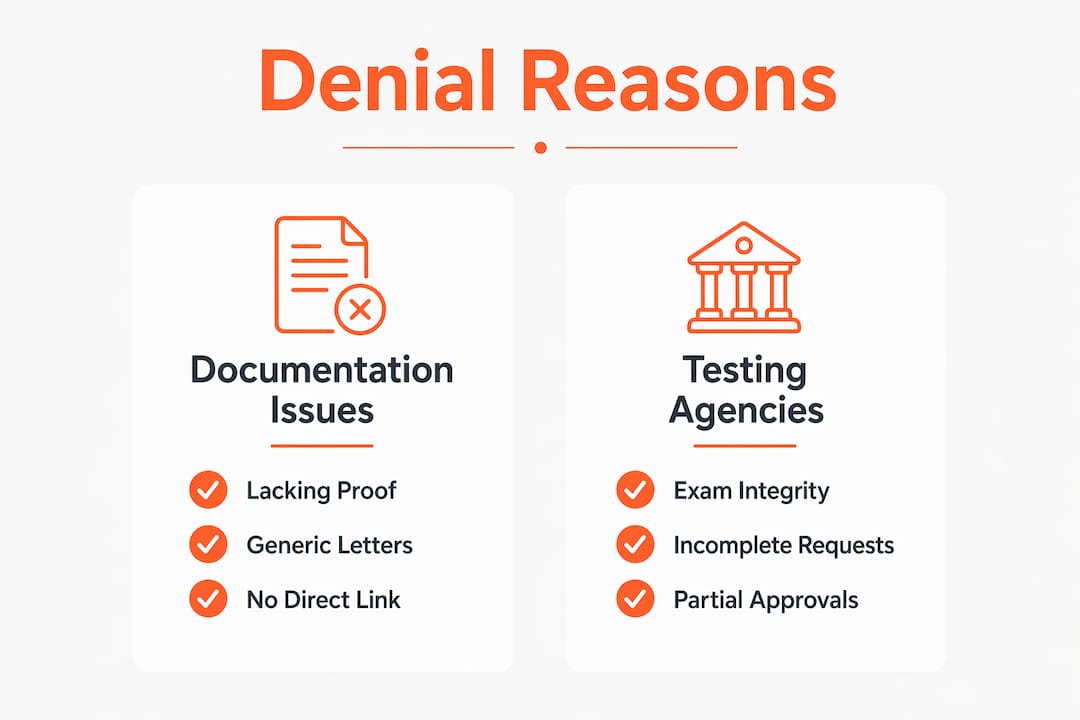
A generic medical letter without a direct link between the diagnosis and testing limitations is routinely rejected. Agencies require detailed clinical narratives that explain the specific barriers a student faces during timed examinations. A letter from a pediatrician stating “this student has ADHD and needs extended time” carries almost no weight in the review process.
Pro Tip: Request that the evaluating clinician include a specific section in their report addressing how the student’s cognitive profile affects performance under timed, high-stakes testing conditions. Generic diagnostic summaries are the single most common documentation failure.

Documentation must be narrowly tailored and limited to demonstrating the need for the specific accommodation requested. Submitting a thick file of irrelevant records does not strengthen a case. Targeted, precise documentation does.
How do testing agencies evaluate requests, and what are common reasons for denial?
Testing agencies apply a structured review process that goes well beyond checking whether a diagnosis is present. Reviewers examine whether the documented functional limitations meet the threshold required to justify the specific accommodation requested. Extended time, for example, receives more scrutiny than environmental supports like a separate testing room or preferential seating.
The five most common reasons for accommodation request rejection are:
- Absence of objective standardized test data under timed conditions. Diagnosis alone does not suffice; agencies require scores from processing speed, reading fluency, or similar subtests that demonstrate measurable deficits.
- Missing developmental history. Absent early-life documentation is viewed skeptically. Agencies expect evidence that limitations existed before the student began preparing for high-stakes exams.
- Cognitive strengths offsetting documented weaknesses. Reviewers examine the full cognitive profile and may determine that strong scores in some domains offset weaker scores in others, particularly on MCAT and LSAT reviews.
- Failure to demonstrate functional test impact. A student who earns strong grades and high practice scores may face skepticism about whether a functional limitation actually affects test performance.
- Accommodation alters exam construct validity. Agencies challenge requests that would change what the exam measures, citing security or integrity concerns.
“The burden is on the testing agency to demonstrate that granting an accommodation would fundamentally alter what the exam measures. Families should understand that a denial citing ‘fundamental alteration’ must be backed by specific evidence from the agency, not used as a blanket refusal.” — ADA Requirements: Testing Accommodations
Partial approvals are also common. Agencies may grant structural supports such as a separate testing room or extended breaks while denying extended time, because the documentation supports one need but not the other. This reflects how agencies evaluate each accommodation individually rather than approving or denying a package as a whole.
How can parents and advocates respond to and appeal denials?
A denial letter is not the end of the process. It is a roadmap. The most effective appeals address each specific deficiency the agency identified, supported by new clinical evidence rather than a restatement of prior arguments.
Here is how to build an effective response:
- Read the denial letter carefully and categorize each stated reason. Agencies are required to explain why a request was denied. Each reason represents a gap your appeal must fill.
- Commission targeted supplemental evaluations. If the denial cites missing processing speed data, obtain a neuropsychological evaluation that includes those specific subtests. Do not submit a new general evaluation that repeats the same gaps.
- Request a letter from the treating clinician that directly addresses the denial rationale. The letter should reference the agency’s specific objections and provide clinical evidence countering each one.
- Compile a developmental history file. School records from elementary and middle school, teacher reports, prior IEP or 504 documentation, and early intervention records all strengthen the historical picture.
- Submit within the agency’s appeal window. ACT and College Board both have defined timelines for appeals. Missing these deadlines forces families to restart the process with the next test cycle.
Successful appeals come from directly addressing the denial letter’s stated deficiencies with new evidence, not from simply disagreeing with the decision. Families who submit a letter saying “we believe the denial was wrong” without new documentation almost never succeed.
Pro Tip: Keep a dated paper trail of every submission, confirmation, and communication with the testing agency. If an appeal is escalated or a complaint is filed with the Department of Justice, documentation of the agency’s process becomes critical.
Delays in obtaining documentation close to exam dates significantly limit the ability to appeal or update records effectively. Start the evaluation and documentation process at least six months before the target test date. For the MCAT or LSAT, where evaluation timelines can stretch longer, twelve months is a more realistic planning horizon.
You can find detailed, step-by-step guidance on the SAT accommodation appeals process at Testaccommodations, including sample language for addressing common denial reasons.
What are the key misconceptions about testing accommodations?
Many families enter the process with assumptions that do not match how testing agencies actually operate. Clearing up these misconceptions early prevents avoidable denials.
The table below compares what families commonly assume against what testing agencies actually require:
| Common assumption | Agency reality |
|---|---|
| An IEP or 504 plan guarantees approval | Agencies apply independent standards; IEPs do not guarantee approval |
| A diagnosis is sufficient proof of need | Functional impairment under timed test conditions must be documented separately |
| Strong academic performance helps the case | High grades can actually work against approval by suggesting the disability does not limit performance |
| All accommodations are evaluated together | Agencies evaluate each accommodation individually; partial approvals are standard |
| School accommodations transfer automatically | Testing agencies set their own eligibility criteria independent of school decisions |
The distinction between school accommodations and testing agency standards is one of the most misunderstood aspects of the process. Schools operate under the Individuals with Disabilities Education Act (IDEA) and Section 504 of the Rehabilitation Act, which use a broader standard for accommodation eligibility. Testing agencies operate under the Americans with Disabilities Act (ADA) and apply a narrower functional limitation standard tied specifically to the exam being administered.
Academic success can actually complicate a request. A student who earns a 3.9 GPA while receiving extended time in school may face an agency argument that the accommodation is not necessary for the student to access the exam, since their performance record suggests they are not substantially limited. This is a frustrating but real dynamic that families need to anticipate. Understanding how standardized testing impacts students with disabilities differently than classroom settings is critical context for building a persuasive request.
Testing agencies also emphasize exam construct validity. An accommodation that would change what the exam measures, such as allowing a calculator on a section designed to test mental computation, will be denied regardless of the quality of the supporting documentation.
Key takeaways
Testing agencies deny accommodations primarily because documentation fails to connect a diagnosed disability to measurable functional impairment under timed standardized testing conditions, not because the disability itself is doubted.
| Point | Details |
|---|---|
| Documentation is the deciding factor | Agencies require objective test data linking diagnosis to timed-test impairment, not just a diagnosis. |
| IEPs and 504 plans are not enough | School accommodation records support a request but do not meet the independent standards agencies apply. |
| Partial approvals are common | Agencies evaluate each accommodation separately; extended time faces the highest documentation bar. |
| Appeals must address specific denial reasons | Restating prior arguments fails; new clinical evidence targeting each stated deficiency is required. |
| Start documentation early | Delays in obtaining evaluations close to exam dates severely limit appeal options. |
What I’ve learned from watching families fight these denials
Working with families navigating accommodation denials has shown me one pattern more than any other: the families who succeed are the ones who treat the agency’s denial letter as a checklist, not a verdict. The ones who struggle are the ones who respond emotionally rather than strategically.
The most common pitfall I see is submitting a new request that is essentially identical to the one that was denied. Families obtain a second opinion from a different clinician, but the new report has the same structural gaps as the first. The agency denies it again for the same reasons. This cycle is exhausting and expensive, and it is entirely avoidable if you read the denial letter carefully and build your response around its specific language.
I also want to be direct about something that rarely gets said: testing agencies are not infallible, and their denials are not always correct. The ADA places the burden of proving fundamental alteration on the agency, not on the family. If an agency denies an accommodation by claiming it would alter the exam’s core construct, that claim must be substantiated. Families who understand this have real leverage in the appeal process, particularly if they are working with an advocate who knows how to push back on unsupported rationale.
Realistic expectations matter too. Partial approvals are not failures. Getting a separate testing room approved while extended time is denied is meaningful progress. It also gives you a clearer, narrower target for your next submission. Focus on the gap, not the whole picture.
— Roger
How Testaccommodations can help you secure the accommodations your child needs
Facing a denial from the College Board, ACT, Inc., AAMC, or LSAC is stressful, but you do not have to navigate the process alone. Testaccommodations specializes in advising families who have received accommodation denials on standardized tests and need a clear, expert-guided path forward.
At Testaccommodations, you will find expert-reviewed guides covering the full appeals process, sample documentation language, submission checklists, and practical advice on timing your submissions to meet agency deadlines. Whether your child is preparing for the ACT, SAT, MCAT, or LSAT, the resources on the site are built specifically for families who need more than generic advice. If your child’s accommodation request was rejected, the next step is understanding exactly why and building a targeted response that addresses each gap directly.
FAQ
Why does having an IEP not guarantee testing accommodations?
Testing agencies apply independent eligibility standards under the ADA that focus on functional impairment under timed exam conditions. An IEP reflects school-based eligibility under IDEA, which uses a broader standard not tied to standardized test performance.
What is the most common reason extended time is denied?
Extended time is denied most often because the submitted documentation lacks objective, standardized test scores demonstrating processing speed or reading fluency deficits under timed conditions. A diagnosis without this data does not meet the agency’s functional impairment threshold.
Can a testing agency deny accommodations based on exam integrity concerns?
Yes. Agencies may deny requests if they determine the accommodation would alter what the exam measures, but the burden is on the agency to prove this. A blanket integrity denial without specific justification is legally questionable under ADA requirements.
What should an appeal include that the original request did not?
An effective appeal includes new clinical evidence that directly addresses each reason stated in the denial letter. Supplemental neuropsychological testing, a targeted clinician letter responding to the agency’s specific objections, and additional developmental history records are the most impactful additions.
Can testing agencies charge extra fees for accommodations?
No. Testing entities cannot charge test-takers for accommodations. The cost of providing approved accommodations is covered by the agency, not the candidate.