
Why Students Seek Accommodations Explained Clearly
Accommodations are not extra help. They are not shortcuts. And they are not something students should feel embarrassed to request. Understanding why students seek accommodations explained through legal, practical, and human terms is the first step toward recognizing them for what they actually are: a tool for removing disability-related barriers that prevent students from demonstrating their true abilities on standardized tests like the SAT, ACT, MCAT, and LSAT. This article breaks down the reasons, the process, and the broader context so you can approach the system with confidence.
Table of Contents
- Key takeaways
- Why students seek accommodations explained: the core rationale
- Common reasons students request accommodations
- How the accommodation process works
- Broader context: challenges, misconceptions, and what is changing
- Practical steps for students requesting accommodations
- My perspective: what this system gets right and what still needs work
- How Testaccommodations can help you
- FAQ
Key takeaways
| Point | Details |
|---|---|
| Accommodations level the playing field | They remove barriers caused by disabilities, not inflate scores or provide unfair advantages. |
| Legal protections exist for you | The ADA and Section 504 require testing entities to provide accommodations when documented need is shown. |
| Many disabilities qualify | ADHD, anxiety disorders, dyslexia, and physical disabilities are among the most common qualifying conditions. |
| Start the process early | Applying 1 to 3 weeks before testing or the start of a term gives you the best chance of timely approval. |
| You do not need a formal diagnosis to start | Disability offices encourage early contact even before a formal diagnosis is in hand. |
Why students seek accommodations explained: the core rationale
The most persistent myth about accommodations is that they give students an unfair edge. The truth is the opposite. A student with dyslexia who reads at half the pace of a neurotypical peer is not competing on equal terms when both are given the same amount of time. Removing that disparity is not an advantage. It is a correction.
The legal framework agrees. Under the Americans with Disabilities Act, the ADA mandates that testing entities provide accommodations to allow individuals with disabilities to demonstrate their true aptitude, and those entities must respond to requests in a timely manner to avoid discrimination. That standard exists precisely because standard testing conditions were designed around a neurotypical baseline.
Here is a practical way to think about it: accommodations for learning disabilities do not change what a test measures. They change whether a disability interferes with the measurement. A student with severe test anxiety who freezes in a large room full of distractions is not revealing poor academic ability. They are experiencing a neurological response that the test design inadvertently triggers.
Common accommodations that address these barriers include:
- Extended time (1.5x or 2x) for students whose processing speed or reading fluency is significantly below average
- Separate testing rooms to eliminate auditory or visual distractions for students with ADHD or anxiety disorders
- Screen reader software for students with visual impairments or severe dyslexia
- Scribes or speech-to-text tools for students with motor or communication impairments
- Frequent breaks for students managing chronic pain, attention disorders, or anxiety
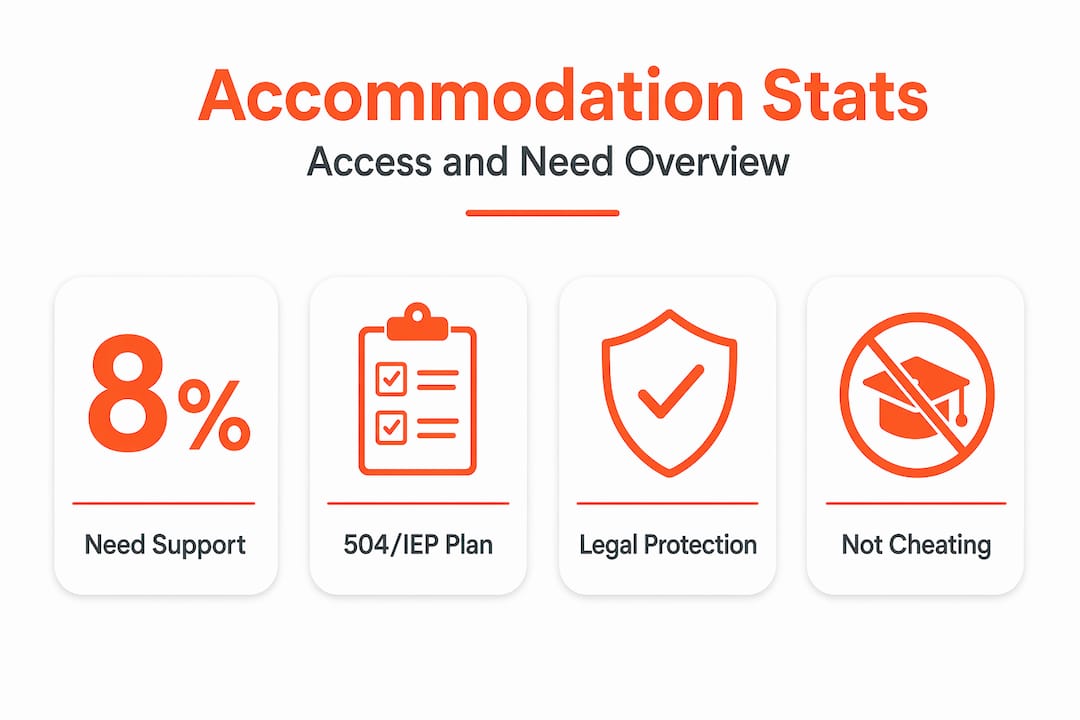
According to a February 2026 memo from Michigan State University, about 8% of students in a typical class require some form of testing accommodation. That is not a small or unusual group. Millions of students across the country have documented conditions that qualify them for support under federal law.
Pro Tip: If you have ever been told that accommodations are “cheating,” point to the ADA. The law exists specifically because standard testing conditions create discriminatory outcomes for students with disabilities.
Common reasons students request accommodations
Students seek accommodations for a wide range of documented conditions. Understanding the most common ones helps clarify why the importance of educational accommodations is not abstract. It is personal and specific.
ADHD (Attention-Deficit/Hyperactivity Disorder): Students with ADHD often struggle with sustained attention, impulse control, and working memory under timed conditions. Extended time and separate rooms are the most frequently requested accommodations for this group.
Anxiety disorders: Generalized anxiety disorder, panic disorder, and social anxiety can severely impair performance in high-stakes, group testing environments. A student may know the material completely but experience cognitive shutdown during the exam itself.
Dyslexia and other reading-based learning disabilities: These conditions affect how the brain processes written language, not intelligence. A student with dyslexia may need extended time, enlarged print, or text-to-speech tools to access the content at a pace that reflects their actual comprehension.
Physical and sensory disabilities: Students who are visually or hearing impaired, or who have conditions affecting motor function, may need assistive technology, alternative formats, or modified response methods.
Mental health conditions: Depression, PTSD, and bipolar disorder can all create functional impairments in concentration, memory, and stress regulation that directly affect test performance.
The accommodations granted vary based on individual need. The table below illustrates how specific disabilities map to typical accommodations:
| Disability | Common accommodation |
|---|---|
| ADHD | Extended time, separate testing room, frequent breaks |
| Dyslexia | Text-to-speech, extended time, enlarged print |
| Anxiety disorder | Separate room, extended time, permission for breaks |
| Visual impairment | Screen reader, large print, Braille format |
| Motor impairment | Scribe, speech-to-text software, alternative response format |
Each accommodation request is evaluated individually. An IEP or 504 plan from high school is supporting documentation, but it does not automatically guarantee the same accommodations on a national standardized test. That is a distinction many students and families learn only after receiving a denial. For a deeper look at testing accommodations examples and how they support performance, Testaccommodations has a detailed resource worth reviewing.
How the accommodation process works
Understanding student support means understanding that the process has real steps, real requirements, and real timelines. It is not as simple as submitting a form. Here is how it typically unfolds:
- Self-identification: You disclose your disability to the testing body or disability services office. This is voluntary but necessary to trigger any formal process.
- Documentation submission: You provide evidence of your disability, usually through a psychoeducational evaluation, a diagnosis from a licensed professional, or records from your school (such as an IEP or 504 plan).
- Needs assessment: The disability office or testing body reviews your documentation and determines which accommodations are appropriate and supported.
- Approval and notification: You receive written confirmation of approved accommodations, which must then be coordinated with the specific test administration.
The documentation step is where many students run into trouble. Documentation requirements vary and can be burdensome. Testing bodies are legally required to keep documentation requests narrowly tailored, but in practice, students sometimes face requests for additional evaluations that can cost hundreds or even thousands of dollars.
Timing matters enormously. Students should apply 1 to 3 weeks before the start of classes or their test date to allow sufficient time for materials conversion and support arrangement. For high-stakes exams like the MCAT or LSAT, the timelines required by the testing bodies themselves can extend even longer.

Pro Tip: Start the process earlier than you think you need to. Converting materials to accessible formats, scheduling separate testing rooms, and coordinating with proctors all take calendar time that most students underestimate.
Bureaucratic delays are a real risk. If a testing body fails to respond in time, it may constitute a form of discrimination under the ADA. Knowing your rights here is not optional. It is protective. The Testaccommodations guide on building a strong request walks through how to structure your documentation to minimize delays.
Broader context: challenges, misconceptions, and what is changing
One of the most important shifts in the last decade is the destigmatization of mental health. Law professor Katherine Macfarlane notes that more students are empowered to seek accommodations legitimately as mental health awareness grows. The rise in accommodation rates is not evidence of abuse. It reflects the success of the anti-discrimination framework in reaching students who previously suffered in silence.
That said, access to accommodations is not equal across economic lines. January 2026 research found that wealthy families are twice as likely to obtain Section 504 accommodations as lower-income families, largely because navigating the system requires time, access to qualified professionals, and money for private evaluations. A student whose family cannot afford a psychoeducational evaluation is not less disabled. They are less resourced.
“The conversation about rising accommodation rates should focus on access, not suspicion. The system has gaps, and those gaps fall hardest on students who can least afford to fill them.”
This disparity has prompted policy conversations about Universal Design for Learning (UDL), an approach to assessment design that builds accessibility in from the start rather than retrofitting it for individual students. Research on inclusive assessment design suggests that extra time is not inclusion. Truly inclusive assessments reduce the number of students who need individual accommodations in the first place.
On the institutional side, platforms like AccessMSU are helping universities manage growing volumes of accommodation requests efficiently, which reduces processing delays for students. Technology is not solving the equity problem, but it is helping institutions keep pace with demand.
Practical steps for students requesting accommodations
If you are ready to begin the process, here is what student rights to accommodations actually look like in practice:
Contact your disability office or the testing body early. Do not wait until you are failing or until two weeks before your exam date. Early contact is encouraged even without a formal diagnosis in hand.
Gather your documentation. A diagnosis from a licensed psychologist, psychiatrist, or physician is the most common requirement. If you have an IEP or 504 plan from high school, bring that too. It may not be sufficient on its own, but it supports your case.
Request an intake meeting. These meetings are conversations, not clinical exams. They exist to understand your functional barriers, not to re-diagnose you. Disability offices describe them as interactive discussions rather than evaluations.
Follow up persistently. If you do not hear back within the stated timeline, contact the office again. Delays in accommodation approval have real consequences on your testing timeline.
Know when to escalate. If your request is denied and you believe it should have been approved, that is not the end of the road. Testaccommodations works specifically with students and families who have received denials of legitimate requests and helps them understand their options.
Pro Tip: Never rely on verbal assurances. Get every accommodation confirmation in writing before your test date. Testing bodies sometimes have administrative errors that only get caught when the student arrives and the accommodation is not in the system.
My perspective: what this system gets right and what still needs work
I have spent years watching students navigate accommodation systems that were designed with good intentions but built with real friction. What I have observed is this: the students who struggle most are rarely those trying to game the system. They are the ones who waited too long to ask for help, who could not afford a private evaluation, or who assumed their documented need was too minor to qualify.
The benefits of academic accommodations are not theoretical. I have seen students go from devastating test scores to results that actually reflect their knowledge, simply because a separate testing room removed the auditory distractions that derailed them. That is not an unfair advantage. That is a fair shot.
What concerns me is the unequal terrain. Socioeconomic barriers mean that some students who qualify never receive what the law entitles them to. And some students who do receive accommodations face denials on high-stakes national exams that do not recognize the documentation already accepted by their schools. That gap is one of the more serious failures in this system.
My view is that the answer is not skepticism toward students who request accommodations. It is better design, more equitable access to evaluations, and institutions that take their legal obligations seriously. UDL is a promising direction. But until assessments are redesigned from the ground up, accommodations remain the most practical tool for students with disabilities who deserve to show what they actually know.
— Roger
How Testaccommodations can help you
Requesting accommodations for a standardized test is not always straightforward, and a denial is not always final. Testaccommodations advises students and families who are entitled to accommodations for the SAT, ACT, MCAT, LSAT, and other high-stakes exams and are facing denials or bureaucratic obstacles.
Whether you are just beginning to understand your rights or you have already received a denial letter, Testaccommodations provides expert guidance to help you build a case that meets the documentation standards testing bodies require. The team understands what evaluators look for, where requests typically fall short, and how to strengthen a file before resubmission. Visit Testaccommodations to review your options and get support from advisors who work specifically in this space. You do not have to navigate this alone.
FAQ
What does “reasonable accommodation” mean for standardized tests?
A reasonable accommodation is any modification to a standard testing condition that removes a disability-related barrier without fundamentally altering what the test measures. Extended time, separate rooms, and assistive technology are common examples.
Can a school IEP or 504 plan guarantee accommodations on a national exam?
Not automatically. Testing bodies like the ACT and College Board have their own documentation and eligibility requirements. An IEP or 504 plan supports your request but does not guarantee approval on its own.
How early should a student apply for standardized test accommodations?
Students should apply as early as possible, ideally 1 to 3 weeks before the relevant deadline or test date, though high-stakes exams often require even more lead time for processing.
What happens if a testing body denies an accommodation request?
A denial is not always final. Students can appeal the decision, submit additional documentation, or seek guidance from advocates. Testaccommodations specifically advises students in this situation.
Do students need a formal diagnosis before requesting accommodations?
Not necessarily. Disability offices encourage early contact even before a formal diagnosis, using initial meetings to discuss functional challenges and guide next steps.