
Why Standardized Tests Disadvantage Disabled Students
Standardized tests are designed to measure academic ability objectively, but that assumption of fairness breaks down quickly when you look at how these tests interact with disability. For parents and educators, why standardized tests disadvantage disabled students is not always obvious at first. What often looks like a performance gap is actually a design problem. The test format, timing constraints, and underlying norms all reflect a narrow model of learning that leaves many disabled students behind before they even pick up a pencil. Understanding that distinction is the first step toward doing something about it.
Table of Contents
- Key takeaways
- Why standardized tests disadvantage disabled students by design
- Accommodations and why they often fall short
- How alternate tests limit students’ futures
- The grade vs. test score disconnect
- Practical advocacy for parents and educators
- My take on what standardized testing gets wrong
- How Testaccommodations can help your family
- FAQ
Key takeaways
| Point | Details |
|---|---|
| Tests built on neurotypical norms | Standardized tests measure conformity to neurotypical standards, not the full range of student abilities. |
| Accommodations have real limits | Even approved accommodations cannot fully offset biases baked into the test design itself. |
| The cost barrier is steep | Private evaluations required for accommodations can exceed $3,000, giving wealthier families a significant advantage. |
| Alternate tests restrict futures | Students placed on modified assessment tracks face fewer diploma options and narrowed career pathways. |
| Advocacy is both possible and necessary | Parents and educators who understand the system can secure better outcomes through documentation, IEP teamwork, and formal appeals. |
Why standardized tests disadvantage disabled students by design
The problem starts at the drawing board. Tests are designed by neurotypical people, measuring students against a neurotypical average and treating any deviation from that norm as a deficiency rather than a different way of thinking. A student with dyslexia who comprehends material brilliantly through listening will still face a reading-heavy test format that measures her disability more than her knowledge. A student with ADHD who needs movement to regulate attention will be penalized by a format requiring sustained stillness and silence for hours.
This is how standardized tests define disability in practice, even when no one uses that language explicitly. The test format becomes the standard, and anyone who processes information differently is measured against a model that was never built for them. That framing matters because it shifts the conversation from “this student is struggling” to “this test is measuring the wrong thing.”
Several design features work against disabled students specifically:
- Strict time limits favor students who process information quickly, systematically disadvantaging those with processing disorders, anxiety, or motor disabilities.
- Reading-heavy formats create barriers for students with dyslexia, visual impairments, or language processing differences, even on subjects like math or science.
- Lack of format flexibility means students who learn and demonstrate knowledge differently (orally, visually, or through movement) have no equivalent pathway.
- Single-sitting structure ignores fatigue, pain cycles, and mental health conditions that fluctuate throughout a day or testing window.
The impact of standardized tests on disabilities reaches beyond scores. Students who consistently underperform relative to their classroom ability internalize those results. When a child who earns B grades in class scores “below basic” on a state test, the message that sends is harmful, and often inaccurate.
Accommodations and why they often fall short
Accommodations exist precisely because the testing system acknowledges that a one-size format is not equitable. Accommodations like extended time, separate testing rooms, and assistive technology improve accessibility, but they cannot completely level the playing field. That is an important distinction: accommodations remove barriers without changing what the test measures or how it is fundamentally structured.
The process of obtaining those accommodations is its own obstacle. Here is a realistic picture of what families face:
- Obtain a qualifying diagnosis. This typically requires a psychoeducational evaluation, which can cost between $3,000 and $5,000 out of pocket when school evaluations are disputed or unavailable in a timely way.
- Document functional impairment. It is not enough to have a diagnosis. Families must demonstrate how the disability specifically affects test-taking performance, which requires detailed clinical reports.
- Submit to the testing organization. Each organization (College Board, ACT, NBME, LSAC) has its own process, timelines, and documentation standards. A denial from one requires a formal appeal.
- Coordinate with school staff. Parents must work with IEP teams or 504 coordinators to gather supporting records, and schools are not always proactive about providing that documentation.
- Wait, appeal if denied, and repeat. Many families face denials on the first attempt. The bureaucratic path to accommodations systematically favors families with time, money, and knowledge of the system.
Pro Tip: Start the accommodations documentation process at least six months before the first intended test date. Appeals and re-evaluations take time, and missing a testing cycle can delay college applications or professional licensing exams by months.
Even when accommodations are granted, they do not address the deeper problem. Without proper accommodations, tests measure the disability rather than academic knowledge. But even with accommodations, the test still centers a particular kind of performance. Extended time helps with processing speed; it does not change the fact that a student with dyscalculia is still being tested on numerical fluency in a way that her classroom performance may not reflect.

For practical guidance on specific accommodation types, Testaccommodations maintains a detailed resource on testing accommodations examples that support success across different disability categories.
How alternate tests limit students’ futures
When accommodations are not enough, or when a student’s disability is severe enough to require a fundamentally different assessment, schools often move students onto alternate or modified state tests. This sounds like a supportive solution. The reality is more complicated.
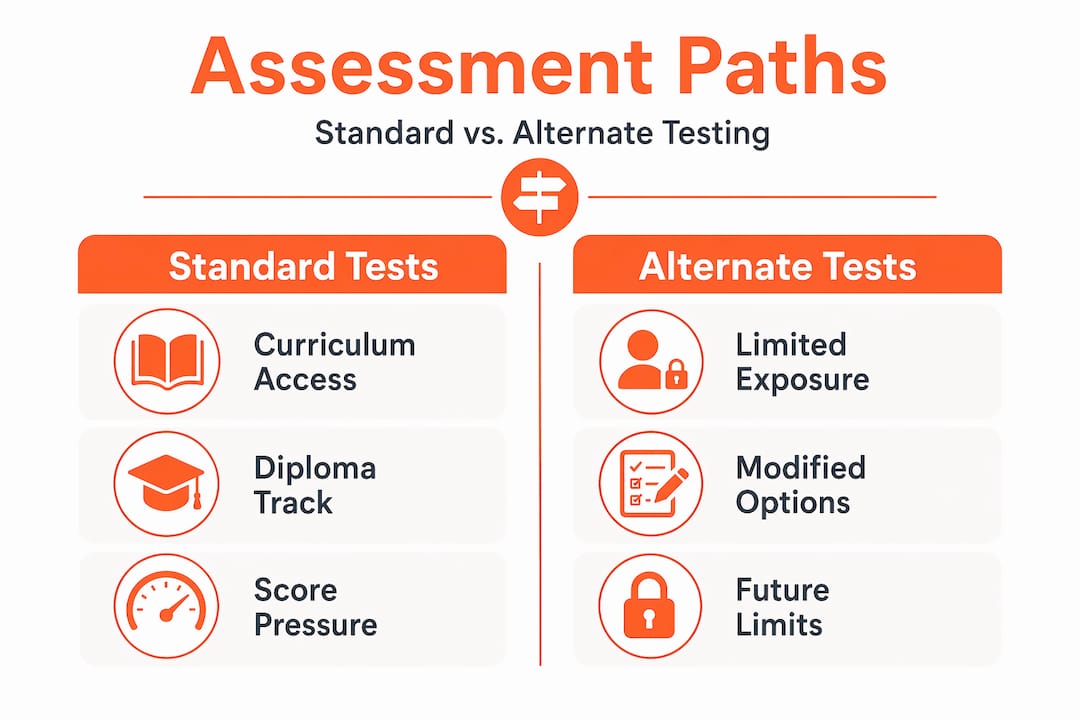
The table below compares what students on standard versus alternate assessment tracks typically experience:
| Factor | Standard assessment track | Alternate assessment track |
|---|---|---|
| Academic expectations | Grade-level curriculum | Modified or reduced curriculum |
| Diploma eligibility | Standard diploma pathway | Often limited to certificate of completion |
| College readiness signals | Standardized benchmarks used by colleges | Not recognized by most postsecondary institutions |
| Career pathway signals | Broad options | Significantly narrowed |
| Federal caps | No cap | Capped at 1% of all tested students |
Memphis-Shelby County Schools recently drew state attention when students with disabilities on modified tests increased from 1.9% to 2.4%, exceeding federal caps. That percentage point increase represents real students placed into a lower-expectation track with lasting consequences.
Students on alternate assessments face limited curricular exposure and restricted diploma options, which directly limits future academic and career opportunities. The increased use of alternate assessments can create a parallel education track that inadvertently reduces lifetime outcomes for the students it is meant to serve. For parents, the question to ask at every IEP meeting is not just “what test is my child taking?” but “what doors does that choice open or close?”
The grade vs. test score disconnect
One of the most common and genuinely confusing experiences for parents is watching a child earn solid grades all year and then score far below grade level on a state test. The gap feels impossible. It is, in fact, explainable.
92% of parents believe their children perform at grade level based on report cards, while only 48% of students test as proficient on standardized state assessments. That is not a gap between reality and parental wishful thinking. It is a gap between two different measurement tools with two different purposes.
The effects of standardized tests on students with disabilities look particularly stark in this discrepancy because several factors pull scores down regardless of actual learning:
- Test anxiety is measurably higher in students with learning disabilities and can depress scores by multiple grade equivalents.
- Fatigue and sensory processing during long test sessions affect students with physical disabilities, PTSD, or chronic health conditions in ways that do not appear in daily classroom work.
- Executive function demands in standardized tests (managing time, switching between question types, self-monitoring pacing) are separate from content knowledge, yet heavily penalize students with ADHD or traumatic brain injuries.
- Language processing barriers affect students with auditory processing disorders or autism spectrum disorder differently in a structured test than in a familiar classroom environment.
Grades and standardized tests measure different constructs. Grades are longitudinal. They reflect growth, effort, consistency, and a relationship with a teacher who understands how a specific student learns. Standardized tests are single-point benchmarks built for population-level comparison. Neither is complete alone, and a multi-measure approach is critical for fair assessment of any student, especially disabled ones.
Practical advocacy for parents and educators
Understanding the problem is necessary. Doing something about it requires a strategy. Here is where to focus your energy:
- Request a full psychoeducational evaluation through the school district. Federal law under IDEA requires schools to evaluate students suspected of having a disability at no cost to the family. This is your starting point for both an IEP and accommodation requests.
- Document functional impairment specifically. Evaluations should connect the diagnosis to test-taking conditions directly. Phrases like “requires extended time due to processing speed deficits in the 12th percentile” carry more weight than a diagnosis alone.
- Understand the difference between modifications and accommodations. This distinction affects which tests your child can take and what credentials they earn. Testaccommodations has a clear breakdown of modifications versus accommodations that every parent and educator should read before any IEP meeting.
- Engage the IEP team proactively. Do not wait for the annual review. Request interim meetings when test cycles are approaching. Ask the team explicitly: “What accommodations apply to state testing, and are they aligned with what College Board or ACT will approve?”
- Appeal denials formally and promptly. Testing organizations deny a meaningful number of accommodation requests. A denial is not final. Testaccommodations works specifically with families navigating test accommodation denials and can guide the appeal process.
Pro Tip: Keep a dedicated folder (physical or digital) with every evaluation, IEP, 504 plan, teacher letter, and accommodation approval your child has ever received. When you apply for accommodations on the SAT, ACT, MCAT, or LSAT, having that history organized and accessible saves weeks.
For educators, the most powerful advocacy step is best practices in testing that your school or district may not be implementing consistently. Teachers who document accommodation use in daily instruction create a paper trail that strengthens future accommodation requests from testing organizations.
My take on what standardized testing gets wrong
I have worked with enough families navigating accommodation denials to say this plainly: the testing system does not need minor adjustments. It needs a fundamentally different definition of what fairness means.
The current framework assumes that fairness means giving everyone the same test. What it actually produces is a system that reveals deficits rather than strengths and tells us more about who fits the testing mold than who has genuinely mastered the subject matter. I have seen students with documented high intelligence score in the average range because their processing speed falls in the 10th percentile. I have seen families spend thousands of dollars fighting for accommodations that should have been automatic given the clinical evidence.
What strikes me most is the cost borne by families who are already managing more than most. Disability does not distribute evenly, and neither does access to the documentation, evaluations, and legal knowledge needed to fight the system. Families who cannot afford a private neuropsychological evaluation, or who do not know they can appeal a denial, simply accept a score that does not reflect their child’s potential.
I believe in advocating loudly for systemic reform, including performance-based assessments, portfolio evaluations, and genuine flexibility in how knowledge is demonstrated. Until those reforms arrive, the best thing I can offer is this: the system has gaps, but it also has rules. Learning those rules is how you protect your child right now. Resources on standardized testing reform are a good place to start understanding what a better system could look like.
— Roger
How Testaccommodations can help your family
If your child has been denied test accommodations for the SAT, ACT, MCAT, LSAT, or another standardized exam, you do not have to navigate that process alone. Testaccommodations specializes in exactly this situation: advising students and families who are entitled to accommodations and have been turned down.

The team at Testaccommodations helps families build stronger documentation, understand what testing organizations are actually looking for, and prepare compelling appeals. Whether you are dealing with a first-time denial or a repeat rejection, explore your accommodation options and find out what your next step should be. Educators looking for classroom-level guidance can also find resources on common accommodation problems and solutions that affect both daily instruction and formal test settings.
FAQ
Do standardized tests discriminate against disabled students?
Yes, in a structural sense. Tests are designed around neurotypical norms, which means format, timing, and task design all disadvantage students whose disabilities affect processing speed, reading, or sustained attention.
Why are test accommodations so hard to get?
The documentation requirements are detailed, and private evaluations can cost over $3,000, creating a system where access depends heavily on family resources and knowledge of the appeals process.
Can a student with a disability take a standard diploma-track test?
Yes, with appropriate accommodations, most students with disabilities can take standard assessments. The concern arises when students are placed on alternate assessment tracks, since alternate tests limit diploma and career options in ways families are not always informed about upfront.
Why does my child’s report card not match their standardized test scores?
Grades and standardized tests measure different things. 92% of parents report grade-level performance on report cards, while under half test as proficient. For disabled students, factors like test anxiety, fatigue, and executive function demands lower scores without reflecting actual subject knowledge.
What should I do if my child’s accommodation request is denied?
File a formal appeal as soon as possible with updated documentation that specifically links the diagnosis to test-taking functional impairment. Testaccommodations works directly with families facing denials and can help strengthen the case for approval.