
Why SAT and ACT Policies Differ for Accommodations
If you’ve been researching testing accommodations for your student, you’ve likely assumed the SAT and ACT operate by similar rules. They don’t. Understanding why SAT and ACT policies differ is one of the most consequential things a family can learn before starting the accommodations process. The procedural gaps between these two exams affect documentation requirements, submission timelines, and even which accommodations are available. Getting this wrong can mean missed deadlines, denied requests, or a student sitting for a high-stakes test without the support they’re legally entitled to receive.
Table of Contents
- Key Takeaways
- Why SAT and ACT policies differ: the foundational overview
- Procedural differences that change everything
- Deadlines and timing: what the calendar actually looks like
- How accommodation types and testing options differ
- Common misconceptions that create real problems
- My perspective on what actually makes the difference
- Get the support your student deserves
- FAQ
Key Takeaways
| Point | Details |
|---|---|
| SAT approval comes first | Students must receive an SSD code before registering for the SAT, reversing the typical registration order. |
| ACT registration precedes requests | For the ACT, students register first, then submit accommodation requests through the school’s TAA system. |
| Deadlines are not interchangeable | SAT requires submission at least 7 weeks before the test; ACT deadlines vary by test date and are often tighter. |
| ACT has two testing categories | National Testing and Special Testing serve different needs and affect where and how accommodations are administered. |
| Early action prevents denial | Starting the process months in advance allows time for documentation, school coordination, and appeals if needed. |
Why SAT and ACT policies differ: the foundational overview
Both the SAT and ACT are required to provide accommodations under the Americans with Disabilities Act (ADA), but each organization operates as an independent testing body with its own policies, systems, and approval workflows. That legal obligation is the same. The path to fulfilling it is not.
Both exams offer similar core accommodations, including extended time (at 50% or 100%), extra or extended breaks, screen readers, separate room testing, and approved medical devices. Students with ADHD, learning disabilities, anxiety disorders, visual or hearing impairments, and a range of physical conditions regularly qualify for these supports on both exams.
The legal basis is consistent. Accommodations exist to remove barriers so that a student’s score reflects their actual knowledge and ability, not the impact of their disability. As one framework puts it:
Accommodations are not advantages. They are ADA rights designed to level the playing field and allow ability to be measured accurately.
Where families run into trouble is in assuming that because the accommodations look similar, the processes to obtain them are also similar. They are not. The differences between SAT and ACT in terms of how requests are submitted, who manages them, and when they must be filed are significant enough to derail a well-intentioned family that starts too late or follows the wrong process.
Procedural differences that change everything
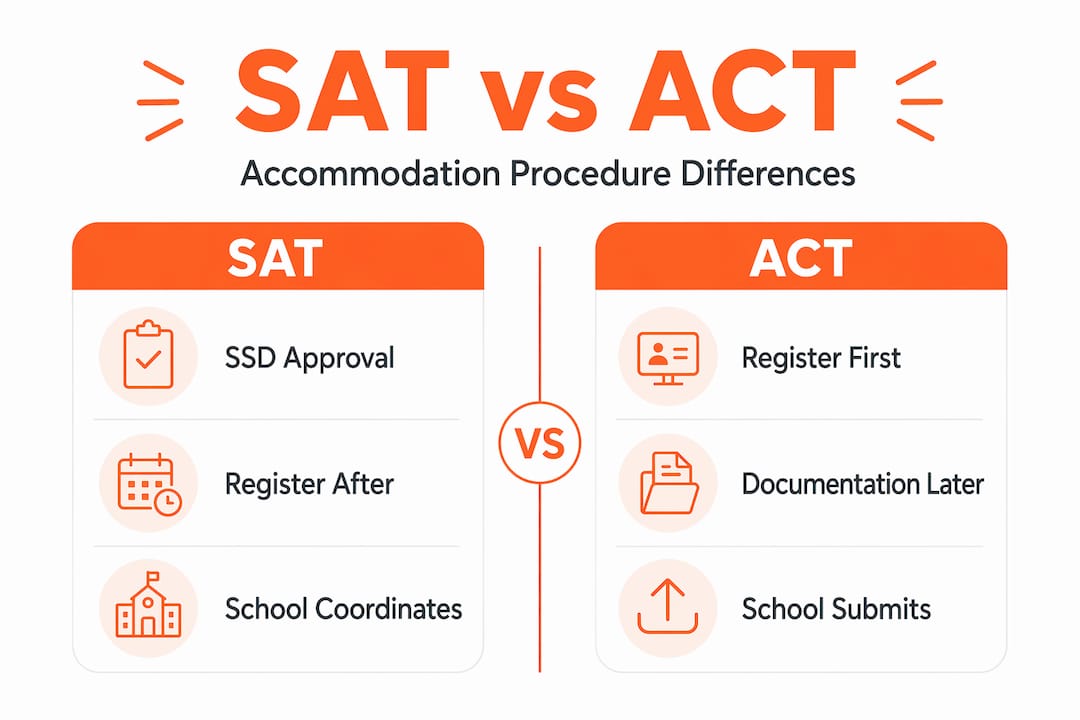
This is where the impact of differences between the SAT and ACT becomes most concrete. The order of operations is fundamentally reversed between the two exams, and that single fact has enormous consequences for planning.
approval must come before registration. A student works with their school’s SSD (Services for Students with Disabilities) coordinator to submit documentation through the College Board’s SSD Online system. Once approved, the student receives an SSD code. That code is then used to register for the test. If approval arrives less than 14 days before your test date, or after the published SSD deadline, the accommodations may not be available for that administration. The approval does carry over to future College Board tests, so the work is not wasted.
The ACT works in reverse. Registration comes first, and then the student’s school submits the accommodation request through the TAA (Test Accessibility and Accommodations) system via the school’s Test Accessibility Coordinator (TAC). The student cannot submit independently. The school must be involved.
Here is a step-by-step look at how the two workflows compare:
SAT accommodation workflow:
- Student gathers documentation (IEP, 504 plan, psychoeducational evaluation)
- School SSD coordinator submits request through SSD Online
- College Board reviews and approves the request
- Student receives SSD code
- Student registers for the SAT using that code
ACT accommodation workflow:
- Student registers for the ACT
- Student works with school’s TAC to compile documentation
- School submits accommodation request through the TAA system
- ACT reviews and approves the request
- Accommodations are applied to the registered test date
These differences in school involvement, documentation routing, and sequencing mean that a student preparing for both exams in the same testing season must manage two completely separate processes simultaneously. Missing a step in either workflow can result in sitting for a test without accommodations.
Pro Tip: Contact your school’s SSD coordinator and TAC at the start of the academic year, not weeks before a test date. Both processes require school staff involvement, and coordinators often manage large caseloads. Early contact gives everyone time to gather documentation and meet deadlines without rushing.
Deadlines and timing: what the calendar actually looks like
Timing is where many families fall short between intention and execution. Knowing that deadlines exist is not the same as knowing what they are and building a calendar around them.

For the SAT, requests must be submitted at least 7 weeks before the intended test date through SSD Online. This is a firm deadline, not a guideline. School-submitted requests can be approved in as few as 5 days, but requests requiring manual review take considerably longer. Building in buffer time is not optional; it is necessary.
For the ACT, deadlines vary by test date. Processing typically takes 5 to 10 business days after documentation is received, but the submission window often closes just 2 to 3 weeks after the registration deadline. That compressed window can catch families off guard, especially if documentation needs to be updated or the school coordinator is managing multiple students.
| Exam | Submission deadline | Processing time | Who submits |
|---|---|---|---|
| SAT | At least 7 weeks before test date | 5 days (standard) to several weeks (manual review) | School SSD coordinator via SSD Online |
| ACT | Varies by test date; typically 2–3 weeks post-registration | 5–10 business days after documentation received | School TAC via TAA system |
Pro Tip: Starting the process months in advance allows time for appeals, gathering documentation, and coordinating with the school. If a request is denied, families typically have the right to appeal, but that process takes additional weeks. A student who applies three months out has options. One who applies three weeks out often does not.
How accommodation types and testing options differ
Beyond procedural differences, the SAT and ACT also differ in how they categorize and administer specific accommodations. This is an area where comparing SAT and ACT rules reveals meaningful distinctions that affect which exam might be a better fit for a particular student.
The ACT draws a formal distinction between National Testing and Special Testing. National Testing accommodations include extended time and certain other supports that can be administered at standard national test centers. Special Testing is reserved for students with more complex needs, such as multi-day testing, oral administration, or braille formats. Special Testing is administered at the student’s school rather than at a national test center, which affects scheduling, supervision, and logistics.
The SAT administers accommodations through designated test centers using the student’s SSD code. Students approved for certain accommodations may be directed to specific testing sites rather than standard registration centers. Paper testing availability and assistive technology options also vary between the two exams, so a student who relies on a specific tool should verify compatibility before choosing a test date.
When comparing SAT and ACT rules on accommodation availability, consider the following:
- Extended time formats: Both exams offer 50% and 100% extended time, but the distribution of that time across sections differs.
- Multi-day testing: The ACT’s Special Testing category allows multi-day administration; the SAT has a separate process for extended time that may span additional time blocks.
- Assistive technology: Both exams permit approved screen readers and other tools, but approval and configuration requirements differ between the College Board and ACT.
- Paper vs. digital: The SAT has moved toward a digital format. Students who require paper testing should confirm availability through their SSD coordinator well in advance.
Choosing between the SAT and ACT based on accessibility is a legitimate and often overlooked factor. A student whose accommodations are complex or whose school has stronger experience with one system may find one exam more manageable from a logistics standpoint alone.
Common misconceptions that create real problems
One of the most persistent misconceptions families encounter is the belief that requesting accommodations signals weakness or that it will flag a student’s application as somehow less credible. This is false. Accommodations are ADA rights that exist to ensure scores reflect ability, not disability. Colleges do not receive information about whether a student tested with accommodations.
A second misconception is that approval on one exam automatically transfers to the other. It does not. A student approved for extended time on the SAT must go through a separate process to receive the same accommodation on the ACT. Documentation may overlap, but the approvals are independent.
Families also frequently underestimate the role of the school. Both processes require active participation from school staff. A coordinator who is unaware of a student’s needs or who is not contacted until the last minute cannot realistically complete the required steps in time.
The most common reason accommodation requests fail is not lack of eligibility. It is lack of preparation time and incomplete documentation.
You can find detailed guidance on common accommodation problems and how to address them, including documentation gaps, coordinator communication issues, and appeal strategies.
My perspective on what actually makes the difference
I’ve worked with enough families navigating this process to say with confidence: the procedural details are where outcomes are won or lost. Not the quality of the documentation, not the severity of the disability. The order of operations.
I’ve seen students with thorough psychoeducational evaluations and clear IEPs miss their test dates because no one realized the SAT required accommodation approval before registration. That’s not a documentation failure. It’s a planning failure, and it’s entirely preventable.
What surprises families most is how little coordination happens automatically between schools and testing organizations. You cannot assume your school’s SSD coordinator is tracking your student’s test schedule. You cannot assume the TAC knows the ACT deadline for a particular test date. You have to ask, follow up, and confirm.
My honest advice: treat the accommodation process like a separate college application. Give it its own timeline, its own checklist, and its own deadlines written on a calendar. The families who succeed are the ones who start in September for spring test dates. The ones who struggle start in February.
— Roger
Get the support your student deserves
Navigating two separate accommodation systems while managing test prep, school deadlines, and college planning is genuinely difficult. Testaccommodations specializes in helping families who have received denials or who are unsure whether their documentation meets the standards required by the College Board or ACT.
Whether you’re just starting the process or you’ve already received a denial, the team at Testaccommodations can review your situation and help you understand your options. You can also explore the SAT accommodation steps and the ACT requirements for 2026 to get a clearer picture of what each process demands. Your student’s right to accommodations is protected by law. Getting the process right is what Testaccommodations is here to help with.
FAQ
Why do SAT and ACT accommodation policies differ?
The SAT and ACT are operated by separate organizations, the College Board and ACT Inc., each with its own systems, timelines, and approval workflows. Because they function independently, their policies for requesting and approving accommodations follow different procedures even though both are governed by ADA requirements.
Does SAT accommodation approval transfer to the ACT?
No. Approval on one exam does not transfer to the other. Students must submit separate accommodation requests to the College Board and ACT, even if the documentation is the same.
What is the SAT accommodation submission deadline?
SAT accommodation requests must be submitted at least 7 weeks before the test date through the school’s SSD coordinator using the College Board’s SSD Online system.
What is the difference between ACT National Testing and Special Testing?
National Testing accommodations are administered at standard test centers, while Special Testing, which includes complex accommodations such as multi-day testing, is administered at the student’s school rather than at a national test center.
Can a student submit their own ACT accommodation request?
No. ACT accommodation requests must be submitted by the school’s Test Accessibility Coordinator (TAC) through the TAA system. Students cannot submit independently, which makes early communication with school staff critical.