
Why LSAT vs. Bar Exam Accommodation Differs: 2026 Guide
LSAT and Bar Exam accommodations differ fundamentally because each testing authority requires independent documentation and assesses unique functional impairments according to the exam’s specific demands. The Law School Admission Council (LSAC) governs LSAT accommodations, while individual state bar boards govern Bar Exam accommodations under their own interpretation of the Americans with Disabilities Act (ADA). These are separate legal entities with separate review processes. Understanding why lsat bar exam accommodation differs is the first step toward building a documentation strategy that works for both exams. Between 10% and 15% of bar applicants now request accommodations, a figure that reflects growing awareness and growing scrutiny.
Why LSAT and bar exam accommodation differs at the core
The single most important thing to understand is this: the LSAT and the Bar Exam are not the same type of test, and they are not administered by the same authority. That distinction drives every difference in how accommodations are reviewed, approved, and documented.

The LSAT measures aptitude for law school admissions. It is a timed, single-day test focused on logical reasoning, analytical thinking, and reading comprehension. The Bar Exam, by contrast, measures competency for professional licensing. The DC Bar Exam, for example, is a 2-day, 12-hour exam requiring sustained performance across multiple testing sessions. That difference in duration and stakes changes everything about what “functional impairment” means in context.
Here is why the functional demands matter so much:
- Stamina requirements: The Bar Exam demands sustained attention and processing speed over multiple days. A student who manages a 3-hour LSAT with minimal difficulty may experience significant impairment across a 12-hour licensing exam.
- Professional licensing stakes: Bar boards apply heightened scrutiny because the outcome determines who is licensed to practice law. That scrutiny extends directly to accommodation requests.
- Exam-specific impairment matching: Each authority evaluates whether your documented condition meaningfully limits your ability to perform under that exam’s specific conditions, not standardized testing in general.
- Independent ADA interpretation: State bar examiners apply the ADA independently and are not bound by LSAC’s prior decisions. An approval from LSAC carries no legal weight with a state bar board.
Pro Tip: When preparing your accommodation request, frame your functional impairment in terms of the specific exam you are applying for. A report that describes difficulty sustaining attention over 3 hours reads very differently to a bar board than one that describes difficulty over 12 hours.
What documentation standards do LSAC and state bar examiners require?
The documentation gap between LSAC and state bar boards is where most applicants run into serious problems. The two authorities do not share the same standards, and assuming they do is one of the most common and costly mistakes in this process.
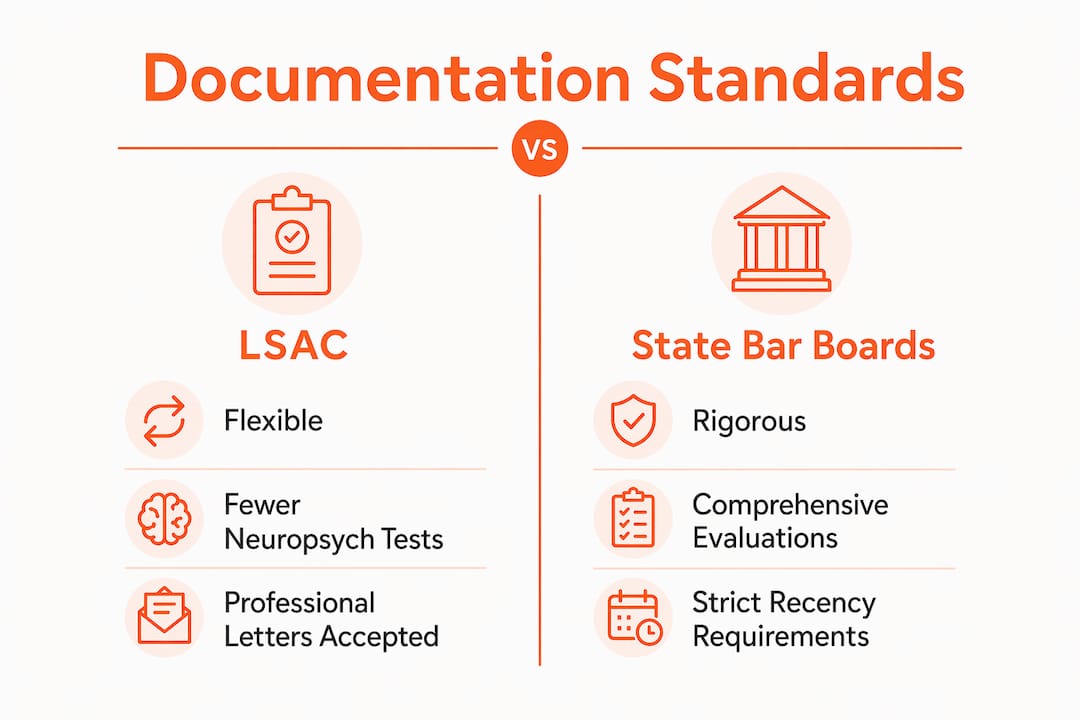
LSAC documentation: more flexible
LSAC does not typically require comprehensive neuropsychological batteries for all accommodation categories. For some conditions, a detailed letter from a qualified professional, such as a licensed psychologist or psychiatrist, may satisfy LSAC’s requirements. This flexibility makes the LSAT accommodation process more accessible for many applicants. That accessibility, however, can create a false sense of security about what the Bar Exam will require.
State bar board documentation: significantly more rigorous
Bar exam boards require comprehensive, objective neuropsychological evaluations. These reports must demonstrate functional impairment through standardized testing data, not just clinical observation or diagnosis. Bar examiners require evidence of functional impairment specifically affecting timed testing performance. A diagnosis of ADHD or dyslexia, standing alone, is not sufficient.
| Documentation Element | LSAC (LSAT) | State Bar Boards |
|---|---|---|
| Professional letter accepted | Often yes | Rarely, if ever |
| Full neuropsychological battery required | Not always | Typically required |
| Recency requirement | Varies by condition | 3–5 years depending on jurisdiction |
| Functional impairment data required | Recommended | Required |
| Standardized test scores required | Sometimes | Almost always |
Recency requirements vary by jurisdiction and condition. Virginia allows evaluations within 5 years. The DC Bar requires ADHD documentation within 3 years and psychological documentation within 1 year as of 2026. These windows are not suggestions. Submitting an evaluation outside the accepted recency window is one of the fastest paths to a denial.
Pro Tip: Request a copy of your state bar’s accommodation guidelines before scheduling any evaluation. The specific tests and recency windows required vary enough between jurisdictions that a generic neuropsychological report may not satisfy your state’s criteria.
Why accommodation approvals do not transfer automatically
Many students assume that an LSAT accommodation approval, or even a law school accommodation, will carry weight with their state bar board. This assumption is incorrect, and it leads to real denials. Accommodations approvals on the LSAT, MPRE, or in law school do not guarantee bar exam accommodations. Each exam requires a completely separate review.
Here is why prior approvals do not transfer:
- Separate governing authorities: LSAC, law school disability services offices, and state bar boards are three distinct entities. None is legally required to honor another’s decision.
- Different legal standards: Each authority interprets the ADA according to its own policies and the specific demands of its exam. A bar board’s ADA analysis focuses on professional licensing, which carries a different legal weight than academic testing.
- Condition-specific scrutiny: Bar boards are particularly cautious about evaluations prepared solely for the bar application. Historical documentation from law school, LSAC, and prior accommodations provides critical context that demonstrates a chronic, longstanding condition rather than a newly claimed one.
- Updated evidence requirements: Even if your condition has not changed, your documentation may have aged out of the bar board’s recency window. A 5-year-old evaluation that worked for the LSAT will not satisfy most bar boards in 2026.
- Functional impairment must be re-demonstrated: The bar board needs to see that your condition impairs your performance specifically under bar exam conditions. Prior approvals show history; they do not show current functional impact on a multi-day licensing exam.
Prior approvals are not worthless. They strengthen your application by establishing a documented history of accommodation need. They simply cannot replace current, exam-specific documentation.
What practical steps should students take for both exams?
Preparing accommodation documentation for both the LSAT and the Bar Exam requires a forward-looking strategy. Students who plan early avoid the most common and damaging mistakes. The types of approved disability accommodations for the LSAT provide a useful starting point for understanding what categories of support are available before you reach the bar.
Obtain a comprehensive neuropsychological evaluation early. A thorough evaluation that meets bar board standards can also satisfy LSAC requirements. Investing in a bar-quality evaluation before the LSAT means you will not need to repeat the process. Review the neuropsychological evaluation requirements before scheduling your assessment.
Maintain all prior accommodation records. Keep copies of every IEP, 504 plan, LSAC approval letter, and law school accommodation decision. These records establish the chronic nature of your condition and protect you against bar board skepticism about newly submitted evaluations.
Check your state bar’s specific requirements before applying. Recency windows, required test batteries, and acceptable evaluator credentials differ by jurisdiction. What satisfies the California Bar may not satisfy the New York Bar or the DC Bar. Check requirements at least 12 months before your planned exam date.
Focus your evaluation on functional impairment, not diagnosis. The evaluator’s report must connect your condition to specific, measurable limitations under timed testing conditions. Reports that describe symptoms without linking them to exam performance are routinely denied. Functional impairment, not diagnosis, is the deciding factor in accommodations approval.
Submit complete applications the first time. Outdated evaluations or reports lacking objective testing data are among the most common reasons for denial. Incomplete applications delay the process and may force you to retest under standard conditions while your appeal is pending.
Use the LSAT accommodation process as a rehearsal. The complete LSAT accommodation guide walks through the full application process. Treat your LSAT application as practice for the more rigorous bar process.
Key takeaways
LSAT and Bar Exam accommodations differ because separate authorities apply distinct ADA standards, require different documentation, and assess functional impairment against each exam’s unique demands.
| Point | Details |
|---|---|
| Separate governing authorities | LSAC and state bar boards each apply the ADA independently; prior approvals do not transfer. |
| Documentation standards vary | Bar boards require comprehensive neuropsychological evaluations; LSAC is often more flexible. |
| Functional impairment is the standard | Diagnosis alone is insufficient; reports must show measurable impact under timed exam conditions. |
| Recency windows are strict | Most bar boards require evaluations within 3–5 years; check your jurisdiction before scheduling. |
| Early planning prevents denials | A bar-quality evaluation obtained before the LSAT can serve both exams if kept current. |
The misunderstanding that costs students the most
After working with students navigating both the LSAT and Bar Exam accommodation processes, the single most damaging misunderstanding I see is this: students believe that getting approved for the LSAT means they are set. They treat the bar application as a formality. It is not.
The bar board is not reviewing whether you have a disability. It is reviewing whether your documented condition meaningfully limits your ability to perform under the specific conditions of a multi-day professional licensing exam. That is a different question entirely. I have seen students with strong LSAC approvals receive bar denials because their evaluations described symptoms without connecting them to stamina, processing speed, or sustained attention over 12 hours.
The other pattern I see consistently is late starts. Students contact us after receiving a denial, often with an evaluation that is 4 or 5 years old and was written for a different exam. Rebuilding documentation under time pressure, while also preparing for the bar, is genuinely difficult. Starting the evaluation process during your second year of law school, not the semester before the bar, gives you the time to get it right.
The LSAT eligibility checklist for 2026 is a practical starting point for understanding what documentation you need to build from the beginning. Use it early.
— Roger
How Testaccommodations can help you get approved
Testaccommodations specializes in advising students and families who are entitled to accommodations and facing denials or complex documentation requirements across the LSAT, MPRE, and Bar Exam.
If you are preparing accommodation requests for legal exams, Testaccommodations provides guidance tailored to your specific jurisdiction, condition, and exam timeline. The team reviews your existing documentation, identifies gaps before you submit, and helps you build a record that meets the standards of both LSAC and your state bar board. Early contact gives you the most options. Visit Testaccommodations to get started before a denial forces you to rebuild under pressure.
FAQ
Do LSAT accommodations automatically apply to the bar exam?
No. LSAT accommodations granted by LSAC do not transfer to the Bar Exam. Each exam requires a separate application, independent documentation, and review by its own governing authority.
What type of evaluation does the bar exam require?
Most state bar boards require a comprehensive neuropsychological evaluation with standardized testing data, typically no older than 3–5 years depending on the jurisdiction and the condition being documented.
Why is a diagnosis not enough for bar exam accommodations?
Bar examiners require evidence of functional impairment, meaning your report must show how your condition measurably limits your performance under timed, multi-day testing conditions. A diagnosis without that functional data is routinely denied.
Can one evaluation cover both the LSAT and bar exam?
Yes, if the evaluation meets bar board standards and remains within the required recency window. A comprehensive evaluation built to bar board criteria can satisfy LSAC requirements and serve multiple legal exams when kept current.
How early should students start the accommodation documentation process?
Students should begin building documentation no later than their second year of law school. Starting early allows time to obtain a thorough evaluation, maintain records across exams, and address any gaps before bar exam deadlines.