
Why GRE Accommodation Differs from SAT: 2026 Guide
GRE accommodation differs from SAT accommodation primarily because ETS requires a standalone, comprehensive neuropsychological or psychoeducational evaluation, while the SAT routinely accepts existing school-based documentation like IEPs and 504 plans. This distinction shapes everything: the type of clinician you need, the cost of the evaluation, and how far in advance you must start the process. For students and parents who successfully navigated SAT accommodations through a school’s SSD coordinator, the GRE process can feel like starting from scratch. Understanding why GRE accommodation differs from SAT is the first step toward building a documentation strategy that actually works.
Why GRE accommodation differs from SAT: the core distinction
The fundamental reason accommodation policies for the GRE and SAT diverge is the testing context. The SAT is a K–12 college admissions test administered within school systems. The GRE is a graduate-level admissions test administered by ETS, a private testing organization operating under its own documentation standards. These different contexts produce very different requirements.

The SAT, administered by the College Board, allows students to submit IEP or 504 plans as primary documentation. School psychologists, special education teams, and SSD coordinators manage the process. The student’s existing educational record does most of the heavy lifting.
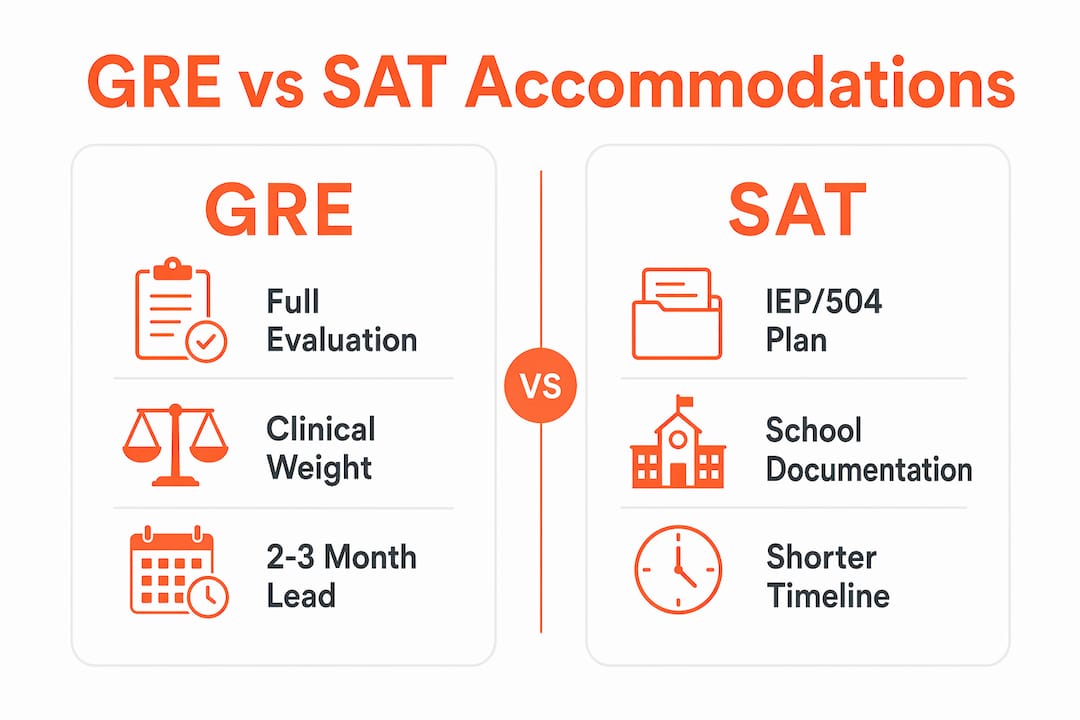
The GRE requires what experts call “clinical weight.” ETS expects comprehensive cognitive evaluations that include IQ testing, processing speed assessments, academic achievement scores, and a functional impact analysis. A school-based IEP rarely contains all of these components. That gap is precisely why students who had accommodations on the SAT are sometimes denied on the GRE.
What documentation is required for GRE vs SAT accommodations?
The documentation gap between these two tests is significant. For the SAT, a current IEP or 504 plan from a student’s school often satisfies the College Board’s requirements. Brief screenings or telehealth assessments may also be accepted when paired with school records. The bar is designed to align with K–12 educational standards.
For the GRE, ETS sets a higher bar. School-based records generally do not meet GRE documentation standards because the graduate-level context demands objective cognitive testing. A licensed psychologist must conduct a full neuropsychological or psychoeducational evaluation. That evaluation must include:
- IQ and cognitive ability testing (e.g., WAIS-IV or similar instruments)
- Processing speed and working memory scores
- Academic achievement measures (e.g., reading fluency, math calculation)
- Functional impairment analysis showing how the disability affects test performance
- Explicit clinical recommendations for the specific accommodation requested
ETS also requires that ADHD documentation include objective testing metrics beyond symptom rating scales alone. A clinician’s checklist or a teacher’s behavior form is not sufficient on its own. Both tests require documentation within a 3–5 year validity window, but the GRE’s quality threshold is far stricter than the SAT’s.
Pro Tip: Ask your evaluating psychologist to include a sentence that explicitly recommends extended time for standardized testing. Clinicians who omit this specific language create one of the most common and easily avoidable reasons for denial.
How do approval timelines differ between GRE and SAT accommodations?
The administrative pathways for these two tests operate on completely different timelines, and confusing them is a costly mistake.
For the SAT, the College Board works through school systems. Your school’s SSD coordinator submits documentation on your behalf, and approvals are often confirmed within a few weeks. Students can frequently schedule their test date before the accommodation is fully finalized.
For the GRE, the sequence is reversed. ETS requires accommodation approval before you register for a test date. You cannot book your seat and then sort out accommodations afterward. This single procedural difference catches many students off guard.
The GRE approval timeline breaks down as follows:
- Obtain your evaluation. A full neuropsychological evaluation typically takes 4–8 hours of testing plus a report writing period of 2–4 weeks.
- Submit your request to ETS. ETS typically takes 4–6 weeks for initial review after receiving your complete application.
- Respond to follow-up requests. If ETS requests additional evidence, add another 2–4 weeks to the timeline.
- Register for your test date. Only after approval is confirmed can you book your seat.
The total lead time from starting your evaluation to sitting for the GRE is realistically 2–3 months at minimum. Missing proper prior approval delays GRE scheduling by 4–10 weeks on average. For students with application deadlines, that delay can be disqualifying.
What ADA guidelines mean for GRE vs SAT accommodation policies
The Americans with Disabilities Act requires equal access to testing for individuals with disabilities. That legal mandate applies to both the College Board and ETS. What the ADA does not do is require identical procedures across every testing organization.
“Testing entities must provide reasonable modifications to their testing policies, practices, and procedures when necessary to ensure that the test measures the skills and aptitudes it is intended to measure, rather than the test-taker’s disability.” — ADA.gov, Testing Accommodations
This distinction matters. Graduate-level tests implement stricter documentation standards because higher test security and construct validity concerns apply. ETS must protect the GRE’s ability to predict graduate school performance. Allowing accommodations based on insufficient documentation would undermine that purpose.
The ADA framework also explains why the SAT aligns more closely with K–12 educational accommodation standards. The College Board operates within a school system context where IEPs and 504 plans are legally recognized documents. ETS operates outside that system and sets its own clinically grounded standards.
For students transitioning from SAT to GRE, this legal nuance has a practical implication. Your SAT accommodation approval does not automatically transfer. It can, however, support a transfer pathway request to ETS, which may reduce the documentation burden under specific conditions.
What practical steps should students take to navigate these differences?
Planning ahead is the single most effective thing you can do. The GRE’s longer approval timeline means that students who start the process late often miss their target test date entirely.
Here are the key steps to manage the process well:
- Start your evaluation 3–4 months before your target test date. This accounts for evaluation scheduling, report writing, ETS review, and potential follow-up requests.
- Use prior approvals strategically. A transfer pathway allows test-takers with prior SAT, ACT, or LSAT approvals to submit those approval letters to ETS. This can reduce the documentation required for a new GRE request.
- Know the transfer pathway’s limits. Requests exceeding 50% extended time always require a full new evaluation, regardless of prior approvals. If you received 50% extended time on the SAT and want the same on the GRE, a new comprehensive evaluation is mandatory.
- Obtain a graduate-level evaluation. Even if your SAT documentation was recently completed, confirm with a licensed psychologist that it meets ETS’s specific requirements before submitting it.
- Check documentation recency. Both tests require documentation within a 3–5 year window, but the GRE’s quality standards mean that an older evaluation may be technically current yet still insufficient.
Pro Tip: Dr. Erica Hurley notes that securing the most demanding approval first, such as the LSAT, can streamline subsequent GRE requests. If you plan to take both tests, consider applying for LSAT accommodations first and using that approval to support your GRE transfer request.
The comparison below summarizes the key differences between GRE and SAT accommodation requirements:
| Factor | SAT | GRE |
|---|---|---|
| Primary documentation | IEP, 504 plan, or school records | Full neuropsychological or psychoeducational evaluation |
| Administering body | College Board via school SSD coordinator | ETS directly |
| Approval timing | Often confirmed close to test date | Must be approved before test registration |
| Review timeline | Typically 1–3 weeks | 4–6 weeks, plus 2–4 weeks for follow-up |
| Transfer from prior approval | Not applicable | Possible, with limitations |
| ADHD documentation standard | Symptom scales often accepted | Objective cognitive metrics required |
Key takeaways
GRE accommodation differs from SAT accommodation because ETS requires comprehensive neuropsychological evaluations, a pre-registration approval process, and objective cognitive metrics that school-based IEPs and 504 plans rarely satisfy.
| Point | Details |
|---|---|
| Documentation standard | GRE requires full neuropsychological evaluations; SAT accepts IEPs and 504 plans. |
| Approval timing | GRE approval must come before test registration; SAT approvals often finalize close to test day. |
| Transfer pathway | Prior SAT or LSAT approvals can support GRE requests, but requests over 50% extended time require new documentation. |
| Lead time | Plan 2–3 months minimum for GRE accommodations from evaluation to test registration. |
| ADA framework | ADA mandates equal access but permits different procedural standards across testing organizations. |
Why these differences matter more than most families realize
The families I work with most often run into trouble not because their child’s disability is unclear, but because they assumed the GRE process would mirror what they experienced with the SAT. That assumption is understandable. If your student received 100% extended time on the SAT with a 504 plan, it feels reasonable to expect the same path for the GRE. The reality is more demanding, and the stakes are higher.
What I have seen repeatedly is that students who wait until three or four weeks before their target test date to start the GRE accommodation process end up either rushing through an inadequate evaluation or missing their deadline entirely. Neither outcome is acceptable when graduate school admissions are on the line.
The stricter GRE documentation standards are not arbitrary. They reflect the fact that the GRE is used to make high-stakes decisions about graduate school admissions, and ETS has a legitimate interest in ensuring that accommodations are clinically justified. I think parents should view these requirements not as obstacles, but as a clear roadmap. ETS tells you exactly what it needs. The challenge is giving yourself enough time to provide it.
One insight that does not get enough attention: if your student plans to take both the GRE and the LSAT, apply for LSAT accommodations first. The LSAT has among the most rigorous documentation standards of any standardized test. Getting that approval first gives you a strong foundation for the GRE transfer pathway request. That sequencing decision alone can save weeks of processing time.
— Roger
How Testaccommodations can help you get approved
Navigating the documentation and timing requirements for GRE and SAT accommodations is genuinely complex. Testaccommodations specializes in advising students and families who have received denials or are preparing their first request and want to get it right.

Testaccommodations provides expert guidance on which evaluation components ETS requires, how to assess whether your existing documentation meets the GRE’s clinical weight standard, and how to time your application to avoid scheduling delays. For students who have already been denied, the team at Testaccommodations reviews what went wrong and builds a stronger case for appeal or resubmission. You can also explore accommodation eligibility criteria to understand exactly where your current documentation stands before submitting to ETS.
FAQ
What makes GRE accommodations harder to get than SAT accommodations?
GRE accommodations require a comprehensive neuropsychological evaluation with objective cognitive testing, while the SAT accepts IEPs and 504 plans. ETS also requires approval before test registration, adding significant lead time.
Can I use my SAT accommodation approval for the GRE?
ETS offers a transfer pathway that allows prior SAT or LSAT approval letters to support a GRE request. Requests exceeding 50% extended time always require a full new evaluation regardless of prior approvals.
How far in advance should I apply for GRE accommodations?
Plan at least 2–3 months before your target test date. ETS takes 4–6 weeks for initial review, plus an additional 2–4 weeks if follow-up documentation is requested.
Does an IEP qualify as documentation for the GRE?
School-based IEPs generally do not meet GRE documentation standards. ETS requires objective cognitive testing metrics that most school-based records do not include.
What is the most common reason ETS denies accommodation requests?
Incomplete or outdated documentation is the most frequent cause of denial. Evaluations that lack explicit clinical recommendations for extended time on standardized testing are particularly vulnerable to rejection.
Recommended
- Graduate Admissions Tests With the Best Accommodation Policies - Test Accomodations
- Ultimate Guide to GRE Accommodations: Everything You Need to Know
- The GRE Test Explained for Students Needing Accommodations - Test Accomodations
- Accommodations for SAT and ACT: What Changes by Exam - Test Accomodations