
Why College Entrance Exams Allow Accommodations
College entrance exam accommodations are legally required modifications that allow students with disabilities to demonstrate their true aptitude rather than the effects of their disability. Federal law, specifically the Americans with Disabilities Act (ADA), mandates that testing organizations like College Board and ACT, Inc. provide these supports so that exam scores reflect what the test actually measures. Understanding why college entrance exams allow accommodations helps families move from confusion to confident action. This guide covers the legal foundation, eligibility criteria, common accommodation types, and practical steps for navigating the application process.
Why college entrance exams allow accommodations: the legal foundation
The legal requirement for testing accommodations is grounded in two specific federal provisions: 42 U.S.C. § 12189 and 28 C.F.R. § 36.309. These statutes classify any organization that offers high-stakes exams as a “testing entity,” which includes College Board (SAT) and ACT, Inc. Both organizations are legally obligated to provide accommodations to qualified individuals with disabilities.
The core principle is straightforward. Federal disability law mandates that exam scores reflect a student’s aptitude, not the impact of their impairment. A student with dyslexia taking the SAT without extended time is not being tested on reading ability under standard conditions. The score reflects the disability, not the student’s knowledge or reasoning.
The ADA’s implementing regulations also place limits on what testing entities can demand from applicants. Specifically:
- Testing entities cannot require documentation that is excessive or unrelated to confirming the disability and the need for accommodation.
- They must give considerable weight to documentation of accommodations already used in school settings.
- They cannot categorically deny accommodation types that are routinely granted in educational settings.
- They must provide accommodations that do not fundamentally alter what the exam measures.
These rules directly shape how College Board’s Services for Students with Disabilities (SSD) and ACT’s Accommodations office review requests. When a denial occurs, it is often because the submitted documentation did not meet these specific regulatory thresholds, not because the student is ineligible.
How do accommodations ensure fairness without giving an unfair advantage?
The most common misconception about college exam accommodations is that they give students with disabilities an edge over their peers. The legal and educational reality is the opposite. Accommodations level access, not outcomes. They remove disability-related barriers so the test can measure what it is designed to measure.

Measurement validity is the technical term for this principle. An exam is valid when its scores reflect the intended construct, such as math reasoning or reading comprehension, rather than a student’s ability to manage a disability under time pressure. Accommodations preserve that validity by removing the noise the disability introduces.
The table below illustrates how common accommodations affect test access without changing test content.
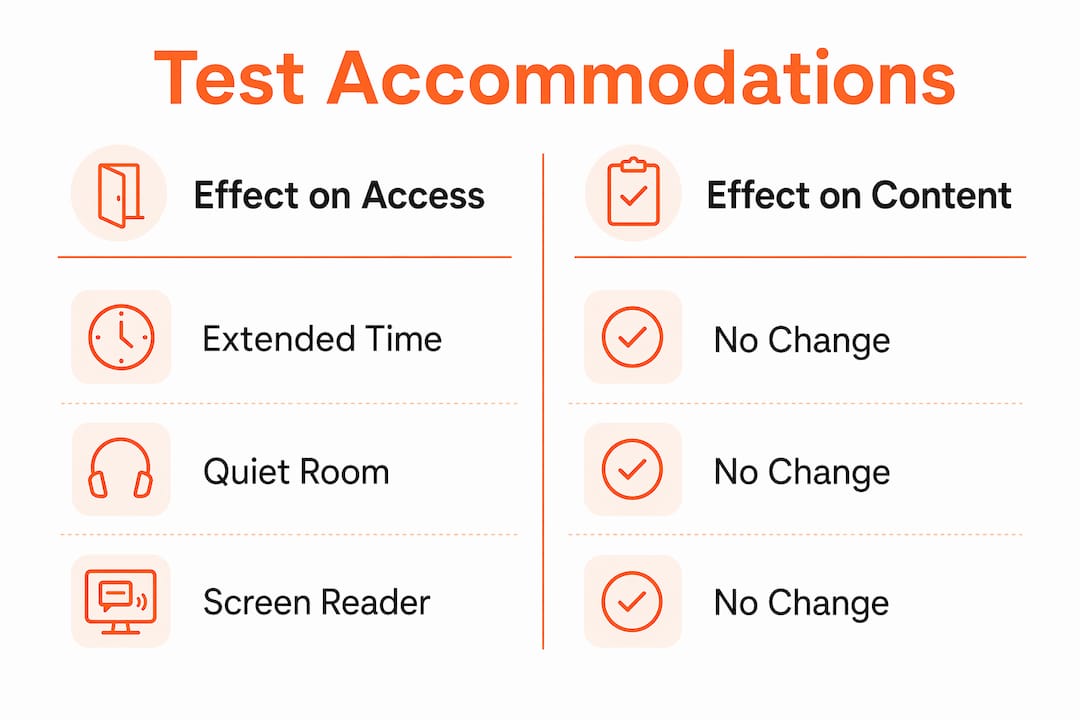
| Accommodation | Effect on Access | Effect on Test Content |
|---|---|---|
| Extended time (50% or 100%) | Reduces time pressure from processing disorders | No change to questions or scoring |
| Small group or separate room | Reduces sensory distraction | No change to questions or scoring |
| Screen reader or text-to-speech | Removes visual processing barrier | No change to questions or scoring |
| Scribe or speech-to-text | Removes fine motor or written expression barrier | No change to questions or scoring |
| Breaks (extended or additional) | Manages fatigue or attention-related impairment | No change to questions or scoring |
College Board enforces strict pre-approval policies to protect this balance. Unapproved accommodations on test day invalidate scores. No exceptions are made. This rule exists to maintain the integrity of every score in the pool, not to penalize students.
Pro Tip: If your student receives accommodations at school, request a formal letter from the SSD coordinator confirming the specific accommodations used and the duration of use. This documentation carries direct weight with College Board and ACT reviewers.
The role of accommodations in testing fairness is not about making the test easier. It is about making the test possible for students whose disabilities would otherwise prevent an accurate measurement of their abilities.
Who qualifies for exam accommodations and what documentation is needed?
A student qualifies for college testing accommodations when they have a documented disability that substantially limits a major life activity, including reading, writing, concentrating, or processing information. The disability does not need to be severe. It must be documented and functionally impairing in the testing context.
The most commonly accepted documentation includes:
- An Individualized Education Program (IEP): An IEP from a public school carries significant weight, particularly when it lists specific testing accommodations the student currently receives.
- A Section 504 Plan: A 504 plan documents disability-related accommodations in a general education setting and is widely accepted by College Board and ACT.
- A psychoeducational evaluation: A comprehensive evaluation from a licensed psychologist or educational diagnostician provides test scores, clinical observations, and a diagnosis. This is often required when school documentation alone is insufficient.
- Medical documentation: For physical, psychiatric, or neurological conditions, a letter from a treating physician or specialist describing the diagnosis and functional limitations supports the request.
Federal guidelines require that documentation requests be limited to what is necessary to confirm the disability and the specific accommodation needed. Testing entities cannot demand a full battery of evaluations if a 504 plan and a brief clinical note already establish the need.
Common misconceptions about documentation include the belief that a diagnosis alone is sufficient (it is not; functional impairment must be documented) and that outdated evaluations are automatically disqualifying (recency matters, but context matters more).
Pro Tip: Check the date on your student’s psychoeducational evaluation before submitting. College Board generally prefers evaluations completed within the last three to five years. If yours is older, a brief update from the original evaluator may be sufficient rather than a full re-evaluation.
Reviewing accommodation eligibility criteria before submitting helps families avoid the most common documentation gaps that lead to denials.
What accommodations are typically allowed on college entrance exams?
The range of approved accommodations for standardized tests is broader than most families realize. College Board and ACT both approve supports that fall into two categories: procedural accommodations and assistive technology accommodations.
Procedural accommodations change how the test is administered:
- Extended time (time and a half or double time)
- Additional or extended breaks
- Small group or individual testing room
- Testing across multiple days
- Use of a scribe or human reader
- Permission to use a word processor for the essay
Assistive technology accommodations involve tools that support access:
- Screen reader software (for digital SAT)
- Text-to-speech functionality
- Braille test materials
- Large-print test booklets
- Magnification devices
Test delivery mode affects accommodation availability. The digital SAT, now the standard format, handles screen readers and text-to-speech differently than the paper-based version did. Some accommodations that required separate materials in the paper format are now built into the digital testing platform. Others, like human readers, still require separate administration.
A critical point for families: not every accommodation a student receives at school translates directly to the exam context. Differences between SAT and ACT accommodations mean that approval on one exam does not guarantee approval on the other. Each organization has its own review process, and documentation must be submitted separately.
The following accommodations are commonly granted at school but may require additional justification for exam approval:
- Preferential seating (may not apply in a standardized testing room)
- Oral administration of all instructions
- Calculator use beyond standard test permissions
- Reduced-distraction environment (must be specifically documented as a disability-related need)
What practical steps help families navigate the application process?
Early planning is the single most important factor in a successful accommodations application. College Board recommends submitting requests at least seven weeks before the test date, but families navigating complex documentation should start the process three to six months in advance.
The following steps reflect college entrance exam accommodation best practices:
- Confirm current school accommodations. Verify that your student’s IEP or 504 plan is current and lists the specific accommodations they use for testing.
- Gather all relevant documentation. Collect psychoeducational evaluations, medical letters, and school records before starting the application.
- Work with the school’s SSD coordinator. For College Board exams, the school’s SSD coordinator submits the initial request. Build that relationship early.
- Submit through the correct portal. College Board uses the SSD Online system. ACT uses its own accommodations portal. Errors in submission routing cause delays.
- Track your application status. Both organizations provide status updates. Follow up if you do not receive a decision within the stated review window.
- Appeal a denial promptly. Denials are not final. Both College Board and ACT have formal appeals processes, and additional documentation can change an outcome.
Pro Tip: Request a copy of your student’s complete SSD file from College Board before submitting a new application or appeal. Knowing exactly what is on record prevents you from submitting conflicting information.
Families dealing with denials should review common problems with test accommodations to understand where the process most often breaks down and how to address it.
Key takeaways
College entrance exams allow accommodations because federal law requires scores to reflect student aptitude, not disability-related barriers, making proper documentation and early planning the foundation of every successful request.
| Point | Details |
|---|---|
| Legal mandate is clear | The ADA requires testing entities like College Board and ACT to provide accommodations for qualified students. |
| Access, not advantage | Accommodations remove disability barriers without changing test content, questions, or scoring standards. |
| Documentation drives approval | IEPs, 504 plans, and psychoeducational evaluations are the primary evidence reviewers use to grant requests. |
| Pre-approval is non-negotiable | Unapproved accommodations on test day invalidate scores; all supports must be confirmed before the exam. |
| Early action prevents denials | Starting the application process three to six months before the test date reduces documentation gaps and delays. |
The part of this process that families deserve to hear directly
After working with families navigating accommodation denials, the pattern I see most often is not a lack of eligibility. It is a lack of preparation. Students who genuinely qualify for extended time or assistive technology are denied because their documentation is outdated, incomplete, or submitted through the wrong channel. The disability is real. The barrier is procedural.
What frustrates me most is the assumption that a denial means the student does not qualify. College Board and ACT deny requests for documentation reasons far more often than for eligibility reasons. A denial letter is not a verdict on your child’s disability. It is feedback on the submission.
The other misunderstanding I encounter regularly is the belief that using accommodations on a college entrance exam signals weakness or will raise red flags with admissions offices. Colleges do not see whether a student used accommodations when they receive a score report. The score is the score. What the accommodation does is make that score an accurate reflection of what the student actually knows.
My advice to every family reading this: treat the accommodations application with the same seriousness you give the test itself. Document thoroughly, start early, and do not accept a denial as the final word.
— Roger
Get expert help with your accommodations request
Navigating the accommodations process alone is difficult, especially when a denial is already on the table. Testaccommodations provides specialized guidance for students and families who have been denied accommodations on the SAT, ACT, MCAT, LSAT, and other high-stakes exams.
The team at Testaccommodations reviews your documentation, identifies the gaps that caused the denial, and helps you build a stronger case for appeal or resubmission. Whether you are starting your first application or responding to a denial, expert support makes a measurable difference in outcomes. Visit Testaccommodations to learn how the process works and what your student is entitled to under federal law.
FAQ
Why are accommodations allowed on college entrance exams?
Federal law requires testing entities to provide accommodations so that exam scores reflect a student’s aptitude rather than the impact of their disability. The ADA classifies College Board and ACT as testing entities subject to these obligations.
Who qualifies for college exam accommodations?
Students with a documented disability that substantially limits a major life activity qualify, provided they submit acceptable documentation such as an IEP, 504 plan, or psychoeducational evaluation. Diagnosis alone is not sufficient; functional impairment in the testing context must be demonstrated.
Do accommodations give students an unfair advantage?
No. Accommodations provide access to the test environment without changing the content, questions, or scoring. They remove disability-related barriers so the exam measures what it is designed to measure.
What happens if a student uses unapproved accommodations on test day?
Scores are invalidated. College Board enforces strict pre-approval requirements, and no accommodation can be added or changed on test day without prior SSD approval.
Can a denied accommodations request be appealed?
Yes. Both College Board and ACT have formal appeals processes. Submitting additional or updated documentation is often sufficient to reverse a denial, particularly when the original submission had gaps in functional impairment evidence.