
What Psychiatric Disability Accommodations Cover for Testing
Many parents assume that once their child has a psychiatric diagnosis, accommodations for standardized tests will follow automatically. That assumption leads to real denials. Understanding what psychiatric disability accommodations cover, the formal term being reasonable accommodations for disabilities, requires knowing that testing bodies evaluate functional limitations, not diagnoses alone. This article walks you through the legal framework, the types of supports available, what documentation you actually need, and how to advocate effectively so your child’s test results reflect their true abilities.
Table of Contents
- Key takeaways
- What psychiatric disability accommodations cover under the law
- Types of accommodations for psychiatric disabilities in testing
- Why documentation is the deciding factor
- How psychiatric and physical disability accommodations compare
- Steps parents can take to secure accommodations
- My honest take on what parents get wrong
- How Testaccommodations can help your family
- FAQ
Key takeaways
| Point | Details |
|---|---|
| Diagnosis alone is not enough | Testing entities require documentation of functional limitations, not just a named condition. |
| Legal protections are strong | ADA Title II and Section 504 protect students’ rights to fair testing conditions in educational settings. |
| Accommodations are wide-ranging | Extended time, quiet rooms, scheduled breaks, and assistive technology are all on the table. |
| Prior accommodations matter | Documented supports from IEPs and 504 plans significantly strengthen accommodation requests for high-stakes tests. |
| Advocacy is often required | Many families face denials and must appeal with stronger documentation or professional guidance. |
What psychiatric disability accommodations cover under the law
The phrase “what psychiatric disability accommodations cover” is a practical question with a legal answer. Under the Americans with Disabilities Act, a psychiatric or mental health condition qualifies as a disability when it substantially limits one or more major life activities, which includes concentrating, communicating, sleeping, and yes, taking tests. The ADA does not require a specific diagnosis to trigger protection. It requires documented evidence that a condition creates real barriers.
ADA Title II governs public entities, including public schools, universities, and the agencies administering standardized assessments. Under this framework, testing bodies are not simply prohibited from discriminating. They are required to provide access so that qualified individuals with disabilities can participate fairly and equally in programs and assessments.
There is a critical distinction worth understanding: an accommodation adjusts how a test is administered. A modification changes what the test measures. The ADA requires accommodations, not modifications. This means a student with severe anxiety might receive a quiet testing room and extended time, but the test content and scoring standards remain the same. Psychiatric disability rights in this context are about leveling the conditions of access, not lowering the bar.
Here are the core legal obligations testing entities carry:
- Provide reasonable accommodations when functional need is documented
- Consider prior accommodations used in educational settings
- Evaluate each request individually based on the specific disability and its impact
- Offer alternatives to standard testing formats when warranted
Pro Tip: If a testing organization denies your accommodation request, request the denial in writing and ask specifically which documentation was deemed insufficient. That information is your roadmap for a stronger appeal.
Common conditions protected under this framework include depression, PTSD, bipolar disorder, anxiety disorders, ADHD, and OCD. The EEOC confirms that these conditions almost always qualify as disabilities under the ADA, which shifts the focus from proving disability status to identifying the right accommodations.
Types of accommodations for psychiatric disabilities in testing
Once a student’s functional limitations are established, the range of available supports is broader than most parents expect. Testing accommodations include adjustments to timing, environment, format, and even who is present during the exam.

Below is a comparison of accommodation categories and the functional limitations they address:
| Accommodation type | Functional limitation addressed | Common examples |
|---|---|---|
| Extended time | Difficulty concentrating, processing speed | 1.5x or 2x standard time allotment |
| Separate testing room | Anxiety, sensory sensitivity, distraction | Private room or small-group setting |
| Scheduled breaks | Fatigue, panic symptoms, medication timing | Breaks every 30 or 60 minutes |
| Assistive technology | Reading or writing difficulties, anxiety | Screen readers, text-to-speech tools |
| Scribe or recorder | Motor or cognitive impairment | Oral responses recorded by a trained proctor |
| Medication allowance | Need to take psychiatric medication during testing | Scheduled dosing permitted during exam |
| Service animal presence | Emotional regulation, anxiety management | Certified service animal permitted in room |
The guiding principle behind all of these is that accommodations reflect true aptitude by removing barriers the disability creates, without changing what the exam actually measures. A student with severe generalized anxiety does not gain an unfair advantage by testing in a quiet room. They simply get a realistic shot at showing what they know.
Real-world scenarios help make this concrete. A high school junior with PTSD who experiences hypervigilance in crowded spaces may qualify for a private testing room for the SAT. A college student with bipolar disorder who takes medication that requires a meal at a specific time may be allowed a structured break with food access during the MCAT. These are not edge cases. They are standard applications of well-established testing requirements.
- Extended time remains the most commonly granted accommodation across psychiatric disabilities
- Distraction-free environments are approved for conditions ranging from ADHD to panic disorder
- Breaks are particularly relevant when medication timing intersects with exam duration
Pro Tip: Check the specific testing agency’s accommodation catalog before submitting your request. The ACT, SAT, MCAT, and LSAT each have their own forms and documentation thresholds, and knowing what they list as available accommodations helps you request exactly what applies.
For a practical list of accommodation examples organized by disability type, Testaccommodations has compiled a resource specifically for families navigating high-stakes tests.
Why documentation is the deciding factor
A psychiatrist’s letter that says “this student has major depressive disorder” is almost never enough. Testing entities evaluate symptom-linked functional impairments, and documentation must explain how specific symptoms create barriers in a test-taking environment. This is where many families fall short, not because the student’s need is not real, but because the paper trail does not tell the right story.
Here is a practical sequence for building documentation that holds up:
Start with a qualified evaluator. A licensed psychologist, psychiatrist, or neuropsychologist should conduct or oversee the assessment. The evaluator must have direct knowledge of the student’s current functioning.
Connect symptoms to test-specific limitations. The documentation should explain that anxiety causes the student to re-read questions compulsively, which slows performance. Or that ADHD impairs sustained focus during timed tasks. Functional impact statements are the core of a credible submission.
Include prior accommodation history. If your child has an IEP or a Section 504 Plan that already grants extended time or a quiet testing room, include that documentation explicitly. Prior accommodations are among the strongest evidence that a need is real and ongoing.
Request current testing data. Psychoeducational evaluations that include standardized cognitive and achievement assessments give testing bodies concrete data points. Scores on processing speed or working memory subtests, for example, directly support a request for extended time.
Avoid diagnosis-only letters. A letter that lists a diagnosis and requests accommodations without functional detail will typically be denied. Ask your provider explicitly to address how the condition affects test-taking performance under standard conditions.
Document treatment history and current status. Showing that the condition is actively managed and that impairments persist despite treatment strengthens the argument that accommodations are necessary, not optional.
Pro Tip: Ask your child’s school psychologist or IEP case manager to write a supporting letter describing observed academic performance limitations. School-based observations carry weight with testing agencies because they document real-world educational impact.
For parents working through this process for the first time, reviewing standardized test accommodations for mental health from Testaccommodations offers detailed guidance on what evaluators look for and how to present documentation effectively.
How psychiatric and physical disability accommodations compare
Parents sometimes wonder whether psychiatric disability accommodations are treated differently from those for physical conditions. The honest answer is: they should not be, but in practice, stigma and skepticism can create additional hurdles.
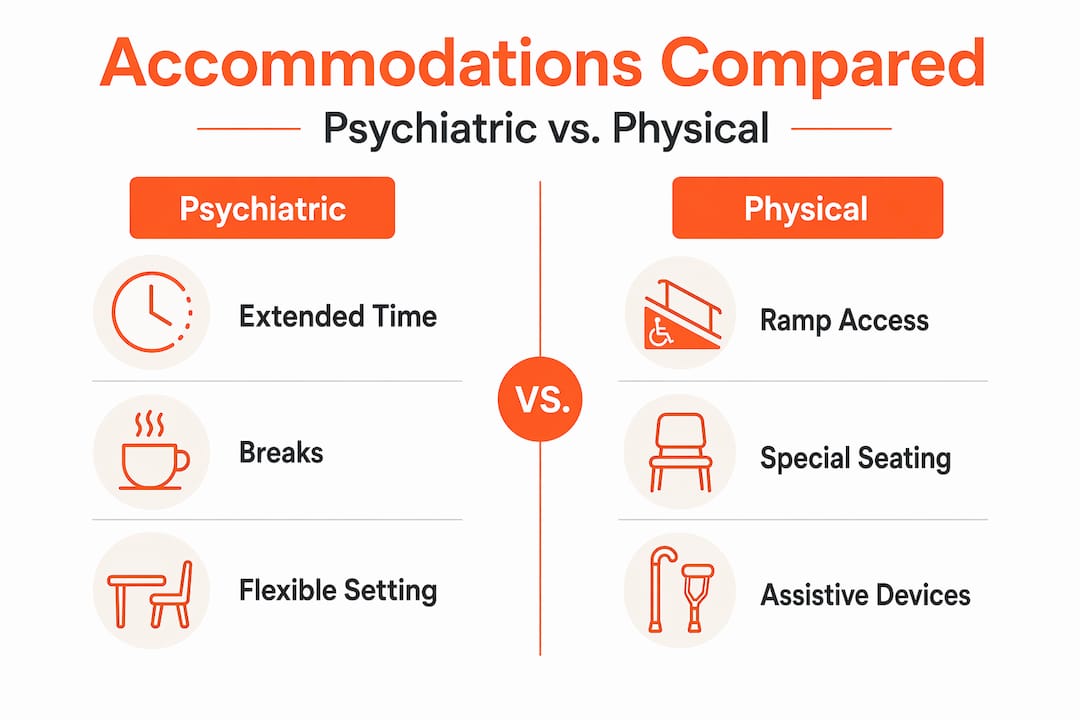
| Dimension | Psychiatric disabilities | Physical disabilities |
|---|---|---|
| Legal protection | ADA, Section 504, IDEA (for minors) | ADA, Section 504, IDEA (for minors) |
| Documentation standard | Functional limitations in testing context | Functional limitations in testing context |
| Common accommodations | Extended time, quiet room, breaks, assistive tech | Wheelchair access, enlarged print, extended time |
| Overlapping accommodations | Distraction-free rooms, extended time, breaks | Distraction-free rooms, extended time, breaks |
| Unique accommodations | Medication timing, emotional support provisions | Physical space modifications, specialized equipment |
The overlap is significant. Extended time and distraction-free environments appear consistently across both categories because concentration and stamina are affected by a wide range of conditions, not just psychiatric ones. What physical disability accommodations cover in terms of environment and timing often mirrors psychiatric supports directly.
Where they differ is in perception. A student in a wheelchair requesting a ground-floor testing room rarely faces skepticism. A student with generalized anxiety requesting the same quiet room may be asked to justify the need more rigorously. This is where understanding your psychiatric disability rights becomes practical, not just theoretical.
The legal standard is identical. What varies is how well the documentation articulates the connection between the condition and the specific barrier. When that connection is clear, psychiatric accommodation requests carry the same legal weight as any other disability category.
Steps parents can take to secure accommodations
Getting accommodations approved for a high-stakes test is a process, not a single event. The earlier you start, the stronger your position.
- Begin before the test registration deadline. Most testing agencies require accommodation requests weeks or months in advance. The ACT and SAT, for example, have specific submission windows that do not align with test registration dates.
- Gather all existing school records. Collect IEPs, 504 plans, prior evaluation reports, and teacher or counselor letters that document the student’s history of need.
- Coordinate with the school’s SSD coordinator. For the SAT and ACT in particular, the School Services for Students with Disabilities (SSD) coordinator plays a central role in submitting and verifying accommodation requests.
- Submit complete documentation the first time. Incomplete submissions are a leading cause of delays and denials. Confirm every required form is included before sending.
- Know your appeal rights. If a request is denied, you have the right to appeal. A denial is not the end of the road, and how standardized testing impacts students with disabilities is a recognized concern that testing agencies are legally required to address.
Pro Tip: Request accommodations for the diagnostic or practice test, if one is available, before the high-stakes exam. Approval on a practice round creates documented precedent that strengthens your formal request.
My honest take on what parents get wrong
Working with families navigating accommodation denials, I have seen a consistent pattern. Parents are often told by well-meaning school staff that a 504 plan is “basically automatic” for standardized tests. It is not. The school’s obligation and the testing agency’s obligation are separate legal requirements, evaluated by different entities under overlapping but distinct standards.
The second pattern I see constantly: families wait too long. They assume the diagnosis is recent and the need is obvious, so approvals will move quickly. Testing agencies do not operate on urgency. They operate on documentation. Submitting three weeks before the exam with a single provider letter is a formula for denial.
What I have found actually works is building a documentation package that reads like a case file, not a form. It connects the diagnosis to the symptom, the symptom to the specific testing barrier, and the barrier to the specific accommodation requested. When every step in that chain is documented, denials are much harder to justify.
The parents who get approvals are not necessarily the ones whose children have the most severe conditions. They are the ones who understood the process, gathered the right evidence, and advocated with precision. That is something any family can do with the right preparation.
— Roger
How Testaccommodations can help your family
If your child has been denied accommodations for the SAT, ACT, MCAT, LSAT, or another high-stakes exam, you do not have to navigate the appeals process alone.
Testaccommodations works directly with families to identify documentation gaps, build stronger accommodation requests, and guide appeals after denials. The team understands what testing agencies look for, and they know how to present psychiatric disability cases in terms that hold up to scrutiny. Whether you are preparing a first submission or responding to a denial, explore your options at Testaccommodations to get the support your child deserves. You can also review the best practices for testing students with disabilities to understand what a strong application looks like before you submit.
FAQ
What conditions qualify for psychiatric testing accommodations?
Conditions including depression, PTSD, bipolar disorder, anxiety disorders, ADHD, and OCD typically qualify when they substantially limit a major life activity such as concentrating or communicating. The focus is on functional limitation, not the diagnosis itself.
Does a 504 plan guarantee accommodations on standardized tests?
No. A school-based 504 plan documents the student’s needs within the school, but testing agencies like the College Board and ACT conduct independent reviews. Prior accommodations strengthen your request significantly, but they do not guarantee automatic approval.
What is the most commonly granted accommodation for psychiatric disabilities?
Extended time is the most frequently approved accommodation across psychiatric conditions because it directly addresses processing speed and concentration barriers that many conditions create. A distraction-free testing environment is the second most common approval.
How do I know if my documentation is strong enough?
Strong documentation connects specific symptoms to specific testing barriers and requests accommodations that directly address those barriers. If your provider’s letter does not describe functional impact in the context of test-taking, it likely needs to be supplemented.
Can a denial be appealed?
Yes. Every major testing agency has an appeals process. You should request the denial rationale in writing, identify the documentation gap, and resubmit with stronger functional impact evidence. Working with an advocate familiar with testing accommodation law improves outcomes significantly.