
The Role of Self-Advocacy in Accommodations for Students
Self-advocacy in the context of educational accommodations is defined as the active process by which students with disabilities communicate their needs, assert their rights, and collaborate with institutions to obtain the support required for academic success. This process sits at the center of every accommodation request, from IEP and 504 plan meetings in K–12 settings to formal requests for extended time on the ACT, SAT, MCAT, or LSAT. Federal law, specifically the Americans with Disabilities Act (ADA) and the Individuals with Disabilities Education Act (IDEA), places the responsibility for initiating accommodation dialogue squarely on the student or family. Research confirms that students who develop strong self-advocacy skills are significantly better positioned to secure the accommodations they need and to sustain academic progress over time.
How does self-advocacy shape the accommodation process?
The role of self-advocacy in accommodations is not passive. Under ADA Title II, institutions are required to engage in a good-faith interactive process to identify appropriate accommodations. That process only begins when a student or family member initiates it. No institution is legally obligated to offer accommodations unprompted, which means the student’s voice is the trigger for everything that follows.
This interactive process is collaborative by design. The student presents documentation of a disability and explains how it creates a functional impairment in the academic setting. The institution then responds with proposed supports. Effective self-advocacy means entering that conversation prepared, specific, and solution-focused rather than vague or reactive.

Research links student-initiated communication directly to better outcomes. Structured self-advocacy training shows moderate to strong evidence of increasing successful accommodation requests. That finding matters because it confirms that advocacy skill is learnable, not innate.
Key responsibilities students carry in this process include:
- Disclosing the disability and its functional impact in clear, specific terms
- Providing current, relevant documentation such as a psychoeducational evaluation or neuropsychological report
- Requesting specific accommodations rather than asking the institution to decide what is appropriate
- Following up in writing after verbal conversations to create a record
- Knowing when an informal request needs to escalate to a formal grievance process
Pro Tip: Always request accommodations in writing, even when you have already spoken with a coordinator verbally. A written record protects you if the request is later denied or mischaracterized.
What are effective self-advocacy strategies for students with disabilities?
Self-advocacy is a learnable set of skills centered on assertiveness, not aggression. The National Disability Authority identifies four core competencies that define effective advocacy: self-knowledge, rights literacy, communication skills, and escalation knowledge. Students who build all four competencies are far more likely to secure appropriate accommodations and to maintain them across academic transitions.
The four core competencies
Self-knowledge. Know your diagnosis, how it affects your learning, and what specific accommodations address those effects. A student who can explain that ADHD causes difficulty sustaining attention during timed tests, and that extended time directly addresses that barrier, makes a far more persuasive case than one who simply says “I have ADHD.”
Rights literacy. Understand the legal frameworks that protect you. The ADA, IDEA, and Section 504 of the Rehabilitation Act each create distinct obligations for educational institutions. Knowing which law applies to your setting, whether K–12 or postsecondary, shapes how you frame your request.
Communication skills. Use “I” statements to reduce conflict and keep conversations collaborative. “I find that timed tests don’t reflect my actual knowledge because my processing speed is affected by my disability” lands differently than “You’re not giving me a fair test.” The first invites problem-solving. The second invites defensiveness.
Escalation knowledge. Know the difference between informal negotiation and a formal grievance. Effective advocacy distinguishes between these two tracks and knows when to move from one to the other. Escalating too quickly can damage relationships. Waiting too long can cost you the accommodation during a critical exam cycle.
Preparation and documentation
Keeping detailed, chronological records of every accommodation request, response, and follow-up conversation is one of the most underused self-advocacy techniques. Those records become your evidence if a request is denied and you need to appeal. Link each accommodation you request directly to a specific functional limitation documented in your evaluation. That connection is what reviewers look for when assessing whether a request is reasonable.
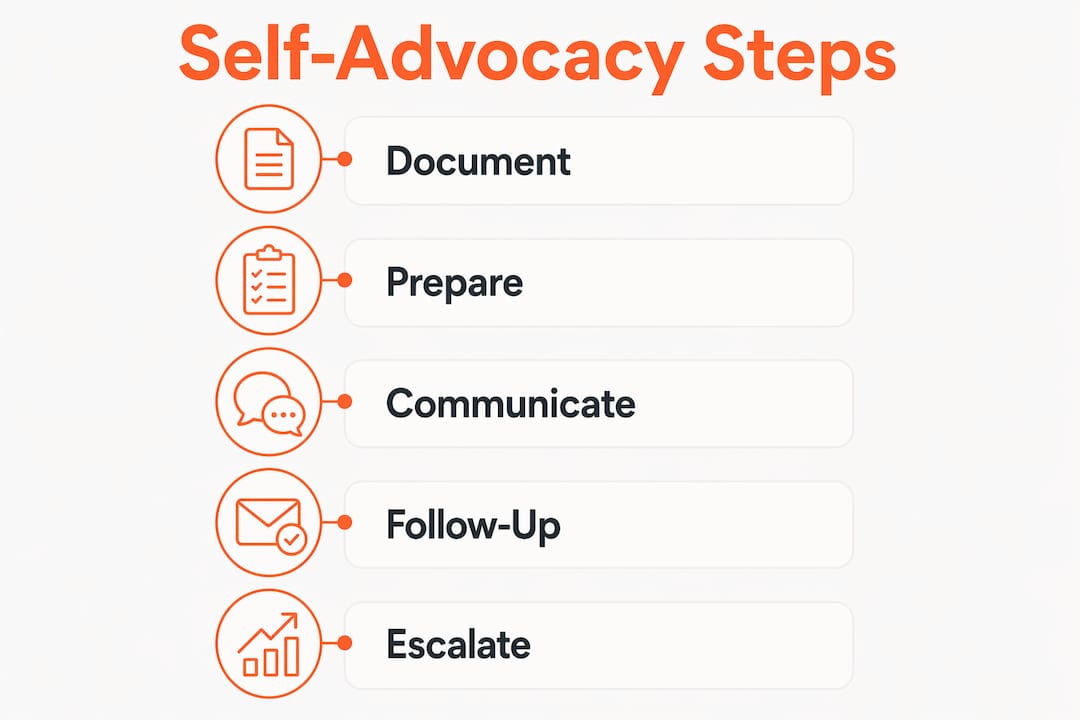
Pre-written advocacy scripts reduce anxiety and increase clarity, particularly for younger students and neurodivergent learners. Practicing what you will say before a meeting with a disability services coordinator or SSD coordinator removes the pressure of finding the right words in the moment.
Pro Tip: Use the accommodation request checklist from Testaccommodations to organize your documentation before any formal meeting. A complete file submitted upfront reduces back-and-forth and speeds up approval.
What are the benefits and challenges of self-advocacy?
The benefits of self-advocacy extend well beyond securing a single accommodation. Research with 326 students found that self-advocacy accounts for 24% of the variance in career readiness, with academic accommodations serving as a key mediator. That figure is significant. It means that students who advocate effectively in school are building skills that transfer directly into professional settings.
The psychological benefits are equally real. Students who successfully advocate for their needs report greater confidence, stronger sense of identity, and increased independence. Each successful request reinforces the belief that their needs are legitimate and that systems can respond to them.
“Advocacy burnout is a genuine risk when students and families carry the full weight of every request alone. Building a support network of educators, counselors, and advocacy organizations prevents the exhaustion that comes from fighting the same battles repeatedly.”
The challenges are real and should not be minimized:
- Fear of conflict. Many students worry that asking for accommodations will label them or create tension with teachers and administrators. This fear is common and understandable, but it often leads to under-requesting, which leaves functional needs unmet.
- Advocacy fatigue. Families who have navigated multiple denial cycles report significant emotional exhaustion. Proactive, regular advocacy prevents crises by addressing needs before they become urgent, which reduces the intensity of each individual request.
- Institutional resistance. Some institutions push back on accommodation requests, particularly for standardized tests. Knowing your legal rights and having complete documentation shifts the balance of that conversation.
The most effective counter to all three challenges is preparation. Students who arrive at meetings with organized documentation, clear language, and a specific ask are harder to dismiss than those who arrive uncertain and underprepared.
How can families and educators support self-advocacy development?
Families play a decisive role in building self-advocacy skills early. Students who participate in their own IEP or 504 meetings from a young age, even briefly, develop a working understanding of their rights and needs that carries forward into postsecondary settings. Waiting until high school to introduce these concepts creates a steep learning curve at exactly the wrong time.
Practical ways families can build advocacy skills at home include:
- Role-playing accommodation conversations before actual meetings so students practice the language in a low-stakes setting
- Encouraging students to read their own evaluation reports and ask questions about what the findings mean
- Reviewing accommodation letters together and discussing whether the listed supports actually address the student’s functional needs
- Helping students draft their own accommodation request emails rather than writing those emails on their behalf
Educators and school counselors contribute by creating space for students to speak for themselves during meetings rather than speaking over them. An IEP meeting where the student never speaks is a missed opportunity to build the exact skills that student will need in college and beyond.
Families preparing for standardized test accommodations should begin the process at least six months before the target test date. Testing organizations like the College Board and ACT require specific documentation formats, and gathering that documentation takes time.
Pro Tip: If your student does not have an IEP or 504 plan, accommodations may still be available. Review the options for students without formal plans to understand what documentation you will need to build a case from scratch.
The goal is not to advocate for your student indefinitely. The goal is to teach your student to advocate for themselves. Every time a parent steps back and lets the student lead a portion of a meeting, that student gains real experience that no amount of coaching can fully replicate.
Key Takeaways
Self-advocacy is the single most consistent predictor of whether a student with a disability secures the accommodations they need, sustains them across academic transitions, and builds the confidence to navigate institutional systems independently.
| Point | Details |
|---|---|
| Self-advocacy initiates the process | No institution is legally required to offer accommodations unprompted; students must initiate the dialogue. |
| Four competencies drive success | Self-knowledge, rights literacy, communication skills, and escalation knowledge form the foundation of effective advocacy. |
| Documentation is non-negotiable | Detailed, chronological records of every request and response protect students during appeals and denials. |
| Research confirms career impact | Self-advocacy accounts for 24% of variance in career readiness, making it a lifelong skill, not just an academic one. |
| Families must start early | Students who participate in IEP and 504 meetings from a young age develop advocacy skills that transfer to postsecondary settings. |
Why self-advocacy changed how I see accommodation work
After years of working with students and families navigating accommodation denials, the pattern I see most often is not a documentation problem. It is a communication problem. Students arrive at meetings uncertain of what they are asking for, why they are asking for it, and what they will do if the answer is no. That uncertainty reads as weakness to institutions that are looking for any reason to narrow the scope of what they provide.
The students who succeed are not always the ones with the most comprehensive evaluations. They are the ones who can say, clearly and calmly, “My disability affects this specific function, this accommodation addresses that specific barrier, and here is the documentation that supports both claims.” That sentence, or a version of it, is the core of every successful accommodation request I have ever seen.
What I find most encouraging is that this skill is genuinely teachable. I have watched students who were terrified to speak in their own IEP meetings become confident advocates by the time they reached college. The shift does not happen overnight, but it does happen when families invest in practice, preparation, and the belief that their student’s needs are worth fighting for.
Self-advocacy is not a one-time event. It is an iterative process that gets stronger with each request, each meeting, and each successful outcome. The students who internalize that lesson early carry it into every setting they encounter for the rest of their lives.
— Roger
Testaccommodations can help when advocacy alone is not enough
Knowing how to advocate is the first step. Knowing what to do when your request is denied is the next one. Testaccommodations works specifically with students and families who have been denied accommodations for standardized tests, including the ACT, SAT, MCAT, and LSAT.
The team at Testaccommodations reviews your documentation, identifies gaps that led to the denial, and helps you build a stronger case for appeal. Whether you are preparing your first request or responding to a formal denial, the test accommodations guidance available through Testaccommodations gives you a clear path forward. You do not have to navigate this process alone, and you do not have to accept a denial as the final word.
FAQ
What is the role of self-advocacy in accommodations?
Self-advocacy is the process by which students with disabilities initiate, communicate, and follow up on accommodation requests. Federal law requires students to start this process themselves, making self-advocacy the foundation of every successful accommodation outcome.
What are the four core self-advocacy competencies?
The four core competencies are self-knowledge, rights literacy, communication skills, and escalation knowledge. Students who develop all four are significantly more likely to secure and maintain appropriate accommodations across academic settings.
How does self-advocacy affect long-term success?
Research with 326 students found that self-advocacy predicts career readiness, accounting for 24% of the variance in career outcomes. Academic accommodations serve as a key mediator in that relationship.
What should I do if my accommodation request is denied?
Document the denial in writing, review whether your supporting documentation addresses the institution’s stated reasons for refusal, and determine whether the situation calls for informal negotiation or a formal grievance. Testaccommodations specializes in helping students respond to standardized test denials effectively.
Can students advocate for accommodations without an IEP or 504 plan?
Yes. Students without formal plans can still request accommodations by providing independent documentation such as a psychoeducational evaluation. The process requires more preparation, but it is legally available under the ADA at the postsecondary level.