
The Role of IEP in Test Accommodations: 2026 Guide
An Individualized Education Program (IEP) is the governing document that determines which testing accommodations a student with disabilities is entitled to receive during standardized and high-stakes exams. The role of IEP in test accommodations is both legal and procedural: it authorizes specific supports, records the student’s disability-related needs, and creates the paper trail that testing entities rely on when approving requests. Under the Individuals with Disabilities Education Act (IDEA) and the Americans with Disabilities Act (ADA), the IEP team holds decision-making authority over how a student participates in assessments. Without a properly documented IEP, families face an uphill battle when requesting accommodations for exams ranging from state assessments to the SAT, ACT, MCAT, and LSAT.
How is the IEP used to determine eligibility for test accommodations?
The IEP team, which includes parents, educators, and specialists, decides both how a student participates in assessments and which specific supports are required. These decisions are recorded directly in the IEP document, and that documentation becomes the foundation for every accommodation request that follows. Per ADA guidance, testing accommodations are defined as changes to the regular testing environment and auxiliary aids or services that allow students to demonstrate their true aptitude without altering what the test measures. The goal is access and equity, not a modification of assessment standards.

Understanding the difference between accommodations and modifications is critical here. Accommodations change how a student accesses a test. Modifications change what is being tested. Testing entities, including College Board and ACT, Inc., grant accommodations but do not grant modifications for their standardized exams. Your IEP must clearly specify accommodations, not modifications, for the documentation to carry weight with these organizations.
Common IEP test accommodations include:
- Extended time (typically 50% or 100% additional time)
- Separate testing room or reduced-distraction environment
- Reader or text-to-speech technology for students with reading disabilities
- Scribe or speech-to-text software for students with writing disabilities
- Large print or Braille test formats
- Frequent breaks or extended breaks between sections
ADA.gov confirms that if a student previously received testing accommodations under an IEP or Section 504 Plan and can certify current need, testing entities generally grant the same accommodations for current standardized exams without requiring additional documentation. This applies to students in public schools and to students funded in private schools under IDEA or Section 504. The phrase “certify current need” is doing significant work in that sentence. It means the accommodation must still be actively used and relevant to the student’s present functional impairment.
Pro Tip: Review your child’s IEP at least 60 days before any major standardized test. Confirm that every accommodation your child uses in school is explicitly listed in the IEP document, not just referenced in meeting notes or verbal agreements.
How do states vary in implementing IEP-based test accommodations?
State education agencies translate federal IDEA requirements into their own policies, and those policies differ in meaningful ways. Ohio, California, and Wisconsin each illustrate a distinct approach to how IEP accommodations connect to test-day settings.
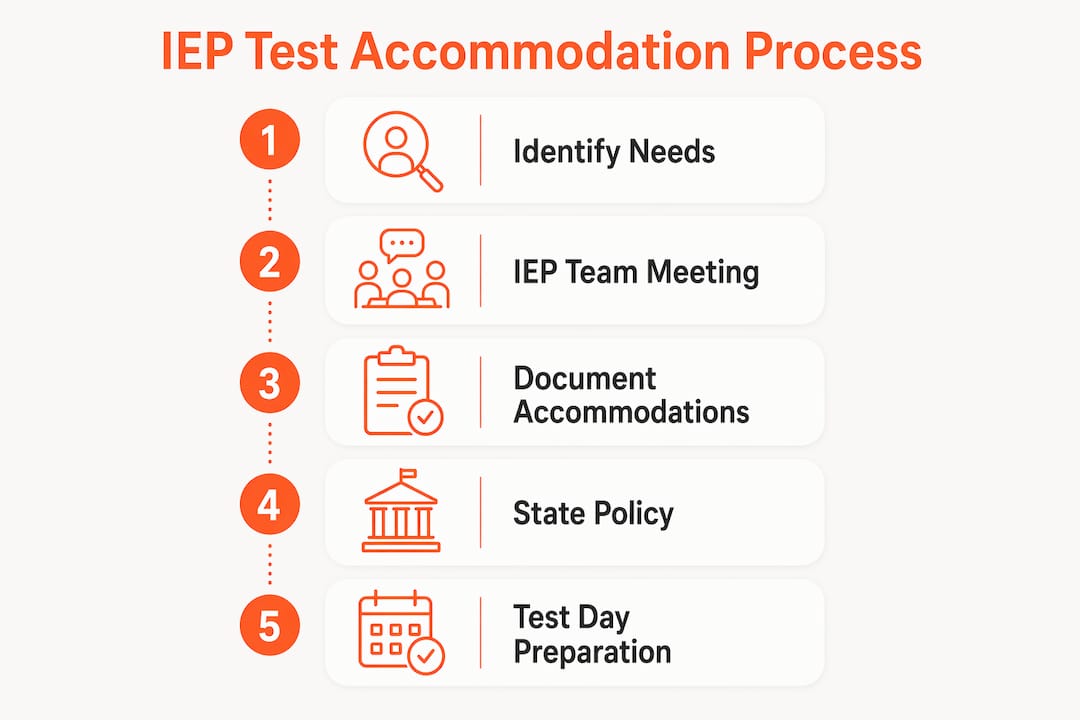
The Ohio Department of Education and Workforce frames the IEP as the key documentation hub for operationalizing accommodations on testing day. Ohio requires that all accommodations used on state assessments be documented in the student’s IEP. Alternate assessments are available when regular assessments are not appropriate even with accommodations in place, but the IEP remains the authorizing document throughout.
California’s system adds a procedural layer that trips up many families. The California Department of Education mandates that IEP-specified accommodations for CAASPP and ELPAC tests be entered into the ISAAP system (Individual Student Assessment Accessibility Profile) before the exam window opens. Schools must translate IEP accommodations into specific test configurations inside this electronic platform. If that step is missed, the accommodation does not exist on test day, regardless of what the IEP says.
Wisconsin takes the strictest approach to alternate assessments. The Wisconsin Department of Public Instruction requires IEP teams to formally determine alternate assessment eligibility, and accommodations not listed in the state’s approved accessibility resources require prior written approval and documented consent tracked well in advance of testing. Alternate assessments in Wisconsin are reserved for students with the most significant cognitive disabilities, tied directly to ESSA regulations.
| State | IEP documentation requirement | Alternate assessment eligibility | Unique procedural step |
|---|---|---|---|
| Ohio | All accommodations must be in the IEP | Available when regular assessment is inappropriate even with accommodations | IEP serves as the primary documentation hub |
| California | IEP accommodations must be entered into ISAAP before testing | Determined by IEP team based on student need | Schools must upload settings to ISAAP ahead of the exam window |
| Wisconsin | IEP team determines participation and accommodation needs | Reserved for students with significant cognitive disabilities under ESSA | Unlisted accommodations require prior written approval and consent |
Pro Tip: If your child’s school uses an electronic test administration system like California’s ISAAP, ask the special education coordinator to confirm in writing that all IEP accommodations have been uploaded and verified at least two weeks before the test date.
Do IEPs work for non-K–12 standardized tests like the SAT or MCAT?
The IEP’s authority is strongest within the K–12 public school system. For higher-stakes exams administered by private testing organizations, the IEP serves as persuasive baseline evidence, but it rarely suffices on its own. This is a distinction that catches many families off guard when their child transitions to college entrance exams or professional licensing tests.
ADA guidance supports granting accommodations based on a current IEP combined with certification of current need, but testing organizations like College Board (SAT) and ACT, Inc. typically expect additional documentation. That documentation often includes a recent psychoeducational evaluation, a neuropsychological assessment, or a letter from a licensed clinician confirming the diagnosis and functional impairment. The IEP alone may not be sufficient for these exams.
Key documentation considerations for non-K–12 standardized tests:
- Currency matters. Most testing organizations require evaluations completed within three to five years. An IEP based on a psychoeducational evaluation from elementary school will not satisfy this requirement for a student applying to college.
- Functional impairment must be documented. The IEP must connect the diagnosis to a specific functional limitation that affects test performance. A diagnosis alone, without documented impairment, is not enough.
- Supplementary records strengthen the request. School progress reports, teacher observations, and prior accommodation histories all reinforce the IEP’s credibility as evidence.
- Communication with the testing organization is non-negotiable. Each organization, whether College Board, ACT, Inc., AAMC (for the MCAT), or LSAC (for the LSAT), has its own submission portal, deadlines, and documentation standards.
For students whose accommodation eligibility is being questioned by a testing organization, the IEP is the starting point of the argument, not the conclusion. Families who treat it as the conclusion often receive denials.
Practical steps to make sure IEP accommodations hold on test day
The most common failure point in the entire process is not the IEP itself. It is the gap between what the IEP says and what actually happens on test day. California’s ISAAP experience illustrates this clearly: a student can have a fully compliant IEP and still receive no accommodations because the school failed to enter the settings into the testing platform on time.
Here is a practical sequence for parents and students to follow:
- Audit the IEP at least 60 days before the test. Confirm every accommodation your child uses daily is explicitly listed. Verbal agreements with teachers do not count.
- Request written confirmation from the school. Ask the special education coordinator or SSD (Services for Students with Disabilities) coordinator to confirm in writing that accommodations have been submitted to the testing authority.
- Verify directly with the testing organization. For College Board or ACT, Inc. exams, log into the student’s account to confirm approved accommodations before the test date.
- Prepare a documentation packet. Gather the current IEP, the most recent psychoeducational evaluation, any relevant medical records, and a letter from the treating clinician. Keep copies accessible.
- Certify current need proactively. If the IEP is more than three years old, initiate a re-evaluation before submitting accommodation requests to non-K–12 testing organizations.
- Know the appeal process. If an accommodation is denied, self-advocacy strategies and a formal appeal with supplementary documentation can reverse the decision.
For accommodations that fall outside a state’s pre-approved list, the approval process requires additional steps. Wisconsin’s requirement for prior written consent is one example. In these cases, starting the process early, ideally at the beginning of the school year before a spring testing window, gives the IEP team and the testing authority enough time to process the request without a last-minute crisis.
Pro Tip: On test day itself, bring a printed copy of the IEP and the testing organization’s written approval of accommodations. Testing center staff sometimes have no record of approved accommodations, and having documentation in hand can prevent a significant disruption.
Key takeaways
The IEP is the legal and procedural foundation for every test accommodation a student with disabilities receives, but documentation alone does not guarantee delivery on test day.
| Point | Details |
|---|---|
| IEP as the authorizing document | Every accommodation must be explicitly listed in the IEP for testing entities to honor it. |
| State implementation varies | Ohio, California, and Wisconsin each have distinct procedural requirements beyond the IEP itself. |
| Non-K–12 tests require more | For SAT, ACT, MCAT, and LSAT, the IEP is baseline evidence and supplementary documentation is typically required. |
| Procedural gaps cause denials | Failing to upload accommodations into systems like ISAAP is a leading cause of test-day failures. |
| Early action prevents problems | Auditing the IEP and confirming submissions at least 60 days before the exam prevents most last-minute denials. |
Why the IEP is only as strong as the process behind it
I have worked with families who did everything right on paper and still watched their child sit for a four-hour exam without a single accommodation in place. The IEP was current. The diagnosis was documented. The school had agreed to everything. What failed was the procedural chain between the IEP and the testing room.
The families who navigate this process successfully share one trait: they treat the IEP as the beginning of the conversation, not the end of it. They follow up with the SSD coordinator. They log into the testing portal to verify approvals. They bring documentation to the test center. They do not assume that a signed IEP means the work is done.
The legal framework under IDEA and the ADA is genuinely protective. Alternate assessment eligibility and accommodation rights are codified in federal law. But federal rights require local execution, and local execution fails more often than it should. The families I have seen succeed are the ones who understand both the law and the logistics, and who refuse to accept a denial without pushing back with evidence.
If your child’s accommodation request has been denied by College Board, ACT, Inc., AAMC, or LSAC, the IEP is your starting point for the appeal. Pair it with a current psychoeducational evaluation, a clinician letter, and a clear argument connecting the diagnosis to functional impairment on the specific test. That combination, presented through the right channels, changes outcomes.
— Roger
How Testaccommodations can help you secure what your child is entitled to
Testaccommodations specializes in exactly the situation described above: students and families who are entitled to accommodations for standardized tests and are receiving denials. Whether you are preparing an initial request or appealing a rejection from College Board, ACT, Inc., AAMC, or LSAC, the resources at Testaccommodations are built for your situation.

The Testaccommodations website offers detailed guides on testing accommodations for students with disabilities, practical checklists for documentation, and expert support for families navigating the appeals process. If your child’s IEP is being dismissed or questioned by a testing organization, you do not have to figure out the next step alone. Explore the full library of resources at Testaccommodations and connect with advisors who understand both the legal framework and the procedural realities of securing accommodations in 2026.
FAQ
What is the role of an IEP in test accommodations?
The IEP is the primary document that authorizes and specifies testing accommodations for students with disabilities. Testing entities, including state education agencies and private testing organizations, rely on the IEP as evidence of documented need.
Does an IEP guarantee accommodations on the SAT or ACT?
An IEP provides strong baseline evidence but does not automatically guarantee accommodations on College Board or ACT, Inc. exams. Students typically need to certify current need and may need to submit supplementary documentation such as a recent psychoeducational evaluation.
What happens if a testing accommodation in the IEP is not honored on test day?
If an accommodation listed in the IEP is not provided on test day, parents and students should document the failure immediately and contact both the school’s special education coordinator and the testing organization. A formal complaint or appeal can be filed citing the IEP and any written confirmation of approved accommodations.
Can a student qualify for alternate assessments just by having an IEP?
Having an IEP does not automatically qualify a student for alternate assessments. Alternate assessment eligibility requires meeting federal criteria for significant cognitive disabilities, including substantial adaptive and cognitive deficits, as determined by the IEP team.
How far in advance should families act on IEP-based accommodation requests?
Families should audit the IEP and begin the accommodation request process at least 60 days before a major standardized test. For non-K–12 exams or accommodations requiring prior approval, starting at the beginning of the school year is the safest approach.