
The Role of Accommodations in Testing Fairness
Most people assume testing accommodations give students an unfair edge. That assumption is wrong, and understanding why matters more than most families realize. The role of accommodations in testing fairness is not to make tests easier. It is to remove barriers that prevent students with disabilities or documented needs from showing what they actually know. Under the Americans with Disabilities Act (ADA), test results must reflect aptitude, not the impact of a disability, unless the disability itself is what the test measures. That distinction changes everything.
Table of Contents
- Key Takeaways
- The role of accommodations in testing fairness explained
- Understanding eligibility and documentation
- How accommodations affect test fairness and equity
- Common challenges and misconceptions
- Practical steps for parents and students
- My perspective on accommodations and real fairness
- How Testaccommodations can help you fight for fair access
- FAQ
Key Takeaways
| Point | Details |
|---|---|
| Accommodations preserve fairness | They remove disability-related barriers without changing what the test measures or the standards it upholds. |
| Legal protections are strong | The ADA requires testing entities to provide accommodations so scores reflect true aptitude, not functional impairment. |
| Documentation must be reasonable | Past IEP or 504 plans carry significant weight and cannot be dismissed without cause by testing agencies. |
| Misconceptions persist | Accommodations do not inflate scores; they reduce construct-irrelevant variance so results are more valid, not more generous. |
| Early action matters | Delays and excessive documentation demands can constitute denial of equal opportunity, so starting early is critical. |
The role of accommodations in testing fairness explained
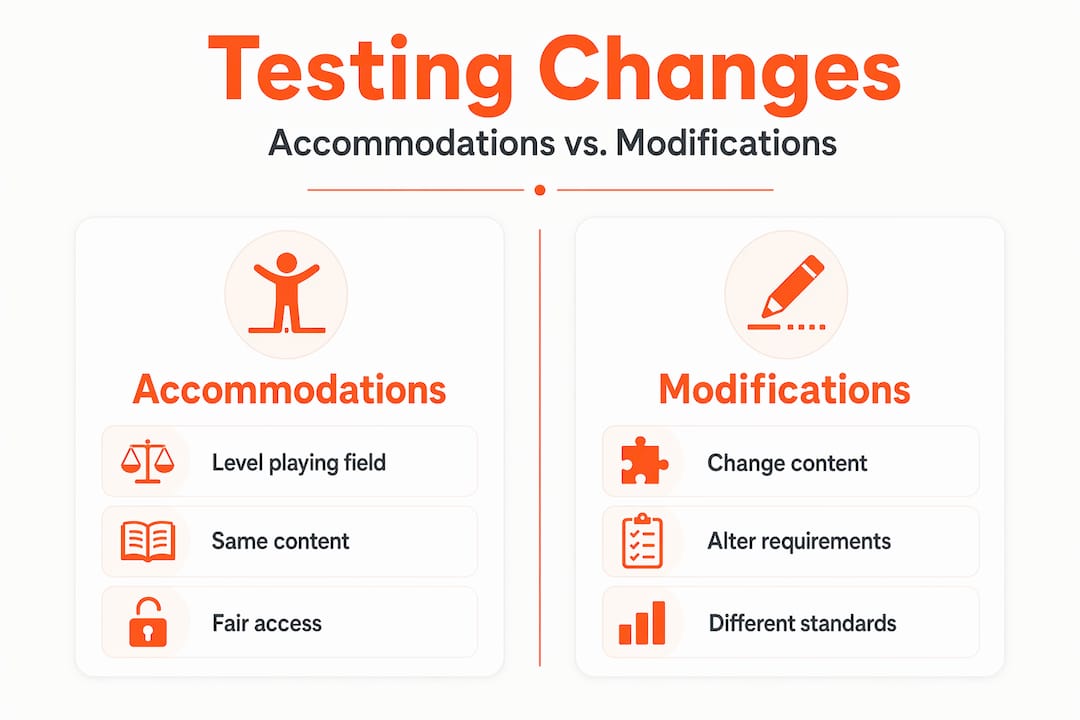
Testing accommodations are changes to the administration of a test, not to its content, difficulty, or scoring standards. This distinction is the foundation of why they exist. A student who reads slowly because of dyslexia and a student who reads slowly because they did not study are not in the same situation. Accommodations recognize that difference.
Common testing accommodations examples include:
- Extended time (typically 50% or 100% additional time) for students with processing disorders, ADHD, or learning disabilities
- Separate testing room to reduce distraction for students with anxiety or attention-related diagnoses
- Text-to-speech software, which reads test questions aloud and is used by students in special education, English learner programs, and those with visual or reading disabilities
- Large print or Braille for students with visual impairments
- Scribe services for students with motor disabilities that affect writing
These are not the same as modifications. A modification changes what is being tested, such as reducing the number of questions or simplifying the language of the test itself. Accommodations change how the test is administered. Fair testing practices require that any change to test administration minimize construct-irrelevant variance without compromising the validity or reliability of the score. In plain terms, accommodations help ensure the test measures what it is supposed to measure, not the student’s disability.
Pro Tip: If you are unsure whether a requested change is an accommodation or a modification, ask this question: does this change what skill the test is measuring, or only how the student demonstrates that skill? If the answer is “only how,” it is likely a legitimate accommodation.
Understanding eligibility and documentation
Knowing your rights is one thing. Proving eligibility is another, and this is where many families run into real difficulty. Testing agencies like the College Board, ACT, and the NBME require documentation to process accommodation requests, but the ADA sets clear limits on what they can demand.
Here is what the process generally looks like for standardized tests:
- Gather existing documentation. An IEP (Individualized Education Program) or Section 504 plan is typically the strongest starting point. These documents are legally established records of disability-related need and prior accommodation use.
- Obtain a psychoeducational or neuropsychological evaluation if required. Many testing agencies request this for diagnoses like ADHD or a specific learning disability. The evaluation must generally come from a licensed professional and address functional impairment in a testing context.
- Document past accommodation use. If a student has received extended time in school or on prior standardized tests, that history carries considerable legal weight. The ADA’s guidance is clear that past accommodations and IEPs must be given considerable weight in the review process.
- Submit the request on time. Each testing agency has its own submission window. Missing it can delay your test date by an entire testing cycle, which can have real consequences for college or graduate school applications.
- Follow up proactively. If a request is under review and a deadline is approaching, contact the agency in writing. Delays in processing requests can themselves constitute a denial of equal opportunity under the ADA.
The legal standard matters here. Testing agencies cannot demand documentation that goes beyond what is reasonably necessary to establish the disability and the need for the specific accommodation. Requests for documentation must be narrowly tailored and should not be more burdensome than necessary.
Pro Tip: Build your request around documented past practice. If a student received 50% extended time in school under a 504 plan, that same accommodation on the SAT or ACT is far easier to justify than requesting something new. Consistency across settings is one of the most persuasive elements of any accommodation request.
How accommodations affect test fairness and equity
This is where the conversation gets more nuanced, and where some of the most persistent misconceptions live. The core argument against accommodations is that they give certain students an advantage. Research does not support that framing.
Properly implemented accommodations preserve fairness by removing disability-related barriers that would otherwise prevent a student from demonstrating their true aptitude. They do not create advantage. They reduce disadvantage.

The following table compares common misconceptions with the research-backed reality:
| Misconception | Reality |
|---|---|
| Extended time inflates scores for all students | Research shows slow test-takers are not worse students; extended time helps those with processing disabilities, not those without |
| Accommodations lower test standards | Accommodations change administration, not content or scoring difficulty |
| Any student could benefit equally from accommodations | Differential benefit is evidence that accommodations are targeting disability-related barriers, not creating general advantage |
| Text-to-speech gives readers an unfair edge | About 7% of students use text-to-speech; impacts vary significantly by student profile and disability type |
Access equity is a legitimate concern, but not in the way critics usually frame it. The real equity problem is not that students with accommodations have it easier. The deeper problem is that access inequities arise from who is able or willing to obtain accommodations, not from accommodations themselves. Wealthier families with more resources and knowledgeable advocates tend to navigate the process more successfully. That gap in access is the fairness issue worth addressing.
There is also an argument in the research that universalizing maximal accommodations, such as offering double time to all test-takers, would actually reduce inequities caused by selective approval. While that approach has practical limitations for large-scale standardized testing, it illustrates the underlying problem: when only some students get accommodations through a gatekeeping process, disparities in access become the fairness concern, not the accommodations themselves.
Common challenges and misconceptions
Even families who understand the purpose of accommodations often hit obstacles that feel both arbitrary and exhausting. Several recurring problems come up again and again.
- Score flagging fears. Some families worry that using accommodations will mark a student’s score as different or less valid. This fear, while understandable, is based on outdated practice. Flagging scores for accommodation use is explicitly prohibited because it discourages students from using accommodations they are legally entitled to and undermines test fairness for diverse learners.
- Inconsistent eligibility decisions. A student who receives extended time at school under an IEP may still be denied the same accommodation by the College Board. These inconsistencies create real confusion and, in many cases, constitute legal violations that families can challenge.
- Excessive documentation demands. Testing agencies sometimes request more documentation than the law requires. Families often comply out of anxiety rather than necessity, spending money on additional evaluations that may not change the outcome.
- Late denials. Receiving a denial close to a test date leaves little time to appeal, which is exactly why early submission and follow-up are so critical.
Pro Tip: If you receive a denial, do not assume the decision is final. Many denials are overturned on appeal, particularly when the request is backed by an IEP, a 504 plan, or a history of prior accommodation use in similar settings. Learn how to identify common accommodation problems before you accept a denial as the end of the road.
Practical steps for parents and students
Securing accommodations on major standardized tests like the SAT, ACT, MCAT, or LSAT requires a deliberate approach. Here is a practical framework to follow:
- Start at least three to six months before the target test date. This gives you time to gather documentation, submit the request within the agency’s window, and address any problems without missing the test cycle.
- Review your child’s existing IEP or 504 plan. Confirm it reflects current diagnoses and accommodations. An outdated plan can weaken an otherwise strong request.
- Request a psychoeducational evaluation if the existing documentation is thin. For older students who may not have current school-based plans, a recent evaluation from a licensed neuropsychologist is often the most effective documentation tool.
- Learn the specific requirements of the testing agency. Each agency has its own forms, timelines, and documentation standards. The College Board’s SSD (Services for Students with Disabilities) process differs from ACT’s, and both differ from the MCAT or LSAT systems.
- Consult resources that specialize in this area. Understanding how to secure test accommodations under the ADA and Section 504 is not something most families should navigate alone, especially if a denial has already been issued.
My perspective on accommodations and real fairness
I have worked with hundreds of families who come to this process believing two different things at once. They believe their child genuinely needs accommodations, and they feel guilty asking for them. That combination stops a lot of students from getting what they are legally entitled to.
What I have seen repeatedly is that accommodations, when implemented correctly, do not tip the scales. They level them. A student with severe dyslexia who reads at a fraction of the speed of their peers is not competing on equal terms when forced into standard time constraints on a reading-heavy test. Giving them extra time does not make them a better reader. It gives the test a chance to measure what they actually know instead of measuring how fast they can work around a disability.
The systemic issues that bother me most are the inconsistencies. I have seen students denied accommodations by testing agencies when those same accommodations were granted and documented in school settings for years. The law is clear on this. Best practices for testing students with disabilities require that past accommodation use be given considerable weight. When agencies ignore that standard, families need to push back, and they often need help doing it.
Accommodations are fairness tools. Not shortcuts. Understanding that distinction is what allows families to advocate without apology.
— Roger
How Testaccommodations can help you fight for fair access
Testaccommodations specializes in helping students and families who have already been denied accommodations on major standardized tests, including the ACT, SAT, MCAT, and LSAT. A denial is not the end of the process. It is often the beginning of a more strategic one.
The team at Testaccommodations works directly with families to review the strength of their documentation, identify where the request fell short, and build a more persuasive case for appeal. Whether you are preparing a first-time request or challenging a denial you believe was unjustified, the expert guidance at Testaccommodations is grounded in a deep understanding of ADA requirements, testing agency standards, and the documentation strategies that actually work. You do not have to accept a denial that conflicts with your child’s legal rights.
FAQ
What does the ADA say about testing accommodations?
The ADA requires that testing entities administer exams in a way that reflects a student’s aptitude or achievement, not their disability, unless the disability is the specific skill being tested. This means qualified students are legally entitled to accommodations that remove disability-related barriers.
Do testing accommodations give students an unfair advantage?
No. Research consistently shows that accommodations benefit students with disabilities significantly more than students without disabilities, which is evidence that they are targeting genuine barriers rather than inflating scores for everyone.
What documentation is needed to request accommodations?
Most testing agencies accept an IEP, a Section 504 plan, or a recent psychoeducational evaluation as primary documentation. Past accommodation use in similar settings carries significant legal weight and should be included in every request.
Can a testing agency deny accommodations even if a student has an IEP?
Yes, but a denial in this situation may violate the ADA. Testing agencies are required to give considerable weight to documented past accommodations, including those established through an IEP or 504 plan. Families can and should appeal such denials.
Are test scores flagged when a student uses accommodations?
No. Flagging scores for accommodation use is prohibited under ADA guidance because it discourages eligible students from requesting accommodations and undermines the principle of equitable testing outcomes.