
Self-Assess Disability Testing Accommodation Criteria
Self-assessing disability testing accommodation criteria is the process of evaluating your own documented disability, functional limitations, and prior accommodation history against the standards set by testing organizations like College Board, ETS, and ACT, Inc. This evaluation helps students and parents determine whether a formal accommodation request is likely to succeed before investing time in documentation. The process is not a diagnosis. It is a structured first step toward understanding whether your situation meets the disability accommodation guidelines that govern standardized tests including the SAT, ACT, MCAT, and LSAT. Knowing where you stand before you apply can mean the difference between a strong submission and a denial.
How to self-assess disability testing accommodation criteria

The formal industry term for this process is an accommodation needs assessment. It involves measuring your documented disability and its functional impact against the criteria for disability testing set by the Americans with Disabilities Act (ADA) and individual testing organizations.
The core criteria you need to evaluate fall into four categories:
- Documented disability: You must have a diagnosis from a licensed, credentialed professional. Testing entities require documentation from qualified professionals who have made individualized assessments. Reports from family members or close personal relationships with evaluators are typically disqualifying.
- Substantial functional limitation: A diagnosis alone is not enough. The disability must substantially limit a major life activity relevant to the test, such as reading speed, sustained attention, or written expression.
- History of accommodations: Prior use of an Individualized Education Program (IEP) or Section 504 plan carries considerable weight. Past accommodation history often outperforms a new generic medical report in the review process.
- Narrowly tailored request: The ADA requires that accommodation requests connect directly to specific functional limitations. Broad medical histories are counterproductive and frequently lead to denial.
When you work through these four criteria honestly, you get a realistic picture of your eligibility before you spend money on evaluations or miss a submission deadline.
Pro Tip: Start your self-assessment by pulling any existing IEP or 504 plan documents. If your child already has a school accommodation history, that record is your strongest asset in any testing accommodation review.
Which self-assessment tools can help you evaluate accommodation needs?
Self-assessment tools give students and parents a structured way to identify patterns of functional difficulty before pursuing a formal evaluation. These tools do not produce diagnoses. Self-assessments serve as orientation tools and cannot replace the norm-referenced testing required for official accommodation documentation.
The table below compares two widely used screening tools:
| Tool | Questions | Areas Covered | Completion Time | High-Concern Threshold |
|---|---|---|---|---|
| Adult ADHD Self-Report Scale (ASRS v1.1) | 6 | Attention, hyperactivity | Under 5 minutes | 4 or more out of 6 |
| Neurodivergence Online Screener | 32 | 4 functional areas | ~5 minutes | Flagged by area score |
The ASRS v1.1 is a clinically validated screener developed in conjunction with the World Health Organization. A score of 4 or more on the six-question version indicates symptoms highly consistent with ADHD and warrants a formal evaluation. That threshold is meaningful because it signals a pattern, not a single bad day. The 32-question neurodivergence screener covers four functional areas in approximately five minutes and is useful for identifying whether difficulties cluster around reading, processing speed, attention, or executive function.
Use these results to prepare for your professional evaluation, not to substitute for it. Bring your screener results to your psychologist or neuropsychologist and ask them to address those specific functional areas in their report. That alignment between self-assessment findings and professional documentation strengthens your eventual accommodation request.
Pro Tip: When reviewing screener results, look for consistency across multiple areas rather than a single high score. Testing organizations respond to patterns of functional impairment, not isolated symptoms.
How to submit a testing accommodation request after self-assessment
Once your self-assessment points toward eligibility, the submission process requires careful sequencing. Moving too fast or skipping steps is one of the most common reasons families receive denials.
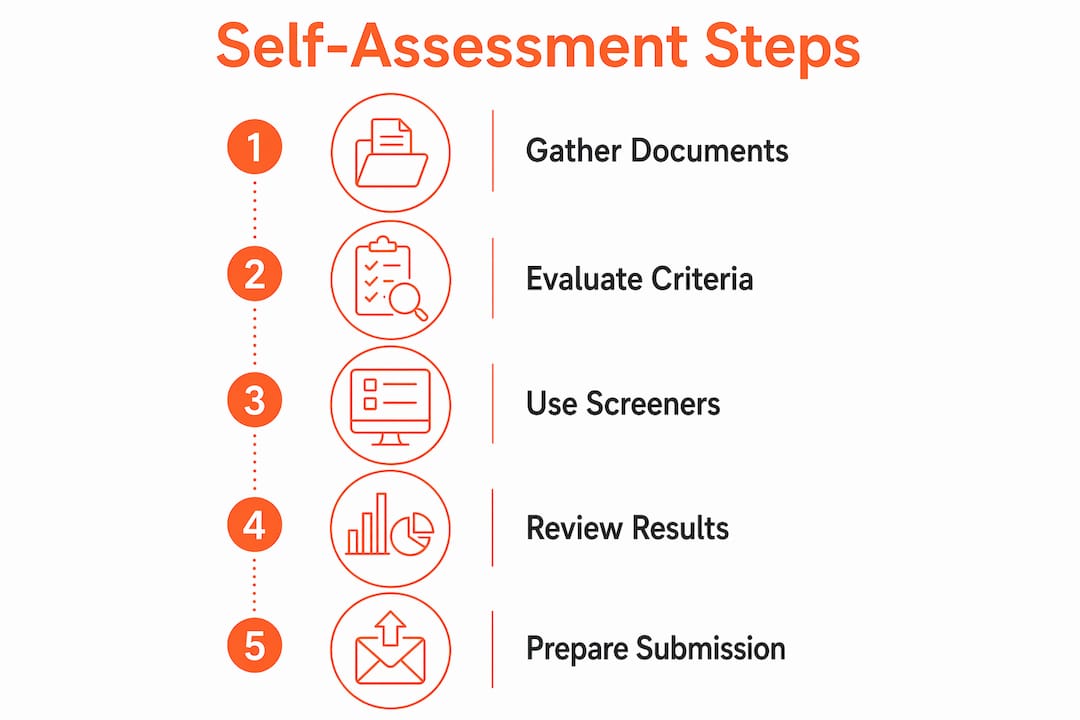
Follow these steps in order:
- Confirm your test date and calculate your deadline. Most testing entities require accommodation requests to be submitted at least 30 days before the test date. For College Board (SAT) and ACT, Inc., deadlines can be earlier. Check the specific organization’s portal immediately.
- Schedule a professional evaluation. Contact a licensed psychologist, neuropsychologist, or relevant specialist. Specify that you need documentation for standardized test accommodations. Ask them to include functional limitations and connect those limitations explicitly to the accommodations you are requesting.
- Gather your supporting records. Collect your IEP, 504 plan, prior evaluation reports, and any school-based accommodation letters. These records establish your history and corroborate the professional’s findings.
- Complete the testing organization’s accommodation request form. Each organization (College Board, ETS, ACT, Inc., LSAC, AAMC) has its own portal and form. Fill out every field completely. Incomplete submissions are a leading cause of delays.
- Submit and confirm receipt. After submitting, verify that the organization has received your request. Keep copies of everything you submit.
Avoid these common mistakes during submission:
- Submitting a generic medical letter that lists a diagnosis without describing functional limitations
- Requesting accommodations that are broader than what your documentation supports
- Missing the deadline because you underestimated how long the professional evaluation would take
- Using a report from a family member who is also a licensed professional (this typically disqualifies the documentation)
“Successful accommodation requests link specific functional limitations directly to the requested accommodations, rather than relying on broad diagnoses.” — ETS Documentation Standards
For a detailed walkthrough of what strong documentation looks like, the Testaccommodations guide on building a strong request is worth reviewing before you finalize your submission.
What challenges and misconceptions derail accommodation requests?
The most damaging misconception in this process is that a self-assessment or even a formal diagnosis automatically qualifies a student for accommodations. It does not. Testing organizations evaluate functional impairment in the context of the specific test, not the diagnosis itself.
Here are the most common pitfalls families encounter:
- Treating diagnosis as sufficient: A diagnosis of dyslexia, ADHD, or anxiety disorder is a starting point. The documentation must show how that condition substantially limits a function directly relevant to the test being taken.
- Submitting overly broad medical records: Accommodation requests must be narrowly tailored to the specific need. Sending a full medical history often works against you because reviewers focus on what is relevant, and irrelevant material can obscure your strongest points.
- Requesting accommodations that alter test standards: Accommodations should remove barriers but not change the fundamental skills being measured. A request for a reader on a reading comprehension test, for example, would likely be denied because it alters what the test measures.
- Undervaluing prior accommodation history: Families sometimes assume that school accommodations do not carry weight with national testing organizations. They do. IEP and 504 plan documentation often carries more credibility than a new evaluation written specifically for the test application.
- Relying on self-assessment alone: Self-evaluation disability measures are orientation tools. They help you identify where to focus, but they are not substitutes for the norm-referenced, professionally administered evaluations that testing organizations require.
Understanding these distinctions before you apply protects your time, your money, and your student’s test timeline. For practical examples of what approved accommodations look like, the Testaccommodations resource on accommodation examples provides useful context.
Key takeaways
Effective self-assessment for disability testing accommodations requires documented functional limitations, a history of prior accommodations, and documentation that connects specific impairments directly to each requested accommodation.
| Point | Details |
|---|---|
| Self-assessment is a first step | Screening tools like the ASRS v1.1 orient you toward eligibility but cannot replace professional evaluation. |
| Functional limitation matters most | A diagnosis alone does not qualify you; documentation must show how the disability limits a test-relevant function. |
| Prior accommodation history is powerful | IEP and 504 plan records carry significant weight in testing organization reviews. |
| Narrow your documentation | Requests linked to specific functional deficits succeed more often than those relying on broad medical histories. |
| Timing is non-negotiable | Submit requests at least 30 days before your test date, and confirm receipt after submission. |
What i’ve learned after years of watching families navigate this process
After working with hundreds of families through the accommodation request process, the pattern I see most often is not a lack of documentation. It is a lack of focused documentation. Parents spend significant money on comprehensive psychoeducational evaluations that run 30 or 40 pages, and then the testing organization denies the request because the report never explicitly connects the student’s reading processing speed to the need for extended time. The connection seems obvious to the family. It is not obvious to a reviewer reading hundreds of applications.
The self-assessment stage is where that focus should begin. When you use a screener like the ASRS v1.1 or a neurodivergence tool and identify that attention and processing speed are the primary areas of concern, you can walk into the professional evaluation and say: “I need this report to specifically address these two functional areas and explain why they require extended time on a timed standardized test.” That instruction changes the quality of the report you receive.
I also want to address the emotional side of this process directly. Many parents feel that asking for accommodations is asking for an unfair advantage. It is not. Accommodations are designed to level the playing field, not to tilt it. A student who needs extended time because of a processing speed deficit is not gaining an advantage over other students. They are removing a barrier that other students do not face. That distinction matters, and it is worth holding onto when the process feels discouraging.
Start earlier than you think you need to. The professional evaluation alone can take four to six weeks to schedule and complete. Add the submission window and the review period, and you are looking at three to four months of lead time for a well-prepared request.
— Roger
How Testaccommodations can help you move forward
Navigating the accommodation request process alone is harder than it needs to be, especially when a denial is already on the table. Testaccommodations specializes in advising students and families who are entitled to accommodations for standardized tests including the ACT, SAT, MCAT, and LSAT and are facing denials of their requests.
The team at Testaccommodations reviews your existing documentation, identifies gaps in your submission, and helps you build a focused, compliant request that meets the standards of College Board, ETS, ACT, Inc., LSAC, and AAMC. Whether you are starting from a self-assessment or responding to a denial, the testing accommodations resources at Testaccommodations give you a clear path forward. You do not have to figure this out alone, and you should not have to accept a denial without understanding why it happened and what you can do about it.
FAQ
What does it mean to self-assess disability testing accommodation criteria?
Self-assessing disability testing accommodation criteria means evaluating your documented disability, functional limitations, and prior accommodation history against the standards set by testing organizations and the ADA. It is an orientation step, not a formal diagnosis or eligibility determination.
Can a self-assessment replace a professional evaluation for accommodations?
No. Self-assessments are orientation tools and cannot substitute for the norm-referenced, professionally administered evaluations that testing organizations require for official accommodation documentation.
How early should i start the accommodation request process?
Start at least three to four months before your test date. Most testing organizations require requests to be submitted at least 30 days in advance, and scheduling a professional evaluation alone can take four to six weeks.
Does an IEP or 504 plan automatically qualify a student for testing accommodations?
Not automatically, but prior accommodation history carries significant weight in the review process. Testing organizations treat documented school accommodations as strong corroborating evidence when paired with current professional documentation.
Why do accommodation requests get denied even with a diagnosis?
Denials most often occur when documentation fails to connect the specific functional limitations of the disability to the accommodations being requested. Testing organizations require narrowly tailored requests that explain exactly why each accommodation is necessary for that student on that test.