
Your Accommodation Request Was Denied: Know Your Rights
Getting your specific accommodation request denied at work is not the end of the road. Under the Americans with Disabilities Act (ADA), a denial triggers a legal obligation for your employer to continue working with you in good faith to find an effective alternative. The key is knowing what to do next, and doing it quickly.
When your request is refused, take these immediate steps:
- Request a written explanation. Federal law does not require employers to provide one, but asking for written reasons creates a documented record you can use in any appeal or complaint.
- Review the stated reason carefully. Was it undue hardship, missing documentation, or a claim that the accommodation falls outside your essential job functions? Each reason calls for a different response.
- Re-engage the interactive process. The ADA requires your employer to continue a timely, good-faith dialogue even after a denial, so do not treat a refusal as a final answer.
- Propose alternative accommodations. Come to the next conversation with two or three realistic options that address the same functional barrier.
- Document everything. Save every email, note every phone call, and send written summaries after verbal discussions. That paper trail is your most valuable asset if the situation escalates.
Why employers lawfully deny specific accommodation requests
Not every denial violates the ADA. Employers have three legally recognized grounds for refusing a particular accommodation type.
- Undue hardship. This means significant difficulty or expense relative to the employer’s size, financial resources, and the nature of the operation. A small nonprofit faces a lower cost threshold than a Fortune 500 company. Critically, undue hardship claims must be backed by specific financial or operational analysis, not a general assertion that the change is inconvenient.
- Fundamental alteration. If granting your request would eliminate an essential function of your job or fundamentally change how the business operates, the employer may lawfully refuse it.
- Insufficient documentation. Employers may request reasonable documentation when a disability or functional limitation is not obvious. A denial on this basis is often curable: obtain updated records from your treating provider and resubmit.
“Employers frequently confuse ‘inconvenience’ with ‘undue hardship.’ A denial citing undue hardship must be supported by specific operational or financial analysis, not a general claim that the accommodation is disruptive.” — EEOC Enforcement Guidance on Reasonable Accommodation and Undue Hardship under the ADA
One pattern worth recognizing: employers sometimes cite undue hardship without having done any real cost analysis. If that is the reason given for your accommodation request refusal, you have every right to ask for the specific figures behind that conclusion, and to point out that tax credits or vocational rehabilitation funding may offset the cost entirely.
What the ADA actually guarantees you after a denial
The ADA’s protections do not evaporate when a specific type of accommodation is denied. Understanding the full scope of your rights shapes every conversation you have afterward.
- Right to an interactive process. Your employer must engage in an informal, collaborative dialogue to identify what you need and what alternatives might work. Refusing to participate in this process is itself an ADA violation.
- Right to an effective alternative. Employers are not obligated to provide the exact accommodation you requested, but they must offer any effective option that does not cause undue hardship.
- Right to request clarification. You can ask your employer to explain, in writing, why a specific alternative was rejected and what analysis supported that decision.
- Right to file a complaint. If the interactive process stalls or your employer acts in bad faith, you may file a charge with the Equal Employment Opportunity Commission (EEOC) or a comparable state agency.
| Legal protection | What it means in practice |
|---|---|
| ADA interactive process | Employer must collaborate with you to find workable alternatives |
| Effective alternative standard | Any accommodation that lets you perform essential job functions qualifies |
| Documentation rights | Employer can request records; you can request their cost analysis |
| EEOC complaint | Available when good-faith dialogue breaks down |
| State law protections | Many states (e.g., California’s FEHA) provide broader coverage than federal ADA |
State laws often go further than the ADA. California’s Fair Employment and Housing Act, for example, covers employers with five or more employees and imposes an explicit duty to initiate the interactive process even when the employee has not formally requested accommodation.
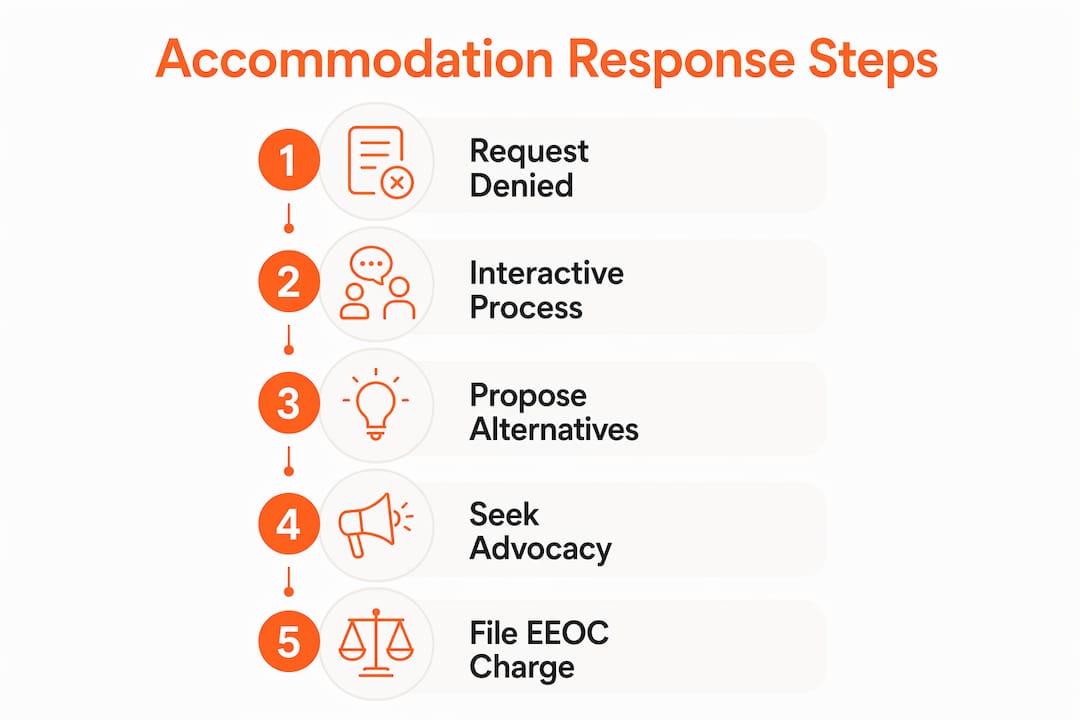
How to respond after your accommodation request is denied
A structured response gives you the best chance of reaching a resolution without litigation. Follow these steps in order.
- Get the denial in writing. If your employer communicated the refusal verbally, send a follow-up email that same day summarizing what was said and asking for written confirmation of the reasons.
- Analyze the stated reason. Match the denial reason to the three lawful grounds above. If the reason does not fit any of them, that is a signal the denial may be legally vulnerable.
- Gather or update medical documentation. If documentation gaps were cited, work with your healthcare provider to produce records that clearly describe your functional limitations and the connection to your requested accommodation. A strong documentation package addresses both the disability and the specific workplace barrier.
- Propose two or three alternatives. Research options before your next meeting. Employees who arrive with researched alternative accommodations have higher success rates in the interactive process. If you requested a private office for concentration and that was denied, alternatives might include noise-canceling headphones, a flexible schedule, or a designated quiet workspace.
- Put every proposal in writing. Email your alternatives to HR after any meeting. This creates a record showing you participated in good faith.
- Escalate internally if needed. If your direct supervisor is the obstacle, request that HR or an ADA coordinator take over the process. Many organizations have formal appeal procedures outlined in their ADA policy.
- Contact the EEOC or a state agency if internal escalation fails. You generally have 180 days from the discriminatory act to file a charge (300 days in states with their own anti-discrimination agencies).
Pro Tip: Before any meeting with HR, write down the two or three alternative accommodations you plan to propose, along with a brief explanation of why each one addresses your functional limitation. Arriving prepared signals cooperative problem-solving and makes it harder for an employer to claim the interactive process was exhausted.

When to seek advocacy or legal help for a denied accommodation
Some situations call for outside support. Recognizing the signs early can prevent months of unproductive back-and-forth.
- The interactive process has stalled. If your employer stops responding, delays meetings without explanation, or refuses to consider any alternative, the good-faith requirement is likely being violated.
- You receive a second denial with no new analysis. A repeated refusal without updated reasoning suggests the employer is not genuinely engaging.
- You face retaliation. Any adverse action (demotion, schedule change, hostile treatment) following your accommodation request is independently unlawful under the ADA.
- The denial affects your ability to perform your job. When an unresolved accommodation refusal directly harms your performance reviews or employment status, the stakes justify professional guidance.
| Resource | What they offer |
|---|---|
| EEOC (eeoc.gov) | Free charge filing; mediation; investigation of employer conduct |
| ADA National Network | Free consulting, publications, and referrals to local ADA centers |
| Job Accommodation Network (JAN) | Free, confidential guidance on accommodation options and legal rights |
| State civil rights agencies | State-level complaint filing; often broader protections than federal law |
| Disability rights attorneys | Representation; demand letters; litigation if needed |
The Job Accommodation Network (JAN) offers free, confidential consulting by phone or online and can help you identify alternative accommodations before or after a denial. The ADA National Network operates ten regional centers across the country, each staffed with specialists who understand both federal and state law. For employees navigating accessibility appeals processes in educational or institutional settings, similar advocacy frameworks apply.
Expert perspectives on navigating accommodation denials
Legal advisors and disability rights specialists consistently make one point that surprises many employees: a written denial is rarely the end of the negotiation. It is, more accurately, the beginning of a more formal phase.
“A denial is often just the start of negotiation. Employees should pivot conversations toward problem-solving on alternatives rather than focusing solely on the refusal.” — Job Accommodation Network (JAN)
Employers sometimes issue denials reflexively, without completing the cost or operational analysis the ADA actually requires. When you push back with specific questions (“What financial analysis supports the undue hardship claim?” or “Which essential job function would this accommodation eliminate?”), employers frequently discover their initial position was not well-founded.
Pro Tip: After every conversation with HR or your supervisor about your accommodation, send a brief follow-up email summarizing what was discussed and any next steps agreed upon. This written record is your most reliable evidence if you later need to file an EEOC charge or pursue legal action.
A few patterns that experienced advocates flag as meaningful:
- Employers who cite undue hardship without providing any cost figures are often relying on assumption rather than analysis.
- Employers who refuse to meet or respond within a reasonable timeframe may be violating their interactive process obligation independently of the merits of your request.
- Proposing alternatives yourself, rather than waiting for the employer to generate options, consistently produces faster resolutions and preserves the working relationship.
Building a strong accommodations request from the start reduces the likelihood of a denial, but when one comes, the same documentation discipline applies to your response.

How a denied accommodation affects your performance and workplace relationships
The impact of an unresolved accommodation refusal extends well beyond the immediate legal dispute. Employees who cannot access effective accommodations often experience measurable declines in productivity, increased absenteeism, and greater difficulty meeting performance standards. Those outcomes can then be misread by managers as performance problems rather than the direct result of an unmet disability-related need.
Workplace relationships also suffer. When an employee perceives that their employer acted in bad faith, trust erodes quickly, and that erosion affects team dynamics, communication, and retention. Employers who handle denials poorly frequently face higher turnover among employees with disabilities, along with the legal and reputational costs that follow.
Addressing a denial promptly and professionally, by re-engaging the interactive process and proposing alternatives, protects both your performance record and the working relationship. Documenting that you acted in good faith throughout also matters if the situation ever reaches the EEOC or a court.
What timeline should you expect for accommodation requests and responses?
The ADA does not specify an exact number of days for employers to respond to accommodation requests, but the EEOC’s guidance makes clear that responses must be timely. Delays that stretch for weeks without explanation can themselves constitute a failure to engage in the interactive process.
In practice, straightforward requests (a chair adjustment, a parking space) should receive a response within one to two weeks. Complex requests involving significant workplace modifications or third-party vendors may reasonably take longer, provided the employer communicates actively throughout. If you have heard nothing after two weeks, send a written follow-up asking for a status update and a projected decision date.
Once a denial is issued, your 180-day window to file an EEOC charge begins. In states with their own anti-discrimination agencies, that window extends to 300 days. Missing these deadlines forfeits your right to federal relief, so calendar them immediately after any denial. For employees considering next steps after a rejected request, reviewing next steps for families and similar guidance can clarify the full range of options available at each stage.
Key Takeaways
A denied workplace accommodation request is not a final answer. The ADA requires employers to continue the interactive process and offer effective alternatives, and employees who document their communications and propose researched options consistently achieve better outcomes.
| Point | Details |
|---|---|
| Written denial request | Always ask for the denial reason in writing to build your documentation record. |
| Lawful denial grounds | Employers may only refuse based on undue hardship, fundamental alteration, or missing documentation. |
| Interactive process obligation | Employers must continue good-faith dialogue and offer effective alternatives even after a denial. |
| EEOC filing deadline | You have 180 days (or 300 days in dual-filing states) from the denial to file a charge. |
| Documentation discipline | Written summaries after every verbal interaction are your strongest evidence for appeals or complaints. |