
Reasonable Accommodation Testing Standard: 2026 Guide
The reasonable accommodation testing standard is defined as the legal requirement that standardized exams be administered in ways that reflect a test-taker’s true aptitude rather than the limitations caused by their disability. Under 28 C.F.R. § 36.309, testing entities must provide modifications that give students with disabilities a fair opportunity to demonstrate what they actually know. This obligation applies to every major standardized exam, including the ACT, SAT, MCAT, and LSAT. Understanding this standard is the first step toward securing the access your student deserves.
What does the reasonable accommodation testing standard require?
The reasonable accommodation testing standard requires testing entities to modify exam conditions so that results measure ability, not disability-related impairment. Federal law under ADA 42 U.S.C. § 12189 establishes this obligation clearly. That means a student with dyslexia who receives extended time is being measured on reading comprehension, not on how fast their disability forces them to process text.
Accommodations fall into several well-recognized categories:
- Extended time: Additional time (typically 50% or 100% extra) for students with processing, attention, or reading disabilities
- Separate testing room: A distraction-reduced environment for students with ADHD or anxiety disorders
- Assistive technology: Screen readers, text-to-speech software, or magnification tools for students with visual impairments
- Accessible formats: Large print, Braille, or digital versions of test materials
- Breaks: Extended or additional breaks for students with physical disabilities or chronic conditions
- Scribe or reader: A human assistant for students who cannot write or read independently
The law draws a firm line at fundamental alteration. An accommodation can be legally denied if it changes what the test actually measures. For example, providing a calculator on a math reasoning exam that tests mental computation crosses that line. Requests that alter exam integrity can be denied without violating the ADA. The key distinction is between removing a disability-related barrier and changing the skill being assessed.
Pro Tip: Frame every accommodation request around what the test measures, not just how the disability affects your student. Show that the accommodation removes a barrier without changing the skill being tested.

What documentation do you need to request accommodations?
Documentation requirements are one of the most misunderstood parts of the accommodation process. Federal rules state that documentation requests must be reasonable and limited to what is necessary to establish the need for the specific accommodation requested. Testing entities cannot demand a full neuropsychological battery when a student’s IEP already documents the same disability and prior accommodations.
The most powerful documentation you already have is your student’s existing records. Here is what carries the most weight:
- IEP (Individualized Education Program): A current IEP from a public school documents both the disability and the accommodations already granted. Testing entities must give this considerable weight.
- 504 Plan: A 504 Plan from a school district carries similar authority and demonstrates that a qualified team already evaluated and approved accommodations.
- Prior test accommodations: If your student received accommodations on a previous standardized exam, that record is strong evidence for the same accommodations on a new exam.
- Evaluation by a qualified professional: When new documentation is needed, it must come from a licensed professional with expertise in the relevant disability, such as a licensed psychologist, neuropsychologist, or physician.
- Functional impact statement: Documentation should explain how the disability specifically impairs the functions the test measures, not just describe the diagnosis in clinical terms.
Testing entities sometimes request excessive documentation despite these federal limits. Applicants can push back by citing their existing IEP or 504 Plan and noting that federal rules prohibit unreasonable documentation demands. Avoid submitting unrelated records or outdated evaluations, as these can slow review rather than help it.
Pro Tip: When submitting documentation, include a one-page summary that connects each accommodation requested to a specific functional limitation and to the student’s existing IEP or 504 Plan. Reviewers process hundreds of files. Make yours easy to approve.
How do you request accommodations step by step?
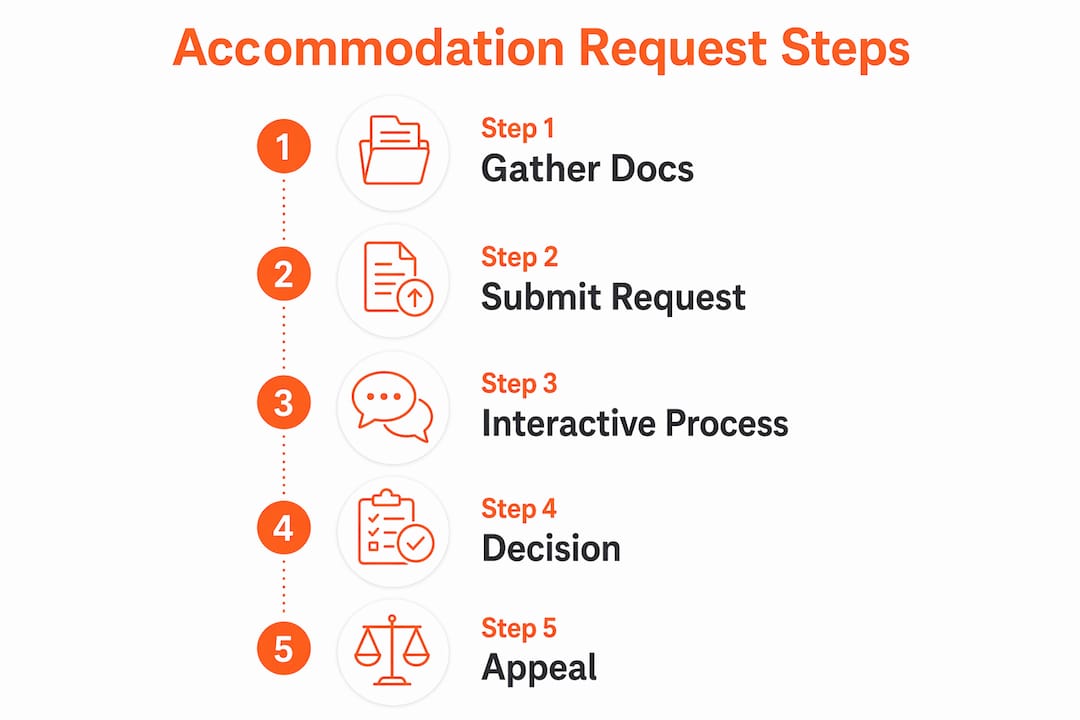
The accommodation request process follows a structured path. Knowing each step reduces the risk of delays or denials.
- Submit your request early. Requests should be submitted at least 30 days before the test date, and many testing programs recommend 60 to 90 days. Late requests may not be approved for the desired test cycle.
- Use explicit ADA language. Explicitly mentioning “reasonable accommodation under the ADA” in your written request signals a formal legal matter. This prompts compliance departments to treat the request seriously rather than routing it through a general customer service queue.
- Submit all documentation at once. Incomplete submissions trigger back-and-forth requests that eat up time. Attach your IEP, 504 Plan, or professional evaluation with your initial request.
- Engage in the interactive process. The ADA requires a good-faith dialogue between the applicant and the testing entity to identify an effective accommodation. This is not a one-way decision. You have the right to participate in that conversation.
- Track every communication. Log dates, names, and the content of every phone call, email, and letter. Maintain detailed, timestamped records of all communications. This documentation protects you if the process stalls or a denial occurs.
- Follow up in writing. After any phone conversation, send a brief email summarizing what was discussed and agreed upon. This creates a paper trail that is difficult to dispute.
The burden of proving undue hardship rests entirely with the testing entity, not with the student or family. A testing organization that stalls, delays without explanation, or refuses to engage in good-faith dialogue may be violating the ADA. Stalling in the interactive process is a recognized red flag for discrimination under federal law.
Testing entities are not required to provide the exact accommodation a student requests. They are required to provide an effective accommodation. If a testing entity proposes an alternative, evaluate whether it genuinely removes the disability-related barrier. If it does not, say so in writing and explain why.
What should you do when accommodations are denied or delayed?
Denials and delays are more common than they should be. Understanding why they happen helps you respond effectively.
Common grounds for denial include:
- Fundamental alteration: The requested accommodation changes what the test measures
- Undue hardship: The accommodation creates significant difficulty or expense for the testing entity (a high bar that testing organizations rarely meet)
- Late submission: The request arrived too close to the test date
- Insufficient documentation: The submitted records do not establish the functional need for the specific accommodation
When a denial arrives, do not treat it as final. Here is how to respond:
- Request a written explanation. You are entitled to know the specific reason for the denial. A vague response is itself a warning sign.
- Counter excessive documentation demands. Testing entities often request excessive documentation despite federal rules. Respond in writing, citing your existing IEP or 504 Plan and noting that federal rules limit documentation demands to what is reasonable and necessary.
- Re-submit with targeted additions. If the denial cites a gap in documentation, address only that gap. Do not flood the reviewer with unrelated records.
- File a complaint with the Department of Justice. The DOJ enforces ADA Title III, which covers testing entities. Unnecessary delays that force missing a test cycle may constitute denial of equal opportunity and are grounds for a formal complaint.
- Consult an advocate or attorney. Organizations specializing in disability rights and education law can review your file and advise on next steps.
Pro Tip: If you suspect the interactive process has broken down, send a written letter to the testing entity stating that you believe the process has stalled and requesting a specific response date. This letter creates a formal record and often accelerates review.
Testaccommodations works directly with students and families who have received denials, helping them build stronger appeals and understand their rights under the ADA. Knowing when to bring in outside expertise can make the difference between a missed test date and a successful outcome.
Key Takeaways
The reasonable accommodation testing standard requires testing entities to modify exam conditions so that results reflect ability, not disability, and the burden of proving any denial falls on the testing organization, not the student.
| Point | Details |
|---|---|
| Legal foundation | ADA 42 U.S.C. § 12189 and 28 C.F.R. § 36.309 require fair testing conditions for students with disabilities. |
| Existing records carry weight | IEPs and 504 Plans receive considerable weight and can satisfy most documentation requirements. |
| Submit early and explicitly | File at least 30 days before the test and use the phrase “reasonable accommodation under the ADA” in your request. |
| Stalling is a red flag | Unexplained delays in the interactive process may constitute ADA violations; document every communication. |
| Denials are not final | Re-submission, DOJ complaints, and legal advocacy are all available responses to an improper denial. |
What I’ve learned from watching families fight for accommodations
Working with families navigating accommodation denials has taught me one consistent lesson: the students who succeed are the ones whose families treat this as a formal legal process from day one, not an informal request.
Most families make the same early mistake. They submit a casual request, leave out their student’s IEP, and wait. When the testing entity comes back asking for a full neuropsychological evaluation, the family feels blindsided. That evaluation can cost $3,000 or more and take months to complete. The test date passes. The student loses a full cycle.
The ADA gives families real power here. The law places the burden of proof on the testing entity, not on you. Your student’s existing school records, built over years by qualified educators and psychologists, carry legal weight. Use them. Lead with them. Do not let a testing organization convince you that those records are insufficient when federal rules say otherwise.
Patience matters, but so does firmness. The interactive process is supposed to be a dialogue. If the testing entity goes silent, push back in writing. If the denial is vague, demand specifics. And if the process has clearly broken down, do not hesitate to bring in an advocate or consult an attorney. The accommodation eligibility criteria under federal law are clear. Families who understand those criteria go into the process with confidence rather than anxiety.
— Roger
Testaccommodations is here when the process gets complicated
Securing test accommodations is straightforward when everything goes right. When testing organizations push back, request excessive documentation, or issue vague denials, the process becomes far more difficult to manage alone.
Testaccommodations advises students and families who are entitled to accommodations for the ACT, SAT, MCAT, LSAT, and other standardized exams and are facing denials or delays. The team helps you build a strong request, interpret your rights under the ADA, and respond to improper denials with the documentation and language that compliance departments take seriously. If your student’s accommodation request has been denied or stalled, visit Testaccommodations to get expert guidance on your next step.
FAQ
What is the reasonable accommodation testing standard?
The reasonable accommodation testing standard is the legal requirement under the ADA that testing entities administer exams in ways that reflect a student’s true ability rather than their disability-related impairment. It applies to all major standardized tests, including the ACT, SAT, MCAT, and LSAT.
How far in advance should you request testing accommodations?
Requests should be submitted at least 30 days before the test date, with 60 to 90 days recommended by many testing programs. Late requests risk not being approved for the desired test cycle.
Can a testing entity deny an accommodation request?
A testing entity can legally deny a request if the accommodation would fundamentally alter what the test measures or create an undue hardship. The burden of proving either of those grounds rests with the testing entity, not the student.
Does an IEP or 504 Plan guarantee accommodations on standardized tests?
An IEP or 504 Plan does not automatically guarantee accommodations, but federal rules require testing entities to give these documents considerable weight. They are the strongest documentation most families already have.
What can you do if your accommodation request is denied?
You can request a written explanation, re-submit with targeted documentation, engage in the interactive process, or file a complaint with the Department of Justice. Consulting a disability rights advocate or attorney is also a recognized option when the process breaks down.