
Qualify for MCAT Accommodations Without a Diagnosis
Many students assume that qualifying for MCAT accommodations requires a formal diagnosis on paper. That assumption stops real candidates from getting support they genuinely need and deserve. You can qualify for MCAT accommodations without a diagnosis if you can demonstrate that a current functional limitation substantially impacts your ability to access the exam under standard timed conditions. This guide walks you through what eligibility actually requires, how to gather the right documentation, how to submit your application correctly, and what to do when the process gets complicated.
Table of Contents
- Key Takeaways
- Qualifying without a diagnosis: what MCAT eligibility actually requires
- Gathering evidence and documentation without a formal diagnosis
- The application process and timelines
- Common challenges when applying without a diagnosis
- Verifying approval and preparing to test with accommodations
- My perspective on functional evidence over diagnosis
- How Testaccommodations can help you through this process
- FAQ
Key Takeaways
| Point | Details |
|---|---|
| Functional limitations drive eligibility | AAMC evaluates how your condition affects MCAT access, not whether you have a formal diagnostic label. |
| Qualified evaluations are non-negotiable | A licensed professional must document your functional limitations with objective, performance-based evidence. |
| Submit at least 105 days early | Late submissions leave no room for reconsideration if your initial request is denied or only partially approved. |
| Prior MCAT attempts raise the bar | If you tested without accommodations before, your evaluator must explain why those scores do not reflect your true access limitations. |
| Partial approvals are common | You may receive some accommodations but not others; knowing your options for reconsideration matters. |
Qualifying without a diagnosis: what MCAT eligibility actually requires
The core misunderstanding most students carry into this process is that a diagnosis is the entry ticket. It is not. MCAT accommodations are determined by functional limitations and test demands, not solely by a diagnostic label. The AAMC wants to know whether your condition creates a substantial barrier to accessing the exam under standard conditions. That is the question your documentation must answer.
Functional limitations relevant to the MCAT include things like:
- Sustained attention deficits that make a seven-hour exam significantly harder than a typical academic task
- Processing speed impairments that cause you to run out of time on passages, even when you understand the content
- Chronic fatigue or pain conditions that worsen meaningfully over extended testing periods
- Anxiety that produces a measurable performance gap between low-stakes and high-stakes timed conditions
A diagnosis can help frame these limitations, but AAMC focuses on current functional barriers, not just diagnostic labels. This means a student with no formal diagnosis who provides objective evidence of a processing speed impairment may have a stronger application than a student with a diagnosis who submits only a letter from a physician without supporting test data.
Pro Tip: Do not confuse “no diagnosis” with “no case.” Your case lives in the functional evidence, not the label.
The distinction between diagnosis and functional impact is not a technicality. It reflects how disability law actually works. The question is always whether a physical or mental impairment substantially limits a major life activity, and standardized testing qualifies as a major life activity.
Gathering evidence and documentation without a formal diagnosis
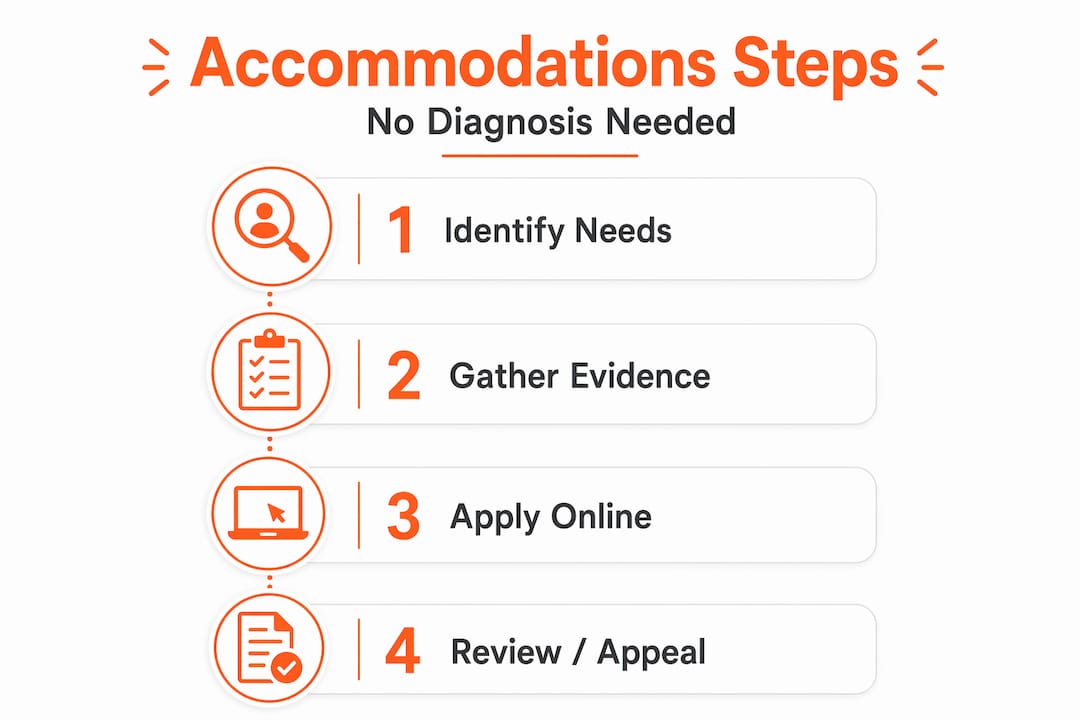
This is where most students either build a strong case or quietly undermine one. The foundation of any successful MCAT accommodations request without a formal diagnosis is a qualified professional’s evaluation that documents your current functional limitations in objective, measurable terms.
Here is a practical sequence to follow:
- Identify a qualified evaluator. Licensed psychologists, neuropsychologists, and physicians with relevant specialization are the professionals whose evaluations carry weight. A general practitioner’s letter alone is rarely sufficient. Documentation must come from a qualified professional whose evaluation links your functional limitations to a specific type of accommodation.
- Request performance-based testing. Ask your evaluator to include standardized, normed assessments. If you are requesting extended time, you need objective timed processing data. If you are requesting additional breaks, you need documentation of fatigue or a need for sustained attention. Matching evidence type to accommodation type improves approval chances significantly.
- Document the functional impact on MCAT-like conditions. Generic statements like “patient reports difficulty concentrating” are not enough. The evaluation should describe how your limitations manifest during long, timed, high-stakes cognitive tasks, which is precisely what the MCAT is.
- Compile your academic and testing history. Even without a diagnosis, prior records matter. A documented history of prior accommodations strengthens applications, but it is not mandatory. School records, teacher observations, IEP or 504 plan documentation, or prior psychological evaluations all add credibility to your request.
- Describe the functional limitation in your own words. The MCAT Accommodations Online (MAO) system includes a section for applicant statements. Use it to connect your documented limitations to the specific demands of the MCAT. Be concrete, not general.
Pro Tip: Ask your evaluator directly: “Does this report explain why I need this specific accommodation for a seven-hour standardized exam?” If they hesitate, the report probably needs more specificity before you submit.
Learning how to build a strong accommodations request before you sit down with an evaluator saves time and prevents the most common reason for denial: documentation that is real but not specific enough to the test context.

The application process and timelines
The MCAT Accommodations Online (MAO) system is where your request formally begins. Understanding the timeline is not optional. It is the difference between having a shot at reconsideration and missing your exam window entirely.
| Milestone | Recommended Timing |
|---|---|
| Begin evaluation with qualified professional | 5 to 6 months before intended exam date |
| Submit MAO application | At least 105 days before exam |
| Receive initial decision | Typically 4 to 6 weeks after submission |
| Submit reconsideration request if needed | Approximately 45 days before exam |
| Confirm accommodation details in registration | After approval, before finalizing test date |
When you complete the MAO application, you will describe your functional limitations in writing and upload supporting documentation. Be precise in the applicant narrative. Reviewers are looking for a coherent story that connects your functional impairment to the specific demands of the MCAT, not a summary of your medical history.
If you have taken the MCAT before without accommodations, address that directly. Prior MCAT scores become part of the evidentiary record and will be noticed by reviewers. Your evaluator must explain, with objective data, why those scores do not reflect adequate access under standard conditions. Ignoring prior attempts is one of the most common and costly mistakes applicants make.
Early planning and buffer time for reconsideration can be the deciding factor in whether you test with support. Do not treat the 105-day window as a suggestion.
Common challenges when applying without a diagnosis
Even well-prepared students run into problems. Knowing where applications typically break down helps you avoid the same pitfalls.
- Conflating diagnosis with functional evidence. Students sometimes submit a physician’s note confirming a condition exists without any data showing how that condition limits MCAT performance. The AAMC needs the “so what” specifically for the exam.
- Documentation that is real but generic. An evaluation that describes your limitations in everyday life without addressing the conditions under which standardized testing occurs is unlikely to succeed. Reviewers are specifically assessing MCAT-like demands.
- Ignoring prior test history. If you took the MCAT without accommodations, documentation must explain why that prior score does not reflect adequate access. Skipping this step signals to reviewers that your limitations may not be as significant as claimed.
- Submitting too late to reconsider. Rushed applications often have gaps. When those gaps lead to denial, there is no time left to appeal before the exam date.
- Misunderstanding partial approvals. Partial approvals are common. You might receive a separate testing room but not extended time. Extended time requests face the heaviest scrutiny and are most often denied when objective, timed processing data is absent.
Pro Tip: If you receive a partial approval, read the denial rationale carefully. It tells you exactly what evidence was missing, which is your roadmap for reconsideration.
Consulting MCAT accommodations resources before you submit, rather than after a denial, is always the more efficient path. TestAccommodations works specifically with students who have received denials and understands what reviewers are actually looking for in documentation.
Verifying approval and preparing to test with accommodations
Once you receive an approval decision, do not assume the process is finished. Verification and preparation are their own steps.
- Review your approval letter carefully. Confirm that every accommodation you requested is listed and described accurately. Discrepancies between what was approved and what appears in your testing record create problems on exam day.
- Register for your exam date after confirming accommodations. Do not register before your accommodations are confirmed in the system. Changing your registration after the fact is possible, but adds unnecessary complexity.
- Understand exactly what each accommodation means in practice. Extended time, for example, is calculated differently depending on the section. Know how your specific accommodations will be applied before you sit down to test.
- Practice under your approved conditions. If you have extended time, practice with extended time. Testing with unfamiliar conditions on exam day, even favorable ones, can disrupt your performance.
- Know your options if denied or only partially approved. You can submit a reconsideration request with additional documentation. If that fails, you can explore whether a formal evaluation leading to a diagnosis changes your eligibility picture. Test Accommodations advises students specifically in these situations, including those navigating testing accommodations FAQs after a denial.
My perspective on functional evidence over diagnosis
I have worked with enough students going through this process to say something plainly: the diagnosis question is a distraction for most people. What I have seen derail applications repeatedly is not the absence of a label. It is the absence of a coherent, exam-specific story told through objective data.
Students often come to me after a denial, holding documentation that is genuinely accurate about their experience but completely silent on what that experience means for a seven-hour, timed, high-stakes exam. Reviewers are not unsympathetic. They are constrained by what the documentation actually says.
What I have learned is that visible academic success without documented cost is one of the most underestimated obstacles in this process. If your GPA is strong and your evaluator does not explain the compensatory effort behind it, reviewers may reasonably conclude that standard conditions are not a barrier for you. The effort has to be visible in the record.
My honest advice: start earlier than you think you need to; find an evaluator who specifically understands standardized testing contexts; and do not submit anything until you can answer this question yourself: does this documentation explain, with data, why I cannot access this specific exam fairly under standard conditions? If the answer is no, keep working.
— Roger
How Testaccommodations can help you through this process
Gathering the right documentation, writing a precise applicant narrative, and managing deadlines across a months-long process is genuinely difficult, especially when you are also preparing for one of the most demanding exams of your academic career.

Testaccommodations specializes in advising students who are entitled to accommodations and are facing denials or navigating the process for the first time without a formal diagnosis. Whether you need guidance on what your evaluation should include, help understanding a partial approval, or support building a reconsideration case, the team at Testaccommodations has the expertise to help. You do not have to figure out what reviewers are looking for on your own. Explore the available resources and connect with specialists who handle these cases every day.
FAQ
Can you get MCAT accommodations with no formal diagnosis?
Yes. MCAT accommodations eligibility is based on documented functional limitations, not diagnostic labels. A qualified professional’s evaluation showing how your condition affects your performance on standardized tests is what matters most.
What counts as a functional limitation for MCAT accommodations?
Functional limitations include measurable impairments in sustained attention, processing speed, fatigue, or anxiety that create a substantial barrier to accessing the MCAT under standard timed conditions.
How early should you apply for MCAT accommodations?
Submit your MAO application at least 105 days before your intended exam date. This timeline allows room for the review process and a reconsideration request if your initial application is denied.
What happens if you previously took the MCAT without accommodations?
Your evaluator must provide objective, data-grounded explanations of why your prior scores do not reflect adequate access to the exam. Ignoring prior attempts is a common reason applications are denied or questioned.
What should you do if your MCAT accommodations are only partially approved?
Read the denial rationale carefully to identify missing evidence, then submit a reconsideration request with documentation that directly addresses those gaps. Consulting a specialist like Testaccommodations before resubmitting significantly improves your chances.