
How to Request Extended Time Without Prior Accommodations
Students can request extended time without prior accommodations on standardized tests like the SAT, ACT, MCAT, and LSAT by providing current professional documentation that demonstrates a disability’s functional impact. No prior IEP or 504 Plan is required. The Americans with Disabilities Act (ADA) requires testing organizations to consider your full history, including informal accommodations, not just formal school plans. The core challenge is not your lack of prior accommodations history. It is the quality and specificity of the documentation you submit.
What does it mean to request extended time without prior accommodations?
Extended time accommodations are defined as formally granted additional testing time for students whose disability substantially limits one or more major life activities, including reading, processing, or concentrating. The ADA establishes that eligibility without prior accommodations is legally valid, provided the student submits current professional documentation and, where applicable, a history of informal support. This matters because many students with ADHD, dyslexia, anxiety disorders, or processing differences never received a formal IEP or 504 Plan in school, yet still qualify for extended time on high-stakes exams.
Testing organizations focus on current functional impairment, not school records alone. A student who received informal extra time from a teacher, or who was allowed untimed practice tests at home, can reference that history as supporting evidence. The ADA explicitly requires testing bodies to consider informal accommodation history alongside professional evaluations. That legal protection is the foundation of every successful extended time request filed without a prior formal plan.

What documentation do you need when you have no prior accommodations?
The documentation requirement is where most first-time applicants either succeed or fail. Testing organizations require current, professionally prepared evaluations that connect a specific diagnosis to a specific functional limitation. A letter from a pediatrician saying a student “has ADHD and may need more time” is not sufficient. The evaluation must explain how the diagnosis impairs timed performance and why extended time is the appropriate remedy.
Acceptable documentation typically includes:
- Neuropsychological or psychoeducational evaluations completed within the past three to five years, depending on the testing body’s requirements
- Physician or psychiatrist letters that describe the diagnosis, treatment history, and specific functional limitations in academic or testing settings
- School records or teacher statements documenting informal accommodations, such as extended deadlines, reduced-time assignments, or untimed classroom tests
- Standardized test scores from cognitive or achievement batteries (e.g., Woodcock-Johnson, WAIS-IV) that show processing speed or reading fluency deficits
The evaluation narrative must link diagnosis to accommodation. Vague applications are routinely rejected by testing organizations, and the most common reason for denial is a failure to specify exactly how much additional time is needed and why. An evaluator who recommends “some extra time” gives reviewers nothing to approve. An evaluator who recommends “time and one-half (50% extended time) due to processing speed deficits in the 18th percentile” gives reviewers a clear, defensible basis for approval.
Informal accommodations carry real weight. Students with ADHD who received teacher-granted extra time without a formal plan can document that history through teacher statements or school correspondence. That informal record, paired with a current professional evaluation, substantially strengthens an extended time request.
Pro Tip: Ask your evaluator to specify the exact percentage of extended time recommended (25%, 50%, or 100%) in the written report. Requests that match the evaluator’s precise recommendation have significantly higher approval rates than requests using vague language.
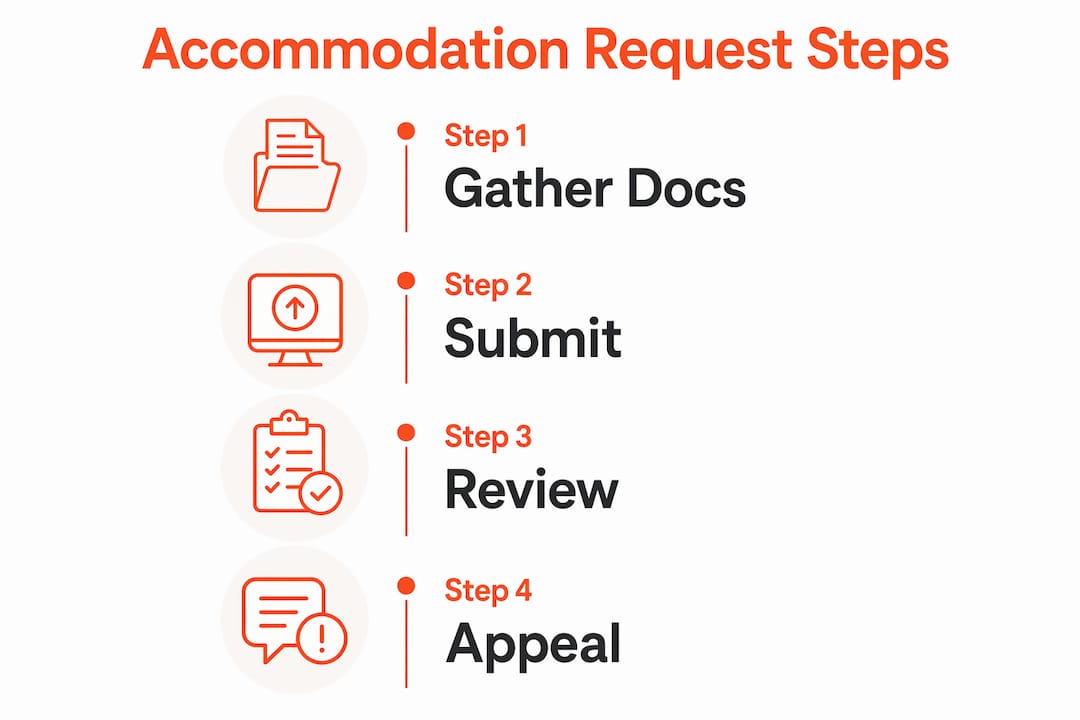
When and how should you prepare and submit your request?
Timing is the second most common point of failure. Students who begin gathering documentation two weeks before a test date almost always miss deadlines or submit incomplete files.
Start 4–6 months before your target test date. Scheduling a neuropsychological evaluation, receiving the written report, and gathering supporting documents takes time. Experts recommend beginning the process at least 105 days before the exam to allow for review and, if necessary, an appeal.
Identify the correct submission portal for your exam. The College Board uses its SSD Online portal for SAT accommodations. The AAMC has its own accommodations request system for the MCAT. The ACT uses its own online platform. Each has different forms, documentation checklists, and reviewer timelines.
Submit SAT accommodation requests at least 7 weeks before the testing start date. Late SAT applications are routinely denied on procedural grounds, regardless of documentation quality. Missing this deadline is an avoidable error.
Complete the narrative sections of the application in full. Do not leave fields blank or write “see attached.” Testing organizations require detailed narratives connecting diagnosis to requested accommodations directly in the application form.
Keep copies of every document submitted. Save confirmation emails, upload receipts, and submission timestamps. If a dispute arises, this paper trail is your primary defense.
Follow up within two weeks of submission. Most testing organizations provide a status update window. If you have not received confirmation of receipt, contact the accommodations office directly.
Pro Tip: Create a dedicated folder (digital and physical) for every document related to your accommodation request. Include the date you obtained each item, the name of the professional who prepared it, and the date you submitted it. This record protects you during appeals.
What are the most common mistakes students make when requesting extra time?
The mistakes that lead to denials are predictable, and most are avoidable with preparation.
- Submitting outdated evaluations. Many testing organizations require evaluations completed within three years. A psychoeducational report from middle school will not support a college entrance exam request.
- Failing to specify the exact time extension needed. Requests that do not name a specific percentage (25%, 50%, 100%) give reviewers no clear accommodation to approve.
- Missing application deadlines. Deadline errors are the fastest path to denial. No testing organization is required to accept late submissions.
- Submitting incomplete forms. Blank fields, missing signatures, or absent supporting documents trigger automatic rejection in most review systems.
- Relying solely on a diagnosis without functional evidence. A diagnosis alone does not establish entitlement. The documentation must show how the condition impairs timed test performance specifically.
“Being denied initially is common, and appeal processes are designed to address documentation gaps. Persistence often leads to success. Students who submit additional specific evidence on appeal frequently receive approval after an initial denial.”
Appeal procedures exist at every major testing organization, and they are not a last resort. They are a built-in part of the process. Testing organizations are also legally prohibited from demanding redundant or excessive documentation that causes undue delays. ADA legal compliance standards require timely review of accommodation requests, and delays that violate equal opportunity protections can be formally contested.
How can students and parents advocate effectively during the process?
Self-advocacy is a skill, and it produces measurable results in accommodation outcomes. These strategies apply whether you are a student managing the process independently or a parent supporting a high schooler through their first standardized test application.
- Communicate in writing with testing organizations. Phone calls leave no record. Emails and portal messages create a documented trail that supports appeals if needed.
- Request a copy of the denial letter and review it carefully. Denial letters specify the exact reason for rejection. That reason tells you precisely what supplemental documentation to gather for an appeal.
- Engage your school’s SSD coordinator or counselor early. Even without a formal 504 Plan, school staff can provide written statements describing informal accommodations they observed or provided.
- Consult an expert if the process feels unclear. Families navigating accommodation eligibility criteria for the first time often benefit from professional guidance, particularly when documentation is complex or a denial has already occurred.
- Document every informal accommodation your student has ever received. Teacher emails, assignment extensions, untimed practice tests, and classroom modifications all count as supporting evidence under ADA guidelines.
- Know your appeal rights and use them. A first denial is not a final answer. Students who submit self-advocacy strategies and supplemental evaluations on appeal succeed regularly.
Persistence matters. The accommodation request process rewards students and families who are thorough, organized, and willing to push back when a denial is unjustified.
Key takeaways
Students without prior formal accommodations can qualify for extended testing time under the ADA by submitting current professional documentation that links their diagnosis to a specific functional impairment and a specific time extension percentage.
| Point | Details |
|---|---|
| ADA eligibility without prior plans | The ADA allows extended time requests based on current documentation, even without an IEP or 504 Plan. |
| Documentation specificity matters most | Evaluations must name the exact time extension (25%, 50%, 100%) and connect it to a diagnosed functional limitation. |
| Start 4–6 months early | Beginning the process well before your test date allows time for review, revisions, and appeals if needed. |
| Informal accommodations count | Teacher-granted extra time and school-based support without formal plans can support your eligibility claim. |
| Denials are not final | Appeal processes exist at every major testing organization and frequently succeed with additional specific evidence. |
What I’ve learned from watching families navigate this process
The students who succeed in getting extended time approved without prior accommodations share one trait: they treat the application like a legal brief, not a form to fill out. Every claim is supported. Every recommendation is specific. Every informal accommodation is documented in writing.
The families who struggle are usually the ones who assume a diagnosis is enough. A diagnosis is a starting point. What testing organizations actually evaluate is functional impairment in a timed testing context, and that requires a professional who knows how to write for that audience. I have seen strong cases denied because the evaluator used vague language, and I have seen borderline cases approved because the documentation was precise and the narrative was clear.
My honest advice: do not wait for a denial to get organized. Start building your documentation file the moment you decide to pursue accommodations. If you do receive a denial, read it carefully. Most denials tell you exactly what is missing. That information is your roadmap for a successful appeal. The appeal process for test accommodations is not a consolation prize. It is a legitimate second review, and it works.
— Roger
How Testaccommodations supports students through this process
Testaccommodations works directly with students and families who are navigating accommodation requests on standardized tests, including those without any prior formal accommodation history.
The team at Testaccommodations reviews documentation, identifies gaps before submission, and advises families on how to strengthen applications and respond to denials. If you have already received a denial, the team can assess whether your documentation meets ADA standards and guide you through the appeal. Students preparing for the SAT, ACT, MCAT, LSAT, or other high-stakes exams can get expert support at every stage, from initial evaluation review to final submission. Families who want to build a strong accommodations request from the start will find practical, specific guidance tailored to their situation.
FAQ
Can I get extended time if I never had an IEP or 504 Plan?
Yes. The ADA allows students to request extended time without prior formal accommodations, provided they submit current professional documentation showing a disability’s functional impact on timed testing.
What type of evaluation do I need for an extended time request?
A neuropsychological or psychoeducational evaluation is the most accepted form of documentation. It must include standardized test scores, a clear diagnosis, and a specific recommendation for the percentage of extended time needed.
How far in advance should I submit my accommodation request?
Experts recommend starting the process 4–6 months before your test date. SAT requests must be submitted at least 7 weeks before the testing start date, and MCAT requests should be filed at least 105 days in advance.
What happens if my extended time request is denied?
You have the right to appeal. Denial letters specify the exact documentation gap, and submitting additional specific evidence on appeal frequently results in approval. Testing organizations are legally required to review appeals promptly under ADA standards.
Do informal accommodations from school count as supporting evidence?
Yes. Teacher-granted extra time, untimed assignments, and other informal classroom supports can be documented through teacher statements or school correspondence and submitted as part of your accommodation request.