
How to Find a Disability Advocate for Standardized Tests
A disability advocate for standardized tests is a trained professional who helps students with disabilities secure legally entitled testing accommodations under the Americans with Disabilities Act and test vendor policies. When you need to find a disability advocate for standardized tests, the stakes are real: without the right support, your child may sit for the SAT, ACT, MCAT, or LSAT without the accommodations they are legally owed. The process involves two separate systems, school-based eligibility and test vendor approval, and an experienced advocate knows how to work both tracks at once. This guide explains exactly what to look for, how to prepare, and where to find qualified support.
What qualifications should you look for in a disability advocate for standardized tests?
The right advocate holds more than general special education knowledge. You need someone who understands the intersection of ADA law, Section 504, IEP procedures, and the specific approval processes of test vendors like College Board, ACT, Inc., NBME, and LSAC. These organizations operate independently from your child’s school, and their documentation standards differ significantly from what an IEP team requires.
Here is what to prioritize when evaluating a potential advocate:
- ADA and Section 504 fluency: The advocate must understand that testing accommodations are changes to the testing environment and auxiliary aids that allow students to demonstrate their true aptitude, not advantages that alter what the test measures.
- Test vendor experience: Confirm the advocate has worked directly with College Board’s Services for Students with Disabilities (SSD), ACT’s Accommodations department, or the relevant vendor for your child’s test. Procedures, timelines, and documentation thresholds vary by vendor.
- Familiarity with both documentation tracks: A strong advocate recognizes that school eligibility and test vendor approval are parallel processes requiring separate documentation efforts.
- Access to free consultations: Organizations like CASE offer a free 45-minute consultation by phone or video, which lets families assess advocacy needs before any financial commitment.
- Track record with denials and appeals: If your child has already received a denial, the advocate’s experience with appeals and dispute resolution becomes the most critical qualification.
Pro Tip: Ask any prospective advocate directly: “Have you worked with College Board’s SSD coordinator process?” and “Can you describe a case where you successfully appealed a denied accommodation?” Vague answers are a red flag.
Checking references from other families and confirming whether the advocate works collaboratively with school teams and test vendors will save you significant time and frustration later in the process.

How to prepare documentation for a standardized test accommodation request
Documentation is where most accommodation requests succeed or fail. ADA standards require that documentation requests be reasonable and limited to what is necessary to establish the disability and the need for the specific accommodation. That means you do not need to submit every evaluation your child has ever received.
The table below outlines the primary documentation types, their purpose, and their relative weight in a test vendor’s review:
| Documentation type | Purpose | Significance |
|---|---|---|
| Current IEP or 504 Plan | Establishes school-based eligibility and existing accommodations | High, especially when combined with certification of current need |
| Psychoeducational or neuropsychological evaluation | Documents cognitive and academic functioning tied to the disability | High; must reflect current functioning (typically within 3 to 5 years) |
| Medical or psychiatric diagnosis letter | Confirms diagnosis from a licensed clinician | Moderate; strongest when linked to functional impairment in test conditions |
| Teacher or counselor observations | Provides behavioral and academic context | Supplementary; supports but does not replace clinical documentation |
| Prior test accommodation approvals | Demonstrates established history of accommodation use | High; College Board and ACT give significant weight to prior approvals |
One critical distinction: having an IEP or 504 Plan does not automatically grant College Board accommodations. Your child must submit a separate request and receive explicit approval from College Board’s SSD office. Many families lose weeks, sometimes an entire test cycle, by assuming the school plan transfers automatically.
Your advocate’s job is to tailor each document to the specific accommodation being requested. Advocacy arguments are strongest when each accommodation is explicitly tied to the student’s documented functional limitations and the specific test condition it modifies. A request for extended time, for example, must connect the student’s processing speed scores to the timed format of the SAT or ACT, not just reference a diagnosis.
Pro Tip: Avoid submitting a large, unorganized packet of records. Organize documentation by accommodation type, with a cover letter from your advocate that maps each piece of evidence to the specific accommodation requested and the ADA standard it satisfies.
For families managing SAT disability accommodations, the documentation timeline matters as much as the content. College Board’s SSD review can take several weeks, so starting at least three months before the target test date is the baseline, not the ideal.
How do you find and engage a disability advocate for standardized test accommodations?
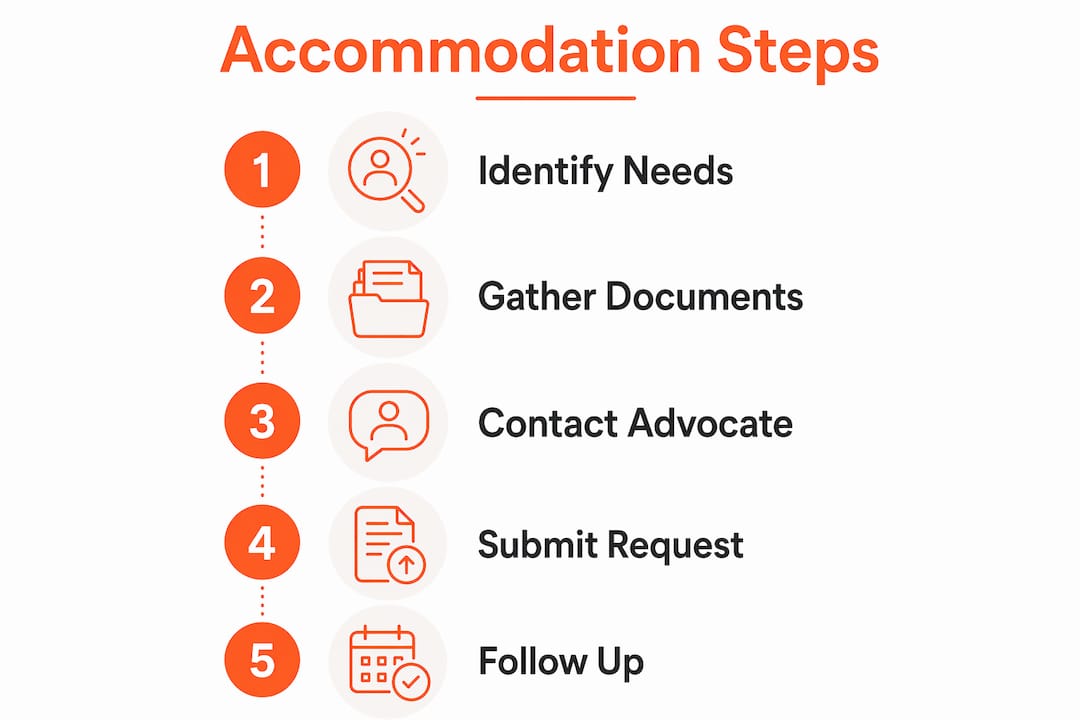
Locating a qualified advocate requires knowing where to look and what to ask once you find one. The following steps give you a structured path from search to active engagement.
Start with nonprofit advocacy organizations. CASE (Community Alliance for Special Education) and similar regional nonprofits maintain lists of trained advocates and offer sliding-scale or free services. Your state’s Parent Training and Information (PTI) center, funded under IDEA, is another no-cost starting point.
Contact your local Area Agency on Aging and Disability Resource Center (ADRC). ADRCs connect families to disability support services, including advocacy referrals for educational and testing contexts.
Ask your child’s school district for a list of independent advocates. Districts are required in many states to provide this information. The advocate you choose should be independent of the school to avoid conflicts of interest during disputes.
Prepare before your first consultation. Bring your child’s most recent IEP or 504 Plan, any prior test accommodation approvals or denials, current evaluations, and a written summary of the accommodations you are requesting and why. Free initial consultations are most productive when families arrive with organized materials.
Ask targeted questions during the consultation. Confirm the advocate’s experience with the specific test vendor, their familiarity with ADA testing accommodation standards, their process for handling denials, and their expected timeline for submitting requests.
Establish a communication plan. Agree on how often you will receive updates, who contacts the test vendor’s SSD coordinator, and what happens if additional documentation is requested mid-review.
If denied, act immediately. Test vendors have formal appeals processes. Timeliness is critical; advocates help families respond quickly to additional information requests and avoid being excluded from test cycles due to delayed approvals.
State dispute resolution agencies and university disability services offices are additional resources, particularly for graduate-level tests like the MCAT or LSAT, where the advocacy landscape differs from K-12 contexts. For a broader overview of how standardized testing impacts students with disabilities, Testaccommodations provides detailed guidance tailored to each major test.
Common mistakes families make when seeking test accommodations
The most damaging mistake is assuming that a school-based accommodation plan transfers automatically to a standardized test. College Board’s separate approval process is the single most common source of denied or delayed accommodations, and it catches families off guard every test cycle.
Several other patterns consistently derail accommodation requests:
- Submitting documentation that does not address functional impairment. A diagnosis alone is not sufficient. The documentation must connect the disability to a specific limitation in the test environment.
- Missing submission deadlines. College Board and ACT have firm deadlines tied to registration windows. Late submissions are not reviewed for that test cycle, regardless of the strength of the request.
- Overloading the request with irrelevant records. More documentation does not mean a stronger case. Reviewers focus on whether the materials directly support the requested accommodation.
- Failing to track communications. Every email, letter, and phone call with the test vendor’s SSD office should be documented with dates and content summaries.
“Testing entities must respond in a timely manner and cannot impose burdensome documentation requirements that go beyond what is necessary to establish the disability and the need for the accommodation.” — ADA.gov
Advocates who specialize in test accommodations know how to limit excessive documentation demands and push back when vendors request information that exceeds ADA standards. That expertise alone can prevent months of unnecessary back-and-forth.
Pro Tip: Create a dedicated folder, physical or digital, for every document, email, and decision related to your child’s accommodation request. If you need to file a formal complaint or appeal, this record becomes your primary evidence.
Understanding the difference between testing modifications vs. accommodations is also worth your time before submitting any request, since vendors treat these categories differently under ADA.
Key takeaways
Securing standardized test accommodations requires a qualified disability advocate who understands both ADA law and the specific approval processes of test vendors like College Board, ACT, Inc., and LSAC.
| Point | Details |
|---|---|
| Advocates navigate two parallel tracks | School-based IEP/504 eligibility and test vendor approval are separate processes requiring distinct documentation. |
| Documentation must be targeted | Each accommodation request must link the student’s functional limitations directly to the specific test condition being modified. |
| Free consultations exist | Organizations like CASE offer free 45-minute consultations to help families assess their advocacy needs before committing. |
| Timeliness determines test cycle access | Late submissions are not reviewed; starting at least three months before the test date is the minimum recommended lead time. |
| Denials are not final | Formal appeals processes exist at every major test vendor, and an experienced advocate significantly improves outcomes. |
Why advocacy is the factor most families underestimate
I have worked with hundreds of families who arrived at the accommodation process confident that their child’s IEP would handle everything. It never does. The gap between school eligibility and test vendor approval is where students fall through, and it is entirely preventable with the right guidance.
What surprises most parents is not the complexity of the law. It is the procedural specificity of each test vendor. College Board’s SSD process, ACT’s accommodation review, and LSAC’s system each have their own documentation thresholds, timelines, and reviewer expectations. An advocate who knows one does not automatically know the others.
My honest recommendation: start with a free consultation before you do anything else. Not because you need to spend money, but because 45 minutes with a qualified advocate will tell you exactly which documents you have, which you are missing, and how strong your current case is. That clarity is worth more than weeks of independent research.
The families who succeed in securing accommodations are not the ones with the most documentation. They are the ones who submitted the right documentation, on time, with a clear argument connecting each accommodation to a specific functional limitation. That is what a skilled advocate delivers. Seeing advocacy as empowerment rather than legal maneuvering changes how you approach the entire process, and it changes outcomes.
— Roger
How Testaccommodations can help you secure the right support
Testaccommodations specializes in advising students and families who are entitled to accommodations for the SAT, ACT, MCAT, LSAT, and other high-stakes tests and are facing denials or delays. The team understands both the legal framework and the procedural specifics of each major test vendor, which is exactly the combination families need when navigating a complex or disputed request.
If your child has been denied accommodations or you are preparing a first-time request and want to get it right, Testaccommodations offers direct, expert guidance on securing test accommodations for students with disabilities. Visit the site to explore consultation options and learn how to build the strongest possible case for your child’s needs.
FAQ
What does a disability advocate do for standardized test accommodations?
A disability advocate helps families prepare documentation, submit accommodation requests to test vendors like College Board or ACT, and appeal denials. Their role is to ensure requests meet ADA standards and the specific requirements of each testing entity.
Does an IEP or 504 Plan automatically grant test accommodations?
No. Having an IEP or 504 Plan does not automatically grant accommodations from College Board or other test vendors. A separate request and approval from the vendor’s accommodation office is required.
How do I find a free disability advocate for standardized tests?
Organizations like CASE offer a free 45-minute consultation by phone or video. Your state’s Parent Training and Information center, funded under IDEA, also provides no-cost advocacy support and referrals for families seeking help with standardized test assistance.
What documentation is required for a standardized test accommodation request?
Documentation must be reasonable and limited to what establishes the disability and the need for the specific accommodation. This typically includes a current IEP or 504 Plan, a recent psychoeducational evaluation, and evidence linking the student’s functional limitations to the requested testing modification.
What should I do if my child’s accommodation request is denied?
File a formal appeal immediately through the test vendor’s process and engage a qualified advocate if you have not already done so. Timeliness is critical because delayed responses can result in missing the next available test cycle entirely.
Recommended
- Why Standardized Tests Disadvantage Disabled Students - Test Accomodations
- How Standardized Testing Impacts Students With Disabilities - Test Accomodations
- SAT Disability Accommodations: Key Steps for Families - Test Accomodations
- Best Practices for Testing Students With Disabilities - Test Accomodations