
How to Apply for LSAT Disability Accommodations in 2026
LSAT disability accommodations are formal testing adjustments granted by the Law School Admission Council (LSAC) to candidates whose documented disabilities create functional limitations under standard timed testing conditions. To apply for LSAT disability accommodations, you submit a request through the LSAC JD Services portal, supported by qualifying professional documentation, at least six weeks before your scheduled test date. The process is governed by strict eligibility standards, documentation requirements, and deadlines that can derail unprepared applicants. This guide walks you through every stage of the LSAT accommodations process, from confirming eligibility to appealing a denial, so you can approach your test date with the support you are entitled to receive.
What are the eligibility criteria for LSAT disability accommodations?
LSAC grants disability support for LSAT candidates who have a documented physical, psychological, learning, or medical condition that substantially limits one or more major life activities, including reading, concentrating, or processing information under timed conditions. The diagnosis alone is not sufficient. LSAC requires evidence that the condition creates a functional impairment specifically relevant to the LSAT’s testing environment.
The following categories of disabilities are covered under LSAC’s accommodation policy:
- Learning disabilities and ADHD: Dyslexia, dyscalculia, processing disorders, and attention deficit disorders qualify when supported by a psychoeducational evaluation completed within the last five years.
- Psychological and psychiatric conditions: Anxiety disorders, depression, PTSD, and similar conditions qualify when documented by a licensed mental health professional with current treatment records.
- Physical and medical conditions: Chronic illness, mobility impairments, visual or hearing impairments, and neurological conditions qualify with physician letters confirming current functional impact.
- Temporary medical conditions: Injuries or short-term conditions may qualify on a case-by-case basis with supporting medical documentation.
Evaluations for learning disabilities or ADHD must be completed within the last five years, and medical conditions require proof of current impairment. This recency standard exists because LSAC must confirm that the condition is active and continues to affect your functioning, not that it existed at some point in the past.
One of the fastest paths through the eligibility process applies to candidates who received identical accommodations on the SAT, ACT, GRE, GMAT, MCAT, or a state bar exam. Prior standardized test accommodations can trigger automatic LSAT approval without requiring you to resubmit a full documentation package. This route is the most efficient available and is worth confirming before you begin assembling new materials.
For a complete breakdown of what qualifies, the LSAT eligibility accommodation checklist from Testaccommodations covers the 2026 documentation standards in detail.
How to prepare the documentation needed to apply for LSAT accommodations

Documentation is where most LSAT special accommodations applications succeed or fail. LSAC does not approve requests based on a diagnosis letter alone. Every document you submit must connect your specific condition to the functional limitations you experience under timed, high-stakes testing conditions.
The core documents LSAC typically requires include:
- Psychoeducational evaluation report: Required for learning disabilities and ADHD. Must include standardized test scores, a DSM-5 diagnosis, developmental and educational history, and explicit accommodation recommendations from the evaluating psychologist.
- Physician or psychiatrist letter: Required for medical and psychiatric conditions. Must confirm the current diagnosis, describe how the condition impairs functioning, and recommend specific accommodations.
- Prior accommodation records: IEP documents, 504 plans, or letters from a previous standardized testing body confirming accommodations granted.
- Personal statement (optional but strategic): A written statement from you describing how your condition affects your ability to perform under standard LSAT conditions.
The most common reason LSAC denies requests is that reports fail to explain why accommodations are necessary specifically for the LSAT’s timed testing conditions. A diagnosis of ADHD, for example, does not automatically justify extended time. Your evaluator must explicitly state that your processing speed, sustained attention, or working memory deficits create a measurable disadvantage under timed conditions. Generic clinical language will not satisfy LSAC’s reviewers.
When working with your evaluator, ask them to address three specific points in their report: the standardized test scores that support the diagnosis, the observed functional limitations in timed or high-pressure tasks, and the direct connection between those limitations and the accommodations being requested. A detailed diagnostic report linking test metrics to timed performance limitations significantly improves approval chances.
Common documentation errors to avoid:
- Submitting evaluations older than five years for learning disabilities or ADHD
- Providing a diagnosis without functional impact data
- Failing to specify which accommodations are recommended and why
- Submitting documents in formats other than PDF
Pro Tip: Write a one to two page personal statement describing specific instances where your disability has impacted your performance under timed conditions, such as standardized tests, timed exams in college, or professional licensing tests. LSAC reviewers are human, and a clear, factual personal narrative can contextualize clinical data in ways that raw scores cannot.
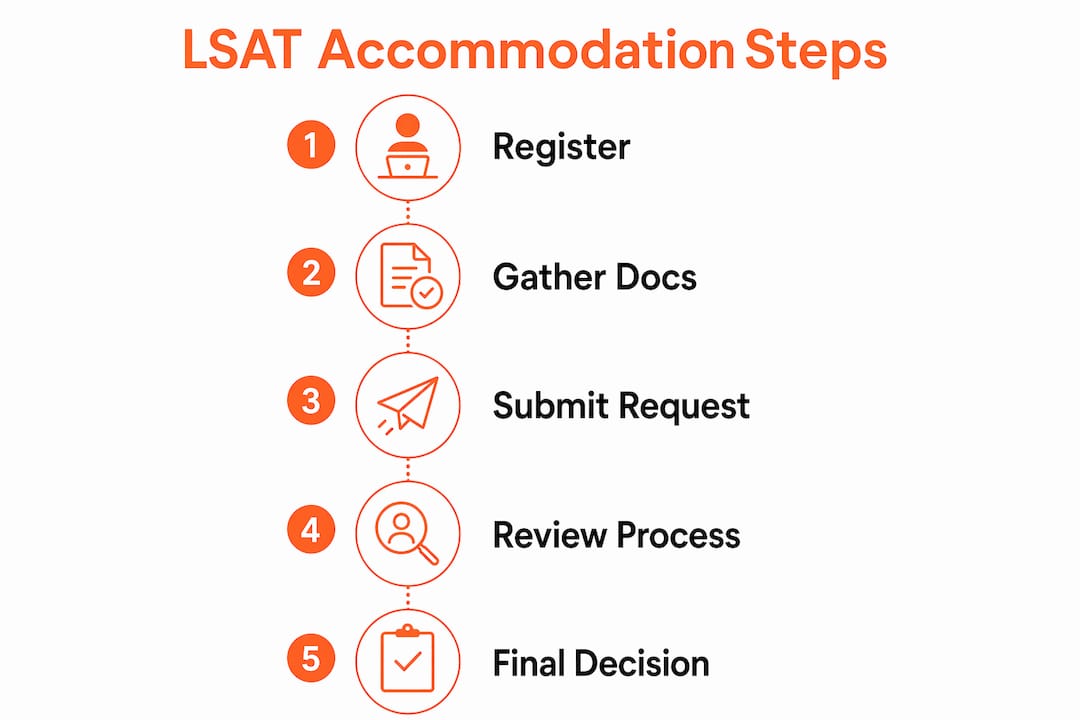
Step-by-step process to apply for accommodations on the LSAT
The LSAT accommodations process follows a defined sequence. Skipping or reordering steps will delay your request or make it ineligible for review.
- Register for the LSAT. You cannot submit an accommodation request until you have an active LSAT registration. Log into your JD Services account at LSAC.org and register for your target test date first.
- Access the accommodations request form. Inside JD Services, navigate to “Request or Modify Accommodations” under the Accessibility Services section. This is the only official channel for submitting LSAT test accommodations.
- Complete the request form. Specify the accommodations you are requesting, such as extended time (time and a half or double time), a separate testing room, a scribe, screen reader access, adjustable lighting, or physical accommodations. LSAC offers a range of accommodations, and each one requires documentation reflecting the specific functional limitation it addresses.
- Upload all supporting documents as PDFs. All documents must be uploaded to the LSAC Accessibility Services portal within JD Services. Paper submissions are not accepted.
- Submit at least six weeks before your test date. Accommodation requests must be submitted at least six weeks before the LSAT date, and review typically takes three to six weeks. Late submissions frequently result in deferral to the next testing cycle.
- Monitor your application status. Log into JD Services regularly to check for status updates or requests for additional documentation. LSAC may ask for supplemental materials, and delays in responding extend your review timeline.
- Confirm your testing modality. Starting August 2026, the LSAT requires in-person testing at Prometric centers, with remote testing exceptions limited primarily to candidates living more than 180 miles from a center or those with qualifying medical conditions. If you need remote testing as an accommodation, request it explicitly in your application.
| Step | Timeline |
|---|---|
| Register for LSAT | As early as possible |
| Begin documentation collection | 8 to 10 weeks before test date |
| Submit accommodation request | At least 6 weeks before test date |
| LSAC review period | 3 to 6 weeks |
| Receive decision | Before test date (if submitted on time) |
Starting documentation collection eight to ten weeks before your test date is best practice, given that late submissions often force candidates to reschedule to the next LSAT cycle entirely.
What to do if your LSAT accommodations request is denied or needs modification
A denial from LSAC is not a final answer. The formal appeals process exists specifically to allow candidates to submit additional evidence and challenge an incorrect decision.
The most common reasons for initial denial include:
- Documentation that does not meet recency standards
- Evaluations that describe a diagnosis without linking it to functional limitations under timed conditions
- Requests for accommodations that are not supported by the specific evidence submitted
- Missing forms or incomplete uploads in the JD Services portal
When you receive a denial, read the explanation carefully. LSAC typically identifies which element of your submission was insufficient. That specificity tells you exactly what to fix. Appeals often succeed when supplemented by additional documentation and strong professional opinions linking the disability to the requested accommodations. A letter from a university disability services office, a peer-reviewed clinical opinion, or an updated evaluation report can each serve as effective supplemental evidence.
The formal appeal must be submitted through JD Services within the timeframe specified in your denial notice. Do not wait. Appeals submitted after the deadline are not reviewed, and you will need to reapply for the next testing cycle.
Pro Tip: Before submitting your appeal, consult with a professional who specializes in standardized test accommodations. An expert reviewer can identify gaps in your documentation that are not obvious to applicants and can help you frame your appeal in the language LSAC’s reviewers respond to most favorably. The testing accommodations appeal guidance from Testaccommodations is a strong starting point.
One reassurance worth stating clearly: law schools do not receive information about whether an applicant used accommodations during the LSAT. Applying for accommodations carries no admissions penalty, and your accommodation status remains confidential throughout the process.
Key takeaways
Applying for LSAT disability accommodations requires early documentation, a functional impairment connection to timed testing conditions, and timely submission through LSAC’s JD Services portal at least six weeks before your test date.
| Point | Details |
|---|---|
| Start early | Begin collecting documentation 8 to 10 weeks before your test date to avoid forced deferral. |
| Connect diagnosis to function | Reports must link your condition to specific limitations under timed LSAT conditions, not just confirm a diagnosis. |
| Use the automatic approval path | Prior accommodations on the SAT, ACT, GRE, GMAT, or MCAT can trigger automatic LSAT approval. |
| Submit through JD Services | All documents must be uploaded as PDFs through the LSAC Accessibility Services portal inside JD Services. |
| Appeal denials with specificity | Identify the exact deficiency cited in your denial and submit targeted supplemental evidence to address it. |
What I’ve learned from watching students fall short of approval
After working with students through the LSAT accommodations process, the pattern I see most often is not a documentation problem. It is a framing problem. Students arrive with legitimate diagnoses, recent evaluations, and genuine functional impairments, and their requests still get denied because the evaluator wrote a clinical report rather than an advocacy document.
LSAC is not a clinical body. Its reviewers are not assessing whether your diagnosis is valid. They are assessing whether the evidence you submitted demonstrates that standard testing conditions place you at a measurable disadvantage. Those are two different questions, and most evaluators are trained to answer the first one, not the second.
The students who get approved consistently have one thing in common: their documentation explicitly addresses what happens to their performance under time pressure. Not in general terms, but with specific data. Processing speed scores. Working memory indices. Observed performance differences between timed and untimed conditions. That specificity is what moves a request from “plausible” to “approved.”
My advice is to treat your evaluator as a collaborator, not just a service provider. Share the LSAT accommodations guide with them before they write their report. Explain what LSAC is looking for. Ask them to address timed performance directly. That single conversation can be the difference between approval and a denial you then have to appeal.
— Roger
How Testaccommodations can help you get approved
Navigating the LSAT disability accommodations process alone is manageable, but the margin for error is narrow. Testaccommodations specializes in advising students and families who are entitled to accommodations and have received denials or are preparing their first application.
The team at Testaccommodations reviews your documentation before submission, identifies gaps that commonly trigger denials, and provides guidance on how to strengthen your request. For students already facing a denial, the service includes appeal strategy support grounded in LSAC’s specific review standards. Visit Testaccommodations to get expert help with your LSAT special accommodations application and improve your chances of approval on the first submission.
FAQ
How early should I apply for LSAT accommodations?
Submit your accommodation request at least six weeks before your test date, but begin collecting documentation eight to ten weeks in advance. Late submissions frequently result in deferral to the next LSAT testing cycle.
What disabilities qualify for LSAT test accommodations?
Learning disabilities, ADHD, psychological conditions, physical impairments, and medical conditions all qualify when supported by documentation showing a current functional limitation under timed testing conditions.
Can I get automatic approval for LSAT accommodations?
Yes. Applicants who received identical accommodations on the SAT, ACT, GRE, GMAT, MCAT, or a state bar exam can receive automatic LSAT approval without submitting a full new documentation package.
Will law schools know I used LSAT accommodations?
No. Law schools do not receive information about whether an applicant used accommodations during the LSAT, so your accommodation status remains fully confidential throughout the admissions process.
What should I do if my LSAT accommodations request is denied?
Read the denial explanation carefully to identify the specific deficiency, then submit a formal appeal through JD Services with targeted supplemental documentation that directly addresses the reason for denial.