
How Spectrum Disorder Accommodations Work for Students
Accommodations for autism spectrum disorder (ASD) are defined as individualized supports that change how a student accesses learning without altering what the student is expected to learn. Under federal law, specifically the Individuals with Disabilities Education Act (IDEA), Section 504 of the Rehabilitation Act, and the Americans with Disabilities Act (ADA), schools are legally required to provide these supports to eligible students. Understanding how spectrum disorder accommodations work is the first step every parent needs to take before entering any IEP or 504 meeting. The distinction between an accommodation and a modification is not just technical. It carries real consequences for your child’s diploma eligibility and standardized test participation.
How spectrum disorder accommodations work: the legal foundation
Accommodations change the method of delivery or assessment, not the academic standard itself. A student who receives extended time on a math test is still expected to master the same math content as peers. That is the defining feature of an accommodation under federal education law.
Three federal laws govern this area. IDEA covers students who qualify for special education services and mandates an Individualized Education Program (IEP). Section 504 of the Rehabilitation Act covers a broader group of students with disabilities who do not qualify for special education but still need support. The ADA reinforces these protections in any program receiving federal funding, which includes virtually every public school in the country.

Spectrum disorder support services under these laws can include sensory tools, communication supports, environmental adjustments, and timing modifications. The key legal standard comes from 34 CFR §104.33, which requires schools to provide a free appropriate public education in the least restrictive environment. Parents who understand this framework enter school meetings with significantly more leverage.
Why the difference between accommodations and modifications matters
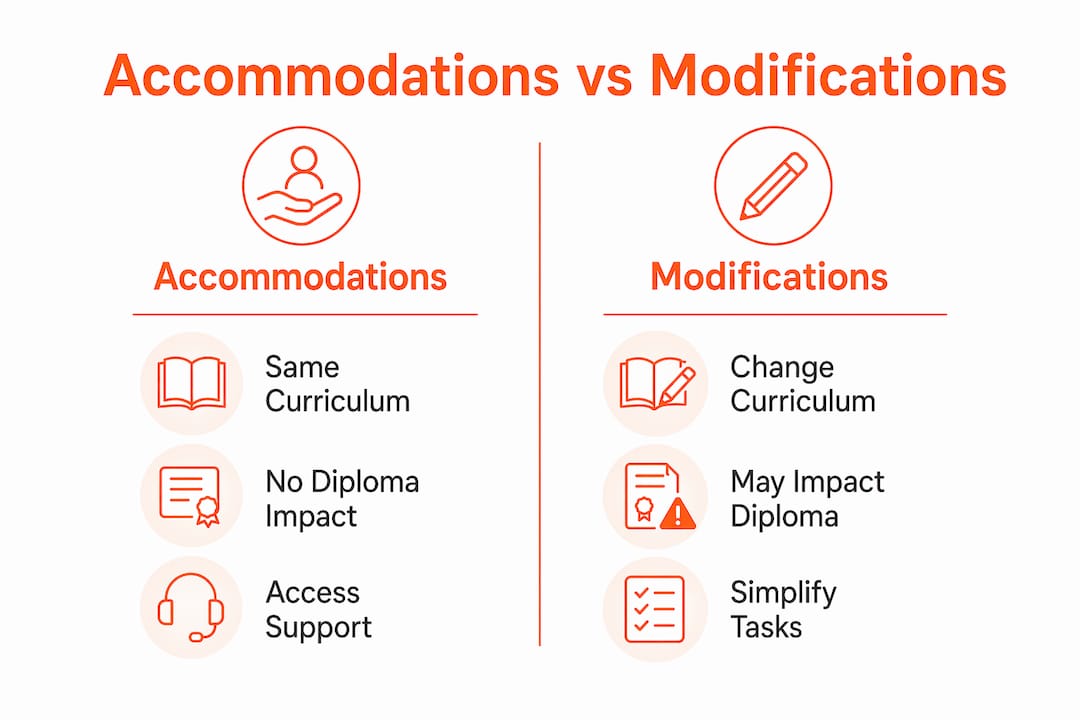
Accommodations versus modifications is the single most consequential distinction in special education law. An accommodation provides access without changing the curriculum. A modification changes curriculum content, which directly affects diploma path and standardized testing requirements under 34 CFR §300.320(a)(6)(ii). That regulation means a student receiving modifications may be working toward an alternate diploma rather than a standard one.
Schools sometimes propose modifications that simplify tasks without clearly labeling them as such. A student assigned shorter reading passages instead of the full text is receiving a modification, not an accommodation. Parents often do not realize this distinction until it affects high school graduation or college admissions eligibility.
| Feature | Accommodation | Modification |
|---|---|---|
| Changes curriculum content | No | Yes |
| Affects diploma path | No | Yes |
| Affects standardized test eligibility | No | Potentially yes |
| Example | Extended time on tests | Shortened reading passages |
| Legal standard | 34 CFR §104.33 | 34 CFR §300.320(a)(6)(ii) |
Pro Tip: If a school proposes a support that reduces the amount or difficulty of content, ask in writing whether it is classified as an accommodation or a modification. The answer has direct implications for your child’s diploma track.
IEP and 504 teams, which must include parents as mandated by 34 CFR §300.321, are responsible for labeling supports correctly. Parents have the right to request that a proposed modification be reframed as an accommodation that preserves grade-level expectations. Exercising that right early prevents long-term consequences.
What accommodations for autism look like in schools and on tests
The most widely used accommodations for autism spectrum disorder fall into four categories: sensory, communication, executive function, and testing environment supports.
Sensory accommodations address the heightened or reduced sensitivity many students with ASD experience:
- Noise-cancelling headphones during independent work or assessments
- Sensory breaks at scheduled intervals throughout the school day
- Preferential seating away from high-traffic areas or fluorescent lighting
- Advance notice of schedule changes to reduce anxiety from unexpected transitions
Communication supports help students who process language differently or use alternative communication methods:
- Visual schedules posted in the classroom and provided in written form
- Written instructions alongside verbal directions
- Augmentative and Alternative Communication (AAC) devices for students with limited verbal output
- Extended wait time after questions to allow for processing
Executive function supports target planning, organization, and task initiation challenges common in ASD:
- Extended time, typically 50% additional time on assessments exceeding a defined length
- Task breakdowns with step-by-step checklists
- Organizational coaching from a designated staff member
- Graphic organizers for writing assignments
Testing environment adjustments are especially relevant for standardized tests like the ACT, SAT, MCAT, and LSAT. These include separate testing rooms, reduced-distraction settings, scheduled breaks, and the use of approved assistive tools. Common accommodations per 34 CFR §104.33 include extended time on assessments, noise-cancelling headphones, and advance notice of procedural changes. These supports do not alter what the test measures. They remove barriers that would otherwise prevent a student from demonstrating what they actually know.
How to obtain accommodations: evaluation, documentation, and school collaboration
Securing accommodations requires a formal process, and knowing the steps prevents costly delays.
Request a school evaluation in writing. Submit a written request to the school’s special education coordinator or principal. The school must respond and, if it agrees to evaluate, must complete the IEP eligibility assessment within 60 calendar days under IDEA, though some states set shorter timelines.
Obtain an independent clinical evaluation. A comprehensive psychoeducational evaluation from a licensed psychologist or neuropsychologist documents functional impairment in specific areas. Schools must consider this external data when making eligibility decisions. Parents who submit independent evaluation reports early in the process significantly influence both the timeline and the outcome.
Attend the eligibility and planning meeting. Parents are required members of the IEP or 504 team. Bring the clinical report, a list of observed functional challenges, and specific accommodation requests in writing.
Review the written plan before signing. Read every accommodation listed. Confirm that each one is labeled as an accommodation, not a modification. Check that the language is specific and measurable, not vague.
Request a Prior Written Notice (PWN). If the school refuses any requested accommodation, federal law requires it to provide a PWN explaining its reasoning. This document is critical if you need to escalate.
Pro Tip: Submit your child’s independent clinical evaluation report before the school’s evaluation is complete. Early submission gives the IEP team concrete functional data and reduces the likelihood of a denial.
The documentation checklist for accommodation requests should include the diagnostic report, functional impact statements, teacher observations, and prior academic records showing the effect of the disability. Incomplete documentation is the most common reason accommodation requests stall.
How to advocate for your child and enforce the plan
Securing a plan is not the finish line. Consistent enforcement requires active parent involvement throughout the school year.
Write specific, measurable accommodation language. Vague phrasing like “extra time as needed” gives teachers discretion to deny the support without technically violating the plan. Specific accommodation wording, such as “50% extended time on all tests exceeding 30 minutes,” removes that ambiguity and makes enforcement straightforward.
Monitor implementation regularly. Ask your child’s teachers at each grading period whether accommodations are being applied consistently. Request written confirmation if you have concerns.
Participate in annual reviews. IEP and 504 plans must be reviewed at least annually. Use these meetings to update accommodations based on your child’s current needs, not last year’s profile.
Use these strategies if the school is not complying:
- Submit a written complaint to the school’s special education director
- File a state complaint with your state’s Department of Education
- Request mediation through the school district
- Contact the Office for Civil Rights (OCR) within the U.S. Department of Education for Section 504 violations
Pro Tip: Keep a dated log of every accommodation-related communication with the school. This record becomes essential if you need to file a formal complaint or pursue due process.
Parents who use self-advocacy strategies consistently report better outcomes at annual reviews and fewer implementation gaps. The school-parent relationship works best when parents come prepared with documentation and specific requests rather than general concerns.
Key Takeaways
Spectrum disorder accommodations are legally protected supports that change how students access learning, not what they are expected to learn, and securing them requires precise documentation, specific plan language, and active parental involvement.
| Point | Details |
|---|---|
| Accommodations vs. modifications | Accommodations preserve diploma eligibility; modifications change curriculum content and may redirect students to an alternate diploma path. |
| Legal framework | IDEA, Section 504, ADA, and 34 CFR §104.33 collectively require schools to provide appropriate supports to eligible students. |
| Documentation is decisive | A comprehensive clinical evaluation showing functional impact is the strongest tool for securing and defending accommodation requests. |
| Specific plan language | Vague wording like “as needed” causes implementation failures; measurable language like “50% extended time” prevents school discretion. |
| Parental rights | Parents are mandated IEP/504 team members under 34 CFR §300.321 and can request Prior Written Notices when accommodations are denied. |
What I’ve learned after years of watching families fight for accommodations
The families who succeed in securing strong accommodations share one trait: they treat the IEP or 504 meeting as a negotiation, not a presentation. They arrive with documentation, specific language, and a clear understanding of the legal difference between an accommodation and a modification.
The families who struggle almost always fall into the same trap. They accept vague plan language because the meeting felt collaborative and they did not want to push back. Six months later, teachers are applying accommodations inconsistently, and the parent has no written record to stand on. I have seen this pattern repeat across every type of school district.
The other mistake I see constantly is underestimating the power of an independent clinical evaluation. Schools respond differently when a licensed neuropsychologist has documented, in clinical language, exactly how a student’s ASD affects their ability to process written instructions under time pressure. That report does not just support the request. It changes the entire tone of the meeting.
My honest advice: do not wait for the school to tell you what your child needs. Get the evaluation, write the specific accommodation language yourself, and bring it to the meeting as a proposal. The school can push back, but you will be negotiating from a position of documented evidence rather than general concern. That difference in positioning determines outcomes more than any other single factor.
— Roger
Getting the right support for your child’s accommodations
Navigating the accommodation process for a student with a spectrum disorder is demanding, especially when requests are denied or plans are not enforced. Testaccommodations.org works directly with families whose accommodation requests for standardized tests like the ACT, SAT, MCAT, and LSAT have been denied or delayed.
Whether your child is preparing for a high-stakes exam or you are building a stronger case for the school’s IEP team, Testaccommodations brings the legal and clinical knowledge needed to move the process forward. Visit Testaccommodations to learn how the team can support your next steps and help you secure the accommodations your child is entitled to receive.
FAQ
What is the difference between an IEP and a 504 plan?
An IEP is created under IDEA and provides special education services along with accommodations. A 504 plan is created under Section 504 of the Rehabilitation Act and provides accommodations only, without specialized instruction, for students who do not qualify for special education.
How long does the school have to complete an evaluation?
Under IDEA, schools must complete an IEP eligibility evaluation within 60 calendar days of receiving a written request, though individual states may set shorter timelines.
Can a school deny an accommodation request for a student with ASD?
Yes, but the school must provide a Prior Written Notice explaining its reasoning. Parents can challenge the denial through mediation, a state complaint, or a complaint filed with the U.S. Department of Education’s Office for Civil Rights.
Do school accommodations automatically transfer to standardized tests?
No. Testing organizations like the ACT and College Board have their own application processes and documentation requirements. A school IEP or 504 plan supports the request but does not guarantee approval. Testaccommodations specializes in cases where these requests are denied.
What makes an accommodation plan enforceable?
Specific, measurable language makes a plan enforceable. Phrases like “50% extended time on all tests exceeding 30 minutes” are far more effective than vague terms like “extra time as needed,” which give teachers discretion to deny the support without formal violation.