
How Accommodation Affects College Admissions: A Clear Guide
Disclosing a disability does not hurt a student’s college admission chances. That is the single most important fact families need to understand about how accommodation affects college admissions. Under the Americans with Disabilities Act (ADA) and Section 504 of the Rehabilitation Act, colleges cannot legally discriminate based on disability status. Admissions offices and disability services offices operate as entirely separate departments. The role of accommodations in student admissions is one of access, not advantage or disadvantage, and knowing that distinction changes how families should plan.
How does disability disclosure impact college admission decisions?
Colleges are legally prohibited from rejecting applicants because of a disability. The ADA and Section 504 create a clear firewall: admissions offices cannot discriminate based on disability status, and disability services offices receive documentation only after a student is admitted. These two functions do not share files or communicate about individual applicants.

Disclosure on a college application is entirely voluntary. No application requires it, and leaving it blank carries no penalty. Some students choose to disclose strategically, and that choice can work in their favor. Strategic disclosure gives admissions committees useful context, such as explaining a dip in grades during a difficult year or demonstrating how a student overcame real obstacles. Done briefly and thoughtfully, it can strengthen an application rather than weaken it.
Admissions officers evaluate academic potential, extracurricular achievement, and personal character. Disability status is not a factor in that evaluation. Students who worry that mentioning a learning difference will trigger bias are responding to a myth, not a legal or institutional reality.
- Disclosure is optional on every major college application platform, including the Common App.
- Disability services offices receive documentation separately, after admission, not during review.
- Colleges cannot ask whether an applicant has a disability during the admissions process.
- A well-written disclosure can add meaningful context to a transcript without creating risk.
Pro Tip: If you choose to disclose, keep it brief and forward-looking. Focus on what you learned and how you adapted, not on the diagnosis itself.
What documentation is needed to secure accommodations in college?
Documentation requirements in college are stricter than most families expect. A high school IEP or 504 plan is a useful starting point, but it rarely meets college standards on its own. Colleges typically require a recent psychoeducational evaluation, usually completed within the past three to five years and after the student turned 16. That evaluation must document the specific diagnosis, functional limitations, and the connection between those limitations and the requested accommodations.
Standardized testing agencies follow their own separate rules. College Board (SAT) and ACT each require independent accommodation applications. Testing accommodation requests must show that the student currently uses the accommodation, not just that it was listed in a past IEP. Extended time of 50% is the most common accommodation approved for students with dyslexia, but approval depends on current, documented use.
The table below summarizes what different entities require:
| Entity | Documentation Required | Key Timing Note |
|---|---|---|
| College disability office | Psychoeducational evaluation (within 3–5 years, post-age 16) | Submit after admission, before classes start |
| College Board (SAT) | Separate SSD application with current-use evidence | Apply months before test date |
| ACT | Independent accommodation request with supporting records | Apply well ahead of registration deadline |
| Housing office | Separate medical or disability documentation | Deadlines often fall in march or april of senior year |
Here is the sequence that works best for most students:
- Schedule a psychoeducational evaluation no later than junior year of high school.
- Confirm the evaluation meets the standards of your target colleges and testing agencies.
- Submit accommodation requests to College Board or ACT separately from any school-based plan.
- After admission, contact the college disability services office to begin the registration process.
- Keep copies of all documentation in a single organized file for easy submission.
Pro Tip: Check each college’s disability services website before applying. Documentation requirements vary by institution, and some schools post their exact standards online.
How does responsibility shift from high school to college?
The legal framework changes completely when a student leaves high school. In K–12 education, the Individuals with Disabilities Education Act (IDEA) requires schools to identify students with disabilities and provide supports proactively. In college, that obligation disappears. The ADA and Section 504 require colleges to provide reasonable accommodations, but only after the student requests them with proper documentation. No one will come looking for you.
This shift catches many students off guard. High school counselors, special education teachers, and IEP case managers handle most of the paperwork and coordination. In college, the student manages everything independently. That includes contacting the disability services office, submitting documentation, attending an intake meeting, and requesting an accommodation letter each semester.
Self-advocacy is the skill that determines whether a student accesses the support they are entitled to. Students who arrive at college knowing how to articulate their needs, follow up on requests, and communicate with faculty are far more likely to use their accommodations effectively. Families can build this skill before senior year by having students take the lead on their own IEP meetings or 504 reviews.
- Students must initiate every step of the accommodation process after admission.
- The disability services office does not contact students; students contact them.
- Accommodations are not retroactive. A student cannot request them after a failed exam and expect a grade change.
- Faculty are not informed of a student’s diagnosis, only of the approved accommodations.
Pro Tip: Practice self-advocacy before college by having your student speak directly to their high school counselor about their own needs. That habit transfers directly to the college environment.
What are the practical steps for securing accommodations once admitted?
The process begins the moment a student receives an admission offer. Waiting until the first week of classes creates unnecessary risk. Housing accommodations often have deadlines as early as march or april of senior year, which means students must act before they even graduate. Missing those deadlines can affect room assignments for the entire academic year.
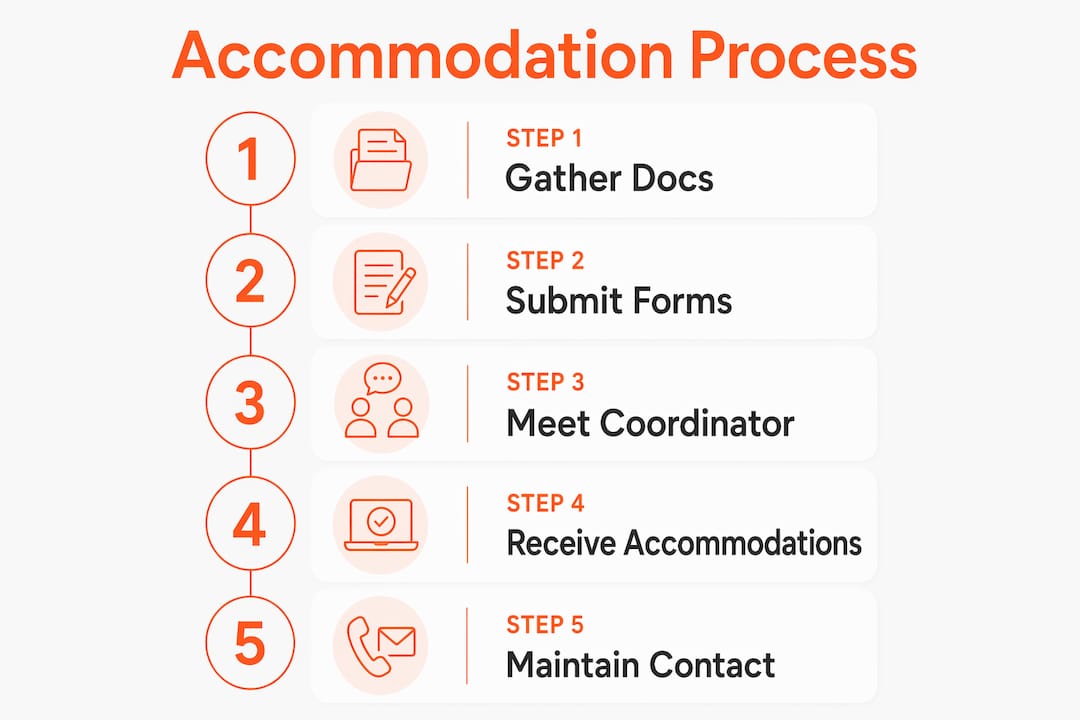
For academic accommodations, the standard process follows these steps:
- Contact the disability services office as soon as you commit to the college.
- Submit all required documentation, including the psychoeducational evaluation and any relevant medical records.
- Attend an intake meeting where a disability services coordinator reviews your needs and confirms eligible accommodations.
- Receive a formal accommodation letter that lists your approved supports.
- Deliver the accommodation letter to each professor at the start of every semester. This step is the student’s responsibility, not the college’s.
Faculty communication is typically confidential. Professors receive the accommodation letter but not the underlying diagnosis. A student with ADHD, for example, would give a professor a letter stating that extended time on exams is approved, without disclosing the specific condition. This protects privacy while giving faculty the information they need to comply.
The impact of accommodations on admissions is minimal, but the impact on academic performance once enrolled is significant. Students who register early and use their accommodations consistently perform better than those who delay or avoid the process out of stigma.
Key Takeaways
Accommodations affect college access, not admission decisions. Students who understand the legal framework, prepare documentation early, and build self-advocacy skills are best positioned to succeed.
| Point | Details |
|---|---|
| Disclosure does not harm admission | Colleges cannot legally discriminate based on disability; disclosure is voluntary and confidential. |
| Documentation must be current | A psychoeducational evaluation within 3–5 years is required; high school IEPs alone are insufficient. |
| Testing agencies require separate applications | College Board and ACT each have independent accommodation processes with their own deadlines. |
| Responsibility shifts fully to the student | In college, students must initiate every accommodation request without school-managed support. |
| Early action prevents missed deadlines | Housing accommodations can close as early as march or april; academic accommodations should be filed at enrollment. |
What families consistently get wrong about accommodations
Most families I work with arrive with the same misconception: they believe the IEP their student has carried since third grade will transfer automatically to college. It does not. The legal system changes, the documentation standards change, and the entire burden of action shifts to the student. That gap between expectation and reality is where students fall through.
The second mistake is waiting too long to update evaluations. A psychoeducational evaluation completed when a student was 12 is not going to satisfy a college disability office or a testing agency. Families need to schedule updated evaluations in the sophomore or junior year of high school, not the summer before college applications are due.
Choosing a college with strong disability services matters more than most families realize. Well-funded disability programs go beyond basic legal compliance. They offer coaching, assistive technology, peer support, and structured check-ins. A student who needs that level of support at a school with a minimal disability office will struggle, regardless of how good the academic program is.
The framing matters too. Students who think of accommodations as a concession or a sign of weakness are less likely to use them. Accommodations secure equal access to demonstrate what a student actually knows. That reframe, from asking for a favor to claiming a legal right, changes how students engage with the entire process.
— Roger
Testaccommodations is here when the process gets complicated
Families who understand the accommodation process early avoid the most costly mistakes. But when a testing agency denies a request, or documentation does not meet the required standard, having expert guidance makes a real difference.
Testaccommodations works directly with students and families who are entitled to test accommodations on the SAT, ACT, MCAT, LSAT, and other standardized exams, especially when those requests have been denied. The team understands the documentation standards, the appeals process, and the specific language that testing agencies respond to. If you are preparing for college and need to secure accommodations before a high-stakes exam, visit Testaccommodations to understand your options and avoid common pitfalls before deadlines close.
FAQ
Does disclosing a disability hurt college admission chances?
No. Disclosure does not negatively impact admission decisions because admissions and disability services offices are legally and operationally separate. Colleges cannot discriminate based on disability status under the ADA.
Do SAT and ACT scores show that a student used accommodations?
No. Scores are reported without any notation about testing conditions, so colleges cannot tell whether a student received extended time or other supports.
Will my high school IEP transfer to college?
No. High school IEPs do not meet college documentation standards. A recent psychoeducational evaluation, typically completed within three to five years and after age 16, is required.
When should students register with college disability services?
Students should contact the disability services office as soon as they commit to a college. Housing accommodation deadlines can fall as early as march or april of senior year, well before graduation.
Can a student request accommodations after a failed exam?
No. Accommodations are not retroactive. Students must register with disability services and deliver accommodation letters to professors before exams, not after a grade has been recorded.