
ACT Accommodations Rejected: Now What?
An ACT accommodations rejection is a formal denial of a student’s request for testing support, such as extended time, scheduled breaks, or a separate testing location, and it is not the final word on whether that support will be granted. Many families receive denial notices and assume the process is over. It is not. The ACT accommodations appeal process gives students and parents a structured path to challenge the decision, correct documentation gaps, and resubmit through the school before the late registration deadline closes the window. Acting within days of receiving a denial notice is the difference between testing with support and testing without it.
Why are ACT accommodations requests rejected?
Understanding why a denial happens is the first step toward reversing it. Denials most often reflect where documentation or process is weakest, not an outright refusal of a student’s legitimate need.
The most common reasons ACT denies accommodations requests include:
- Insufficient documentation. A diagnosis alone does not qualify a student for accommodations. ACT requires evidence that the disability creates a functional impairment under timed testing conditions specifically. A psychoeducational evaluation that documents ADHD, for example, must also connect that diagnosis to measurable performance challenges on timed tasks.
- No demonstrated test-day impact. Reports that describe a student’s general challenges in school without addressing how those challenges manifest under standardized, timed exam conditions are frequently denied. ACT reviewers look for explicit language linking the disability to the requested accommodation.
- Procedural submission errors. Families sometimes submit requests directly to ACT rather than through the school’s Test Accommodations Coordinator (TAC) or SSD coordinator. Improper submissions cause denials that disappear entirely when resubmitted through the correct school-mediated channel.
- Outdated or unqualified documentation sources. Evaluations older than three years, or reports written by professionals outside the accepted scope for the specific disability, are common grounds for denial.
- Incomplete forms or missing signatures. Administrative gaps in the submission packet, such as unsigned forms or missing school verification, can trigger automatic denials unrelated to the student’s actual need.
One critical misunderstanding families carry into the process is that an IEP or 504 plan guarantees ACT approval. It does not. ACT applies its own documentation standards, and a school-based accommodation plan is supporting evidence, not automatic authorization. Knowing this distinction helps you build a stronger appeal from the start.
What to do immediately after an ACT accommodations denial

Speed matters here. ACT reviews requests within about 5 to 10 business days, and the denial notice date starts the clock on your appeal window. Late registration deadlines are firm, and missing them means waiting for the next test cycle.
Follow these steps in order:
Contact your school’s Test Accommodations Coordinator the same day. The TAC or SSD coordinator is the only person who can submit an appeal or corrected request through ACT’s TAA (Test Accessibility and Accommodations) system. You cannot submit directly. Reach out immediately and request a meeting.
Request the written denial explanation. ACT typically provides a reason code or written rationale. Ask your coordinator to pull this from the TAA system if you have not already received it. You cannot fix what you do not know is broken.
Read the denial reasoning carefully and identify the specific gap. Was the documentation insufficient? Was there a procedural error? Was functional impairment not clearly stated? The denial reason tells you exactly what the appeal must address.
Determine whether an appeal or a full resubmission is appropriate. Some denials call for an appeal with supplemental documentation. Others, particularly those caused by procedural errors, require a clean resubmission through the correct school channel. Your coordinator can advise which path applies.
Begin assembling additional or clarifying documentation immediately. Contact the evaluating psychologist, physician, or specialist who prepared the original report. Ask them to add explicit language about functional limitations under timed, standardized-test conditions. This targeted revision is often all that is needed.
Map your deadlines backward from the test date. Deadlines tied to ACT registration create a limited window for appeals to have effect. Know the late registration cutoff and work backward to set internal deadlines for documentation collection, coordinator review, and submission.
Pro Tip: Create a dedicated folder, physical or digital, for every document, email, and phone log related to the accommodations process. Note the date, time, and name of every person you speak with. This record becomes critical if the process escalates to a formal complaint or ADA advocacy.
How does the ACT accommodations appeal process work?
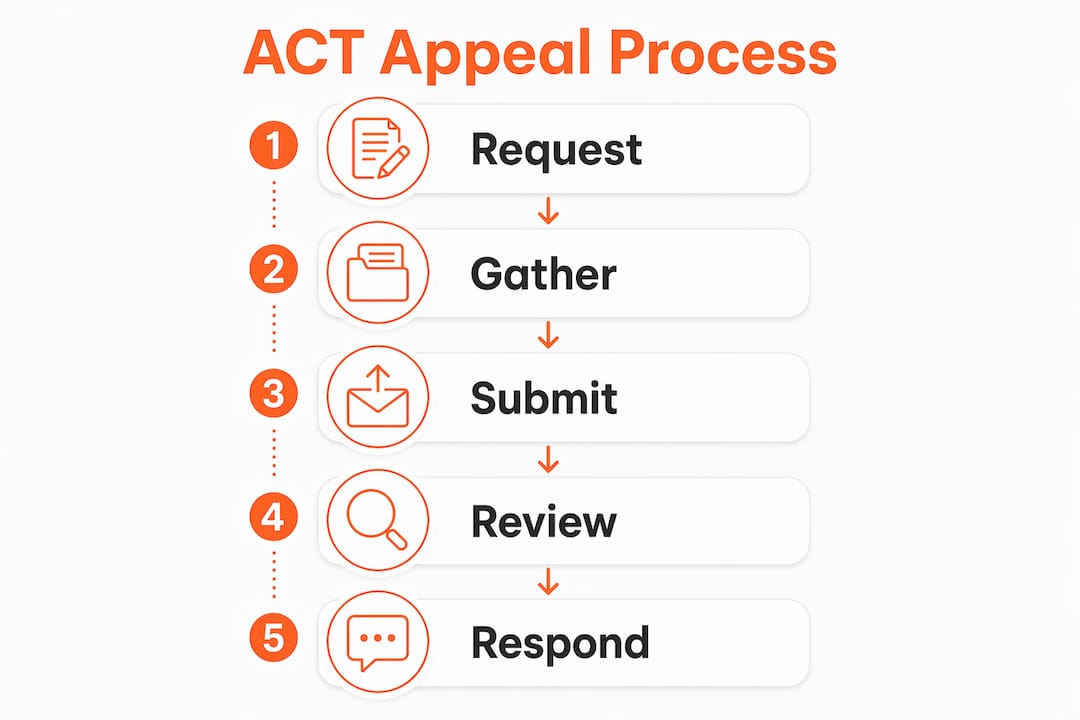
The appeal process runs through your school, not through you directly. Appeals must be filed via the school through ACT’s TAA system, and the school’s SSD coordinator manages the submission. Your role is to supply the strongest possible documentation and to stay in close communication with the coordinator throughout.
Key elements of an effective appeal include:
- Targeted documentation revisions. The appeal packet should directly address the stated reason for denial. If ACT cited insufficient evidence of functional impairment, the revised evaluation must include explicit statements about how the student’s disability affects performance under timed conditions. Appeal packets should explicitly state functional limitations under timed testing conditions for each requested accommodation. This precision is what turns denials around.
- Collaboration with the evaluating professional. Ask the psychologist or specialist to write an addendum rather than a full new evaluation when time is short. A focused, one-page addendum that directly addresses ACT’s stated concern is often more effective than a lengthy revised report.
- Inclusion of supporting school records. Teacher observations, progress monitoring data, classroom accommodation records, and existing IEP or 504 plan documentation all strengthen the appeal. They demonstrate a consistent pattern of need across settings, not just a single evaluator’s opinion.
- Coordination with the school’s special education team. Special education directors and school psychologists can add institutional weight to the appeal. Their professional endorsement of the accommodation request signals to ACT that the school has independently verified the student’s need.
- Understanding the post-submission timeline. After the appeal is submitted through the TAA system, ACT typically reviews it within the same 5 to 10 business day window. Your coordinator should confirm receipt and track the status. If the deadline is approaching and no decision has been issued, the coordinator should follow up directly with ACT.
If the appeal is denied a second time, request a detailed explanation of what additional evidence ACT requires. A second denial does not close all options, but it does require a more deliberate strategy for the next test cycle.
What are your options if the appeal does not succeed right away?
A failed first appeal does not mean the process is over. Several practical pathways remain available, and choosing the right one depends on the specific reason for denial and the time remaining before your target test date.
| Situation | Recommended next step |
|---|---|
| Denial caused by procedural error | Resubmit immediately through school-mediated TAA channel for likely reversal |
| Denial due to documentation gaps | Obtain targeted addendum from evaluating professional addressing functional impairment |
| ACT requesting excessive paperwork | Cite ADA guidance; respond with only narrowly tailored documentation |
| Repeated delays preventing same-cycle testing | File a formal complaint through ADA channels or contact the U.S. Department of Justice |
| No time remaining for current test cycle | Register for next cycle and begin documentation process immediately |
The ADA provides a meaningful layer of protection here. ADA requires testing entities like ACT to respond in a timely manner and to request only narrowly tailored documentation. If ACT is demanding paperwork that goes beyond what is necessary to verify the disability and its functional impact, that demand may itself be a violation of equal opportunity protections. Adequate documentation from qualified professionals should be accepted without repeated demands for further paperwork.
If the process has stalled to the point where same-cycle testing is no longer possible, consider registering for the next available test date without accommodations as a placeholder, then continuing the appeal for that cycle. This preserves your testing timeline while the documentation process continues. For students with college application deadlines approaching, discuss with your school counselor whether an SAT with accommodations could serve as an alternative path. The SAT accommodation appeals process follows a different structure and may move faster depending on your documentation.
Pro Tip: If ACT’s delays are preventing you from testing in the same cycle, document every date and communication. This record supports an ADA complaint if the delay constitutes an effective denial of equal opportunity.
Key takeaways
A denied ACT accommodations request requires immediate, structured action through your school’s coordinator, targeted documentation revisions, and a clear understanding of the appeal timeline.
| Point | Details |
|---|---|
| Denial is not final | An ACT accommodations rejection can be appealed through the school’s TAA submission channel. |
| Documentation must show functional impairment | Reports must connect the disability to specific performance challenges under timed test conditions. |
| Procedural errors are fixable fast | Denials caused by incorrect submission channels can often be reversed with a proper school-mediated resubmission. |
| ADA protections apply | ACT cannot demand excessive documentation or cause delays that effectively deny equal testing opportunity. |
| Deadlines are firm | The denial notice date starts the appeal clock; acting within days is critical to preserving the current test cycle. |
What I’ve learned from watching families navigate this process
After working with families through ACT accommodation denials, the pattern I see most often is not bad documentation. It is documentation that is almost good enough. A psychoeducational evaluation that clearly describes a student’s ADHD, learning disability, or anxiety disorder but never explicitly connects that condition to timed test performance is the single most common reason for denial. The evaluating professional assumed the connection was obvious. ACT’s reviewers did not.
The second pattern is families who wait. They receive the denial notice, feel discouraged, and spend a week or two deciding what to do. By the time they contact the school coordinator, the late registration deadline has passed and the entire effort shifts to the next test cycle. That delay is avoidable and costly.
What actually works is treating the denial notice as a work order. Read the reason. Call the coordinator that day. Contact the evaluating professional that week. The appeal process is not adversarial. It is administrative. ACT is not trying to deny your student support. It is applying a documentation standard, and when you meet that standard precisely, approvals follow.
The families who succeed are not the ones with the most elaborate documentation. They are the ones who respond quickly, address the stated concern directly, and stay in close contact with their school coordinator throughout. Persistence and precision matter far more than volume.
— Roger
How Testaccommodations can help after a denial
Receiving a denial is disorienting, especially when you are working against a registration deadline. Testaccommodations specializes in exactly this situation: advising students and families who have received ACT accommodations rejections and need expert guidance to appeal effectively.

At Testaccommodations, you will find step-by-step resources, appeal checklists, and direct access to advisors who understand ACT’s documentation standards and the TAA submission process. Whether your denial stems from a documentation gap, a procedural error, or an ADA compliance concern, the team can help you identify the fastest path to approval. Review the ACT accommodations checklist before your next submission, and reach out before your late registration deadline closes.
FAQ
What should I do first when my ACT accommodations are denied?
Contact your school’s Test Accommodations Coordinator immediately and request the written denial explanation from ACT’s TAA system. The coordinator is the only person who can submit an appeal on your behalf, and timing is critical.
Can I appeal an ACT accommodations denial on my own?
No. Appeals must be submitted through the school via ACT’s TAA system. Families cannot submit directly to ACT; the school’s SSD or TAC coordinator must manage the process.
How long does ACT take to review an appeal?
ACT typically reviews accommodation requests and appeals within 5 to 10 business days. Acting immediately after a denial is critical to staying within the late registration window for your target test date.
Does having an IEP or 504 plan guarantee ACT approval?
No. ACT applies its own documentation standards independent of school-based plans. An IEP or 504 plan is supporting evidence, but ACT requires documentation that specifically demonstrates functional impairment under timed, standardized-test conditions.
What if ACT keeps requesting more documentation?
Under the ADA, ACT must accept adequate documentation from qualified professionals without repeatedly demanding additional paperwork. If requests appear excessive or are causing delays that prevent same-cycle testing, this may constitute an equal opportunity violation and can be escalated through ADA complaint channels.