
ACT Accommodation Request Process: 2026 Guide
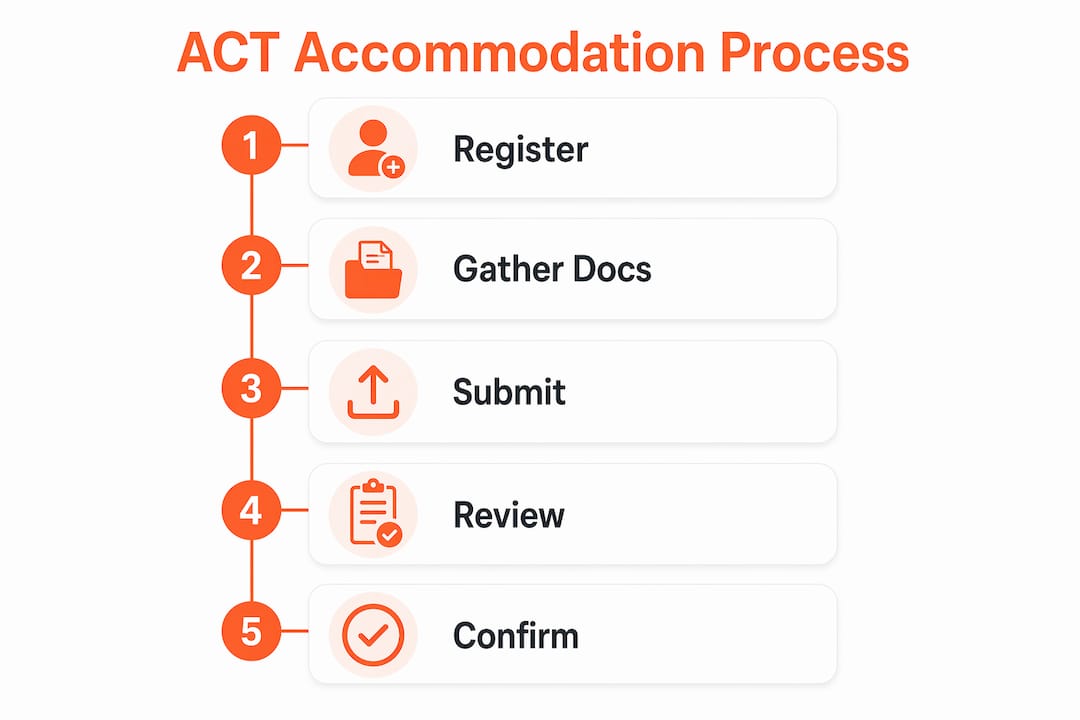
The ACT accommodation request process is a structured procedure that begins with student registration, moves through school official documentation submission, and ends with ACT review and approval. Students must indicate accommodation needs during registration by selecting “Yes” in MyACT, after which the school’s Test Accommodations Coordinator (TAC) submits supporting documentation through the Test Accessibility and Accommodations (TAA) system. ACT then reviews the request, typically within 5–10 business days. Getting this right requires understanding eligibility criteria, submission timelines, and what to do if a request is denied.
What are the eligibility requirements for ACT accommodations?
Eligibility for a disability accommodation request is not based on diagnosis alone. ACT requires objective evidence of a disability that creates a functional impact specifically on timed standardized testing. A student may have a documented ADHD or dyslexia diagnosis, but without evidence showing how that condition limits performance under timed test conditions, the request will likely be denied.
The core eligibility criteria include:
- Current documentation: Psychoeducational evaluations or medical records must generally be within 3–5 years. Older reports are a leading cause of denial.
- Functional impairment evidence: Documentation must explicitly connect the disability to timed testing challenges, not just classroom learning difficulties.
- School-based accommodation history: An active Individualized Education Program (IEP) or Section 504 plan showing a history of accommodation use significantly strengthens a request.
- Qualified evaluator: Reports must come from licensed psychologists, neuropsychologists, or physicians with relevant credentials.
- Specific accommodation justification: Each requested accommodation (such as extended time or a separate testing room) must be individually supported by the documentation.
ACT prioritizes evidence of school-based accommodations like IEPs and 504 plans over clinical diagnoses alone. This reflects ACT’s position that students who have already been granted accommodations in school have a documented, verified need. If your student has an IEP or 504 plan, that document is your strongest starting asset.
Pro Tip: Ask the evaluating psychologist to include a section in the report that explicitly addresses how the student’s disability affects performance under timed, standardized test conditions. Generic clinical language will not satisfy ACT’s review panel.

One frequently overlooked requirement is the connection between the disability and the specific format of the ACT. Documentation must explicitly link disabilities to timed testing challenges, not just general academic struggles. A report that describes classroom difficulties without addressing test-taking performance under time pressure is insufficient. Work with your evaluator to make that connection explicit and detailed.
For a full breakdown of what ACT expects, the ACT accommodation eligibility criteria guide from Testaccommodations covers documentation standards in depth.
How to submit an ACT accommodation request step by step
The submission process follows a specific sequence. Skipping or misordering any step can delay or derail approval. Early application is critical, with experts recommending starting 2–3 months before the test date to allow time for documentation gathering, school coordination, and ACT review.
Here are the steps in order:
- Register for the ACT and select “Yes” for accommodations. Log into MyACT and indicate during registration that you require accommodations. This flags the account for the TAA system and notifies the school’s TAC.
- Contact your school’s Test Accommodations Coordinator (TAC). The TAC is the only person authorized to submit documentation through the TAA system. Students and parents cannot submit directly. Identify your TAC early and establish clear communication.
- Gather and organize all required documentation. This includes the IEP or 504 plan, psychoeducational evaluation, and any supplemental medical records. Confirm that all documents meet ACT’s recency and content requirements before submission.
- Complete consent forms. ACT requires signed consent from the student (and parent if the student is a minor) authorizing the release and review of documentation.
- TAC submits the request through TAA. The TAC uploads all documentation and formally submits the accommodation request. Requests must be submitted by the late-registration deadline, with a recommended lead time of at least 6–8 weeks before the test date.
- Wait for ACT review. The ACT review process typically takes 5–10 business days once complete documentation is submitted. Incomplete submissions restart the clock.
- Confirm accommodations via MyACT. After approval, log into MyACT to verify that the correct accommodations appear on the account. If special testing arrangements are needed, coordinate with the school to confirm logistics.
Pro Tip: Do not wait for the school to initiate contact. Reach out to your TAC the same week you register for the ACT. Schools manage multiple students and competing deadlines, so proactive communication from your end keeps the process moving.
After approval, confirm test-day accommodations through MyACT and verify the testing schedule with your school. Proper confirmation prevents confusion or missed accommodations on test day. A small administrative oversight at this stage can undo months of preparation.
The ACT accommodations checklist from Testaccommodations provides a practical tool for tracking each step and avoiding common submission errors.
What to do if your ACT accommodation request is denied
A denial is not the end of the road. The ACT accommodation request process includes a formal appeal pathway, and many denials are reversed when families respond with stronger documentation.
The most common reasons for denial include:
- Thin or outdated documentation: Reports older than 3–5 years or lacking functional impact language are the most common denial cause.
- Missing connection to timed testing: Documentation that describes classroom challenges without addressing standardized test performance will not meet ACT’s standard.
- Incomplete submission: Missing consent forms, unsigned reports, or absent school accommodation history can trigger automatic denial.
- Accommodation not supported by evidence: Requesting extended time without documentation that specifically supports that accommodation type.
- No history of school-based accommodations: Students who have never received accommodations in school face a higher documentation burden.
When a request is denied, the school can submit an appeal with updated or more detailed documentation by the late-registration deadline. The appeal should directly address the specific reason for denial. If ACT cited outdated documentation, commission a new evaluation. If the denial referenced insufficient functional impact language, work with the evaluator to add a targeted section addressing timed test performance.
Supplemental evidence can also strengthen an appeal. Teacher statements, classroom observation reports, and records of prior testing accommodations all add weight. The goal is to build a file that leaves no gap between the diagnosis and the specific accommodation requested.
Families who feel the denial was unjustified should also review their legal rights for accommodations under the Americans with Disabilities Act (ADA) and Section 504 of the Rehabilitation Act. ACT is required to provide reasonable accommodations to qualified students. Knowing those rights gives you a stronger foundation for advocacy.
Homeschooled students and the exceptions process
The TAA system is designed exclusively for school officials. This creates a real challenge for homeschooled students or those attending schools that are unwilling or unable to submit on their behalf. The TAA system is not accessible to students or parents directly.
ACT has created an “Exceptions” process for these situations. Key features of this pathway include:
- Direct parent or guardian submission: Parents take on the role normally handled by the TAC, gathering and organizing all documentation themselves.
- Teacher surveys required: ACT typically requires written statements from teachers or instructors who have observed the student’s academic performance and challenges.
- Additional documentation burden: The Exceptions process requires more paperwork than the standard TAA route, including detailed instructional records and evaluator credentials.
- Longer processing timelines: Because submissions go through a different review channel, families should expect longer wait times and plan accordingly.
“Families navigating the Exceptions process should start at least 3 months before the test date. The additional documentation requirements and manual review steps make this pathway significantly more time-intensive than the standard school-based submission.”
Homeschooled students are not disqualified from receiving ACT accommodations. The process is simply more demanding. Parents in this situation should contact ACT’s Office of Accessibility directly to confirm current requirements and get written guidance on what documentation is needed before beginning the process.
Key takeaways
A successful ACT accommodation request depends on early action, documentation that explicitly links disability to timed testing, and close coordination with your school’s TAC.
| Point | Details |
|---|---|
| Start 2–3 months early | Late submissions miss deadlines; early starts allow time for documentation and review. |
| Diagnosis alone is not enough | Documentation must connect the disability to functional limitations in timed, standardized testing. |
| TAC submits, not families | Only school officials can use the TAA system; homeschoolers must use the Exceptions process. |
| Appeals are available | Denied requests can be appealed with updated documentation by the late-registration deadline. |
| Confirm after approval | Verify accommodations in MyACT and coordinate test-day logistics with your school. |
What i’ve learned after years of watching families navigate this process
The single biggest mistake I see is families treating the ACT accommodation request process as a paperwork exercise rather than a substantive advocacy effort. They gather whatever documents are on file, hand them to the TAC, and assume approval will follow. When the denial arrives, they are blindsided.
The ACT review panel is not looking for a diagnosis. It is looking for a clear, documented argument that a specific student, with a specific condition, cannot demonstrate their true academic ability under standard timed testing conditions. That argument has to be built deliberately. It requires an evaluator who understands what ACT needs, a TAC who submits on time, and a family that follows up at every stage.
I also want to address a misconception that causes real harm. Some families hesitate to pursue accommodations because they worry it signals weakness or gives their student an unfair advantage. ACT uses holistic review panels with input from educational teams specifically to prevent that. Score scales remain unchanged. Accommodations exist to level the playing field, not tilt it. A student who qualifies for extended time is not gaining an advantage. They are receiving the conditions they need to perform at the same level as their peers.
Start earlier than you think you need to. Communicate with your TAC directly and often. And if you receive a denial, treat it as a request for more information, not a final verdict.
— Roger
How Testaccommodations can support your request
Navigating the ACT accommodation request process is complex, especially when documentation gaps or school communication issues create obstacles. Testaccommodations specializes in advising students and families who are entitled to accommodations and facing denials or submission challenges.

Whether you are preparing your first submission or responding to a denial, expert accommodation support from Testaccommodations can help you identify documentation gaps, understand what ACT’s review panel requires, and build a stronger case. The team works directly with families to review existing evaluations, clarify eligibility questions, and guide the appeal process when needed. For families who feel stuck or uncertain about next steps, professional guidance can make a measurable difference in outcomes. Visit Testaccommodations to learn more about available services and how they apply to your situation.
FAQ
What is the ACT accommodation request process?
The ACT accommodation request process is a structured sequence starting with student registration in MyACT, followed by the school’s TAC submitting documentation through the TAA system, and ending with ACT’s review and approval decision.
How long does ACT take to review accommodation requests?
The ACT review process typically takes 5–10 business days once complete documentation is submitted. Incomplete submissions will delay the clock.
Can parents submit ACT accommodation requests directly?
No. The TAA system is restricted to school officials (TACs). Parents of homeschooled students or students without school support must use ACT’s separate Exceptions process, which requires additional documentation including teacher surveys.
What is the most common reason ACT denies accommodation requests?
The most common reason is thin or outdated documentation that lacks a clear functional link between the disability and timed test performance. Updated evaluations and a documented history of school-based accommodations (IEP or 504 plan) significantly improve approval rates.
When should families start the ACT accommodation request process?
Families should begin the process at least 2–3 months before the test date to allow adequate time for documentation gathering, school coordination, and ACT’s review period.